
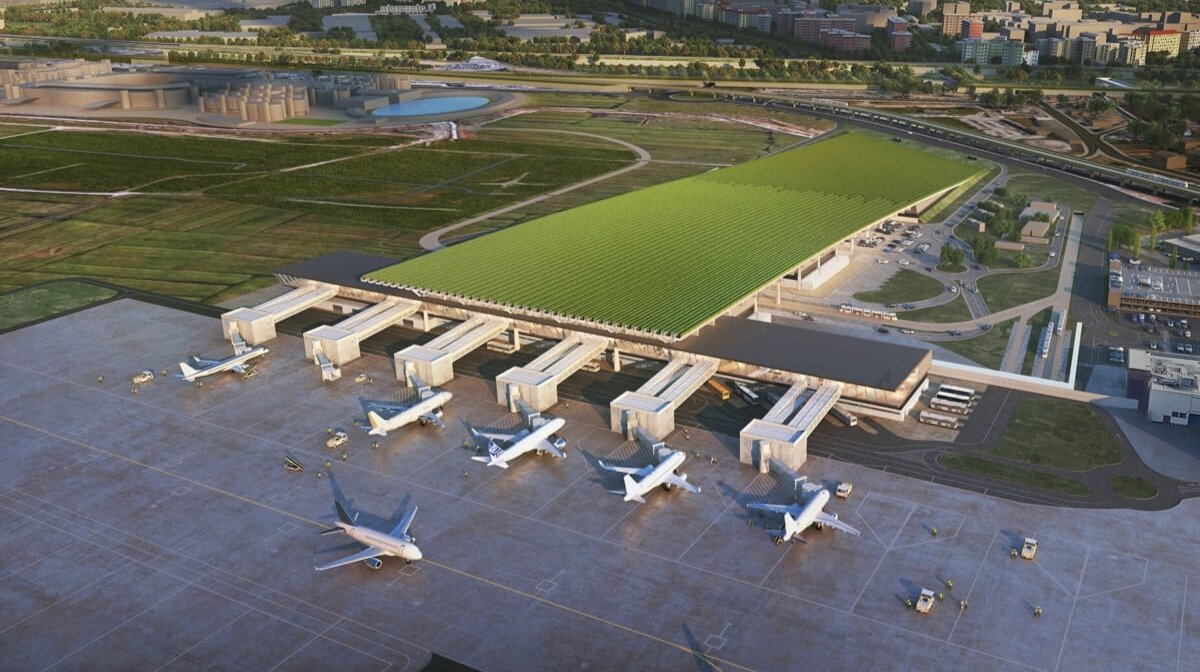

Most airports offer duty-free wine. Florence's new terminal will grow its own.
The first phase of the redesigned Amerigo Vespucci Airport terminal, designed by Rafael Viñoly Architects, is scheduled for completion in 2026. Its most discussed feature is a 19-acre working vineyard spread across the building's gently sloping roof, arranged in 38 rows that run alongside longitudinal skylights bringing natural light into the terminal below. The grapes that are grown there will not be decorative. They will be harvested, processed and aged in purpose-built wine cellars located directly beneath the terminal's roof structure. A leading vintner from the Tuscany region will manage cultivation. The exact grape varieties have not yet been confirmed, but the studio has indicated they will reflect the heritage of Tuscan wine-growing.
The project is owned by Toscana Aeroporti SpA, and the building team includes Tekne SpA as MEP engineer, Eckersley O'Callaghan as structural engineer, and Toscana Aeroporti Construction as general contractor. Rafael Viñoly, who founded the studio in 1983 and died in 2023, conceived the scheme before his passing. His son Román Viñoly has led the project through its development phase.
The structural challenge of putting a productive vineyard on a building roof is not trivial. Soil deep enough to support vines is heavy, and it becomes heavier when wet. The design addresses this through a network of branching columns and linear precast concrete structures that encase the soil and irrigation systems while allowing for wide, column-free spans within the terminal itself. The result is a roof that functions as agricultural land while the floor below functions as an international airport.
The terminal is 538,195 square feet in total and is expected to handle over 5.9 million passengers annually when fully operational. At its centre is a large public piazza where arrivals and departures face each other, an arrangement intended to simplify circulation and create a sense of arrival that feels more like entering a Tuscan town square than passing through a processing facility.
The project also involves a significant piece of civil engineering. Florence's existing runway is being reoriented by 90 degrees and lengthened to accommodate modern aircraft, which have struggled with the constraints of the current layout. A new light rail link will connect the terminal to the city centre, giving passengers an alternative to road transfers.
The sustainability ambitions are woven directly into the physical structure. The vineyard contributes to the building's LEED Platinum rating target, not just symbolically but structurally. Green roofs reduce thermal load, manage stormwater and extend the lifespan of the waterproofing membrane below. In this case, they also produce a commodity, which is a level of integration between sustainability and function that most green roofs do not attempt.
The project is being delivered in two phases. Phase one, which includes the terminal building and the vineyard, is the 2026 completion. Phase two, which will add further capacity and features, is scheduled for 2035. Florence Airport last underwent a major renovation in 1999.
Rafael Viñoly described Florence as perhaps the only city in the world that does not need to be promoted. His argument for the vineyard was not a novelty; it was logic. The airport is the first thing most international visitors encounter when they arrive in Tuscany. Making it reflect what Tuscany actually is, rather than presenting another generic glass box with retail concessions, was the point. Whether a working vineyard above the departure gates achieves that is something travellers will be able to judge for themselves when the doors open later this year.
Comments (0)
Leave a Comment
No comments yet. Be the first to share your thoughts!