
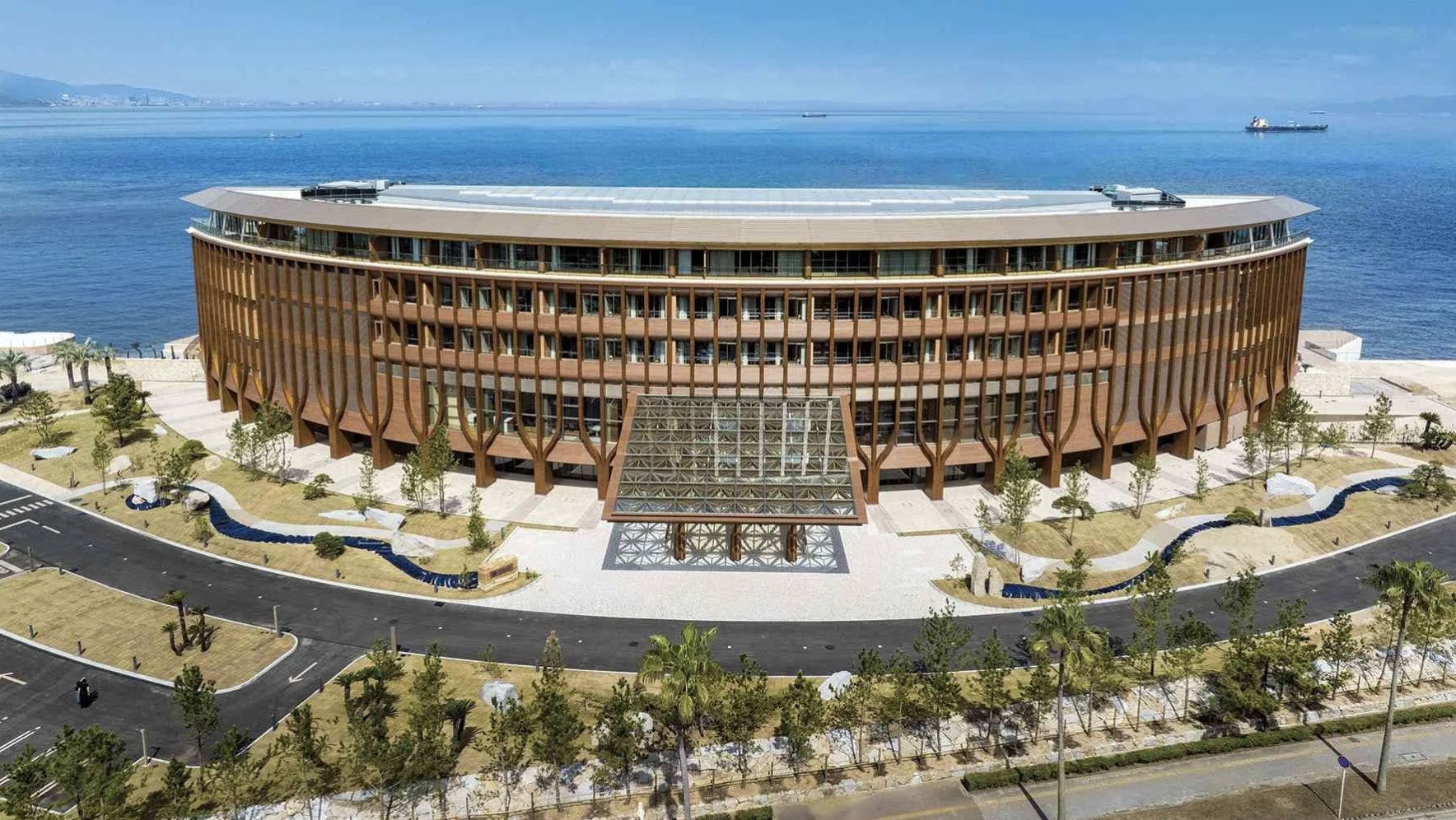

Pritzker Prize winning architect Shigeru Ban has completed a wellness hotel on Awaji Island in Japan, designed around long-stay retreats rather than conventional short breaks.
The hotel, named the Pasona Natureverse Retreat, sits at the tip of the island near Kobe. Its design draws on the concept of Mibyo, a preventive wellness philosophy that translates roughly as pre-illness, aimed at addressing health concerns before they develop.
This marks the third building Ban has designed on the island for Japanese company Pasona Group, following an earlier thatch-roofed restaurant and a timber meditation retreat completed in previous years.
Ban gave the five-storey building a D-shaped plan to respond to its position between coastline and forest. He said distinct facades were created for the east and west sides to reflect those two contrasting landscapes, with two linear structures joined around a light-filled central atrium.
The hotel's 57 rooms are arranged around that atrium, split roughly evenly between rooms facing the sea and rooms facing the forest. The seaward facade emphasises horizontal lines, with balconies running the full width of the building across every level.
On the landward side, timber-clad columns create a more vertical, rhythmic composition. Ban described the seaward facade as highly transparent, built to link interior spaces with the surrounding scenery using horizontal slabs stacked across four levels.
Long-term stays of 30 days or longer form the primary focus of the retreat, though shorter visits are also available. Every guest receives a personalised wellness programme that can include thalassotherapy, hammam-style treatments, yoga, sound therapy and aromatherapy sessions.
Each room includes a private onsen, a natural hot spring bath common in Japanese hospitality. Some rooms are fitted with sensor-equipped beds that track nighttime movement and adjust automatically to support better sleep.
Wellness facilities extend beyond guest rooms to include a dedicated clinic, a treatment room, an aerial yoga studio fitted with suspended fabric hammocks, and a gym. An indoor pool is filled with salt water drawn directly from the Seto Inland Sea.
Food and drink options include five restaurants, several helmed by Michelin-starred chefs, along with multiple cafes spread across the property. A third-floor event hall built for live music performances features 500 glass window panes decorated with artwork.
Ban won the Pritzker Architecture Prize in 2014 and was named a recipient of the 2026 AIA Gold Medal. He is widely known for architecture built from cardboard and other natural materials, including the Cardboard Cathedral in Christchurch, New Zealand, one of his most recognised works. Photography for the Awaji Island project was credited to Hiroyuki Hirai.
Comments (0)
Leave a Comment
No comments yet. Be the first to share your thoughts!