

A version of this article appeared on WhatsApp by The Civil Engineering Hub.
Understanding the exact division of labor between architectural illustrations and engineering documentation forms the bedrock of successful project delivery.
A frequent oversight in contemporary construction management involves treating construction blueprints and material specifications as interchangeable records, which often leads to costly rework.
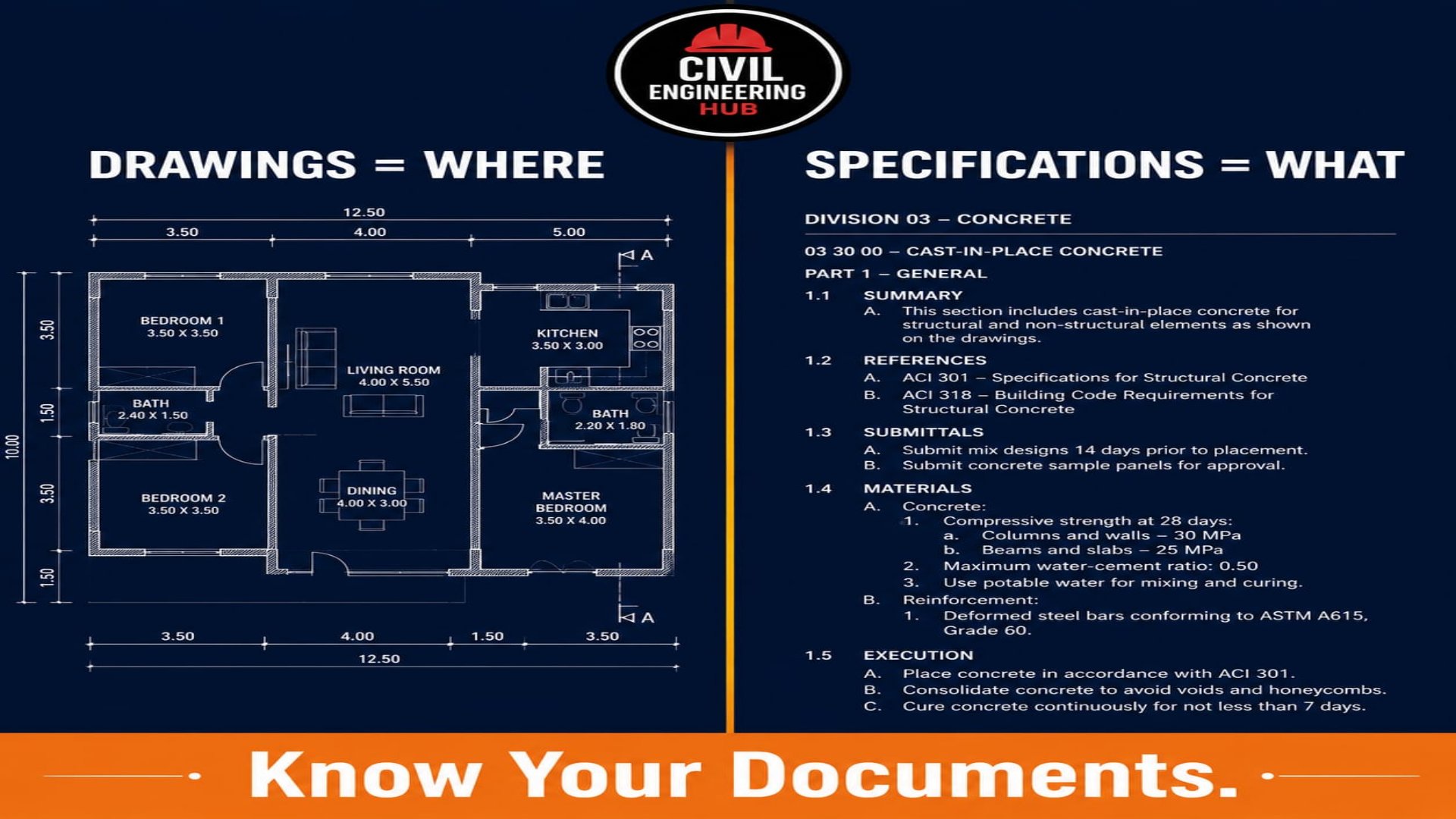
Architectural drawings strictly dictate geographical placement, spatial layout, and dimensional geometry. They answer the fundamental question of where structural elements belong.
Conversely, technical specifications detail the precise physical characteristics, performance benchmarks, and qualitative standards required, effectively answering what materials must be utilized.
When a site supervisor relies solely on physical layouts, critical engineering parameters are frequently missed, compromising structural integrity.
For instance, an architectural plan provides floor dimensions, such as a master bedroom measuring 3.50 by 4.00 meters, or a living room spanning 4.00 by 5.50 meters.
However, these layouts do not reveal the internal strength of the structural frame holding those spaces together.
For that depth of data, site engineers must consult the formal technical specifications document.
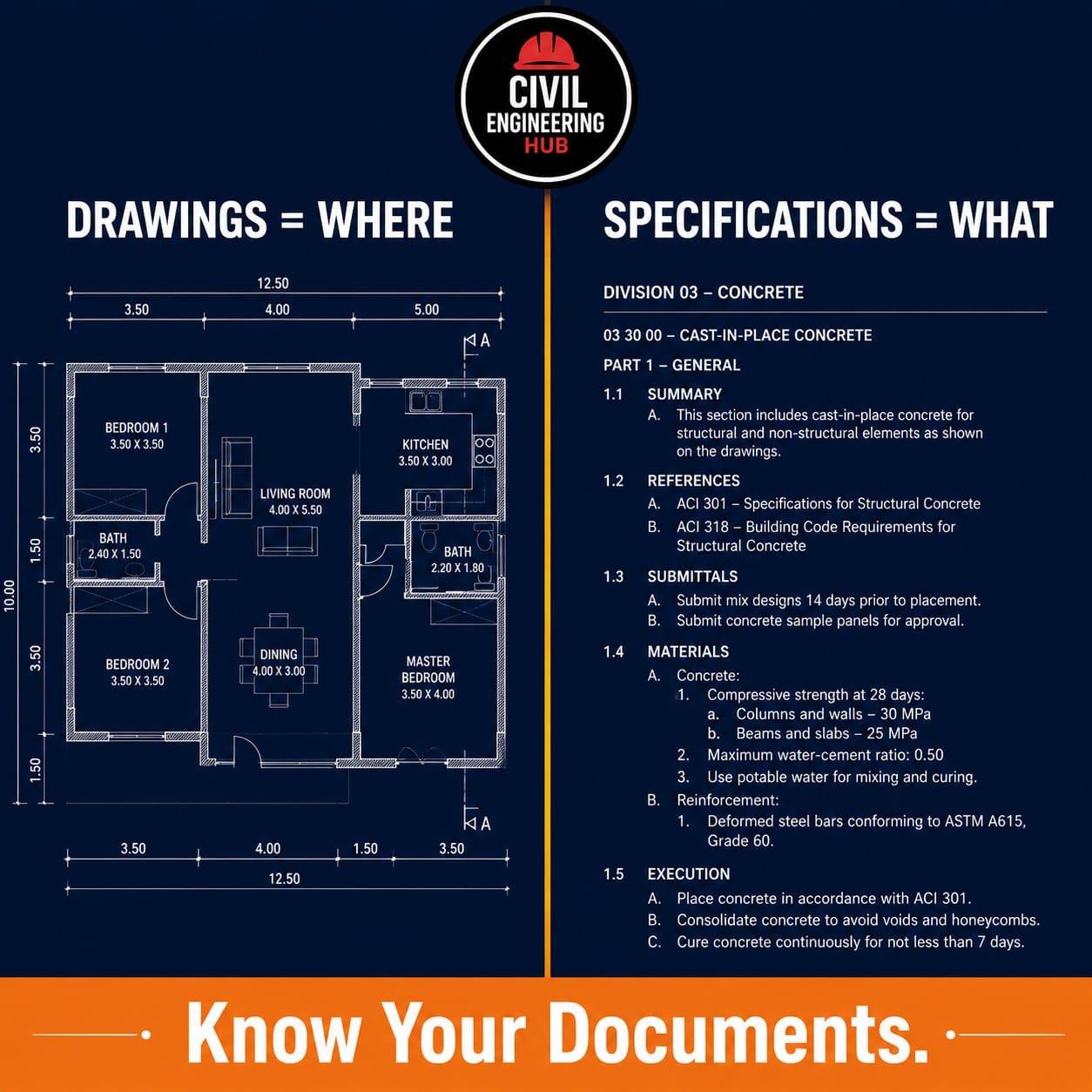
A typical concrete specification layout demonstrates the rigorous documentation required for standard cast-in-place concrete execution:
Division 03 – Concrete
03 30 00 – Cast-in-Place Concrete
Part 1 – General
1.1 Summary
A. This section includes cast-in-place concrete for structural and non-structural elements as shown on the drawings.
1.2 References
A. American Concrete Institute (ACI) 301 – Specifications for Structural Concrete.
B. ACI 318 – Building Code Requirements for Structural Concrete.
1.3 Submittals
A. Submit mix designs 14 days prior to placement.
B. Submit concrete sample panels for approval.
1.4 Materials
A. Concrete:
1. Compressive strength at 28 days:
a. Columns and walls – 30 MPa.
b. Beams and slabs – 25 MPa.
2. Maximum water-cement ratio: 0.50.
3. Use potable water for mixing and curing.
B. Reinforcement:
1. Deformed steel bars conforming to American Society for Testing and Materials (ASTM) A615, Grade 60.
1.5 Execution
A. Place concrete in accordance with ACI 301.
B. Consolidate concrete to avoid voids and honeycombs.
C. Cure concrete continuously for not less than 7 days.
This structured breakdown proves that while drawings establish the boundaries, specifications define the core structural performance.
Megapascals (MPa) determine whether a poured column can sustain the dead loads of upper floors, but this metric never appears on a standard floor plan.
Failing to cross-reference these documents often leads to legal disputes, structural failure, or severe regulatory penalties from municipal authorities.
Contractors must enforce a strict review process, where project managers verify every dimension against its technical counterpart before purchasing materials.
Ultimately, clear document literacy ensures that Kenyan real estate projects remain both physically safe and financially viable over their lifespans.
Comments (0)
Leave a Comment
No comments yet. Be the first to share your thoughts!