
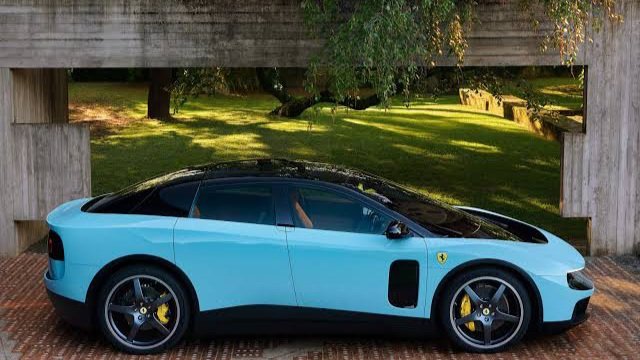

The unveiling of the first fully battery electric production car from Maranello, named the Luce, has triggered an unprecedented corporate and design crisis for the Italian luxury automaker. Within 24 hours of the vehicle's debut in Rome, Ferrari stock crashed 8 per cent, as investors and purists reacted to a machine that breaks entirely from the low-slung, aggressive silhouettes that defined the brand for over 75 years.
The automotive world is split over the aesthetic direction chosen by designer Jony Ive, the former Apple design chief who led the project. Priced at approximately 550,000 Euros, which translates to roughly 640,000 US dollars, the Luce features four electric motors, one for each wheel, generating a combined output of 1,035 horsepower. It achieves zero to 100 kilometres per hour in 2.5 seconds, with a top speed exceeding 310 kilometres per hour, supported by a 122 kilowatt-hour (kWh) battery integrated directly into the chassis structure.
The harshest rebukes came from historical company insiders rather than internet commentators, who likened the car to appliances or rubber clogs. Luca di Montezemolo, who ran Ferrari for 23 years and secured seven Formula 1 constructor's championships, went public with his profound disapproval, stating that the company risks destroying a legend. He openly declared his hope that management would remove the iconic Prancing Horse badge from the vehicle, adding that the design was unique enough that Chinese manufacturers would not try to copy it.
Further political and industrial condemnation followed from Italian Deputy Prime Minister Matteo Salvini, alongside former Fiat executive Carlo Calenda, who labeled the car an aesthetic and technical insult to automotive enthusiasts. The controversy highlights a deeper structural clash between traditional internal combustion engine design values and the rigid aerodynamic requirements dictated by Electric Vehicle (EV) platforms.
Engineering realities explain why the new four-door, five-seat vehicle looks so radically different from petrol-powered predecessors. Traditional sports cars feature a low, ground-hugging profile built around a mid-mounted engine, but battery electric systems require a flat battery pack situated entirely underneath the cabin floor. This skateboard chassis layout forces a raised floor height, a longer wheelbase, and shorter overhangs to maximize battery capacity, while a smooth, rounded skin is required to minimize the drag coefficient to achieve the claimed range of over 500 kilometres.
To defend the rollout, Ferrari Chief Executive Officer (CEO) Benedetto Vigna launched a counteroffensive on CNBC, asserting that the design must represent the shift in technology. He dismissed comparisons to Chinese manufacturing, noting that despite the initial stock drop, the order book already stretches toward the end of 2027. Following his remarks, the stock recovered more than 3 per cent, supported by institutional analysts from Citi and RBC who advised investors that the financial fundamentals remain secure.
Nevertheless, the vehicle enters a hyper-competitive luxury landscape where Chinese tech firms are delivering high performance at lower costs. Build Your Dreams (BYD), the Chinese automotive giant, markets its Yang Wang U9 electric supercar for 150,000 US dollars on a footprint nearly identical to the Luce, utilizing active rear spoilers and aggressive racing creases. Meanwhile, smartphone manufacturer Xiaomi has utilized engineers from Lamborghini and Porsche to construct the SU7 Ultra, a 76,000 US dollar EV that hits 62 miles per hour in under two seconds, outperforming the Italian newcomer on paper.
Comments (0)
Leave a Comment
No comments yet. Be the first to share your thoughts!