
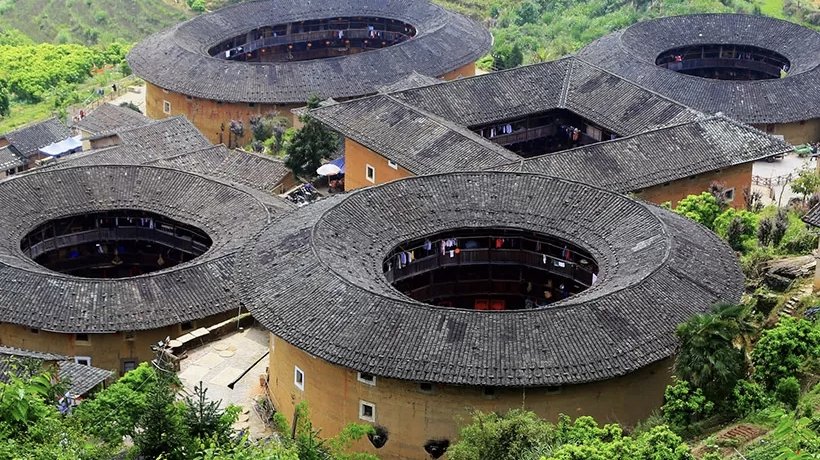

In the mountain valleys of southeastern China's Fujian province, circular earthen structures rise several storeys from rice and tea fields, their thick walls enclosing entire communities behind a single fortified gate. These are the Fujian Tulou, and they remain one of the most remarkable examples of vernacular construction in the world.
Built primarily by the Hakka people between the 12th and 20th centuries, Tulou translates simply as "earthen building." The structures are anything but simple. Foundations were laid using local river stones. Walls were built from fine sedimentary mud sourced from surrounding rice fields, reinforced with split bamboo, mixed with sand and lime, and compacted in layers using a heavy staff, a method that produced walls strong enough to last centuries without a single piece of reinforced concrete or structural steel.
The circular form was not aesthetic, it was defensive. Each structure housed an entire clan, sometimes up to 800 people, across multiple floors arranged around an open central courtyard. A single entrance gate controlled access. Windows to the outside only appeared above the first floor, preventing ground-level breach. The result was effectively a fortified apartment building and village in one.
The largest known circular example, Chengqilou in Yongding County, covers 5,300 square metres and was designed according to Bagua and Feng Shui principles. The oldest surviving structure, Yuchang Building, dates to 1308 and is notable for its pillars, some of which lean at a 15-degree angle without having caused the structure to fail in over 700 years.
During the Cold War, satellite images of these circular complexes circulating in Western intelligence prompted speculation they were nuclear missile silos. On-the-ground investigation revealed communal kitchens and family shrines instead.
UNESCO inscribed 46 Fujian Tulou buildings as World Heritage Sites in 2008, describing them as an extraordinary reflection of a communal response to settlement, highlighting their planning, environmental adaptation, and social function. Thousands more remain outside the heritage listing, many vacant or deteriorating without active conservation.
The Holcim Foundation has since supported restoration efforts aimed at reviving the structures for sustainable community use, recognising in their design principles the same qualities now being rediscovered in contemporary climate-responsive architecture.
Comments (0)
Leave a Comment
No comments yet. Be the first to share your thoughts!