
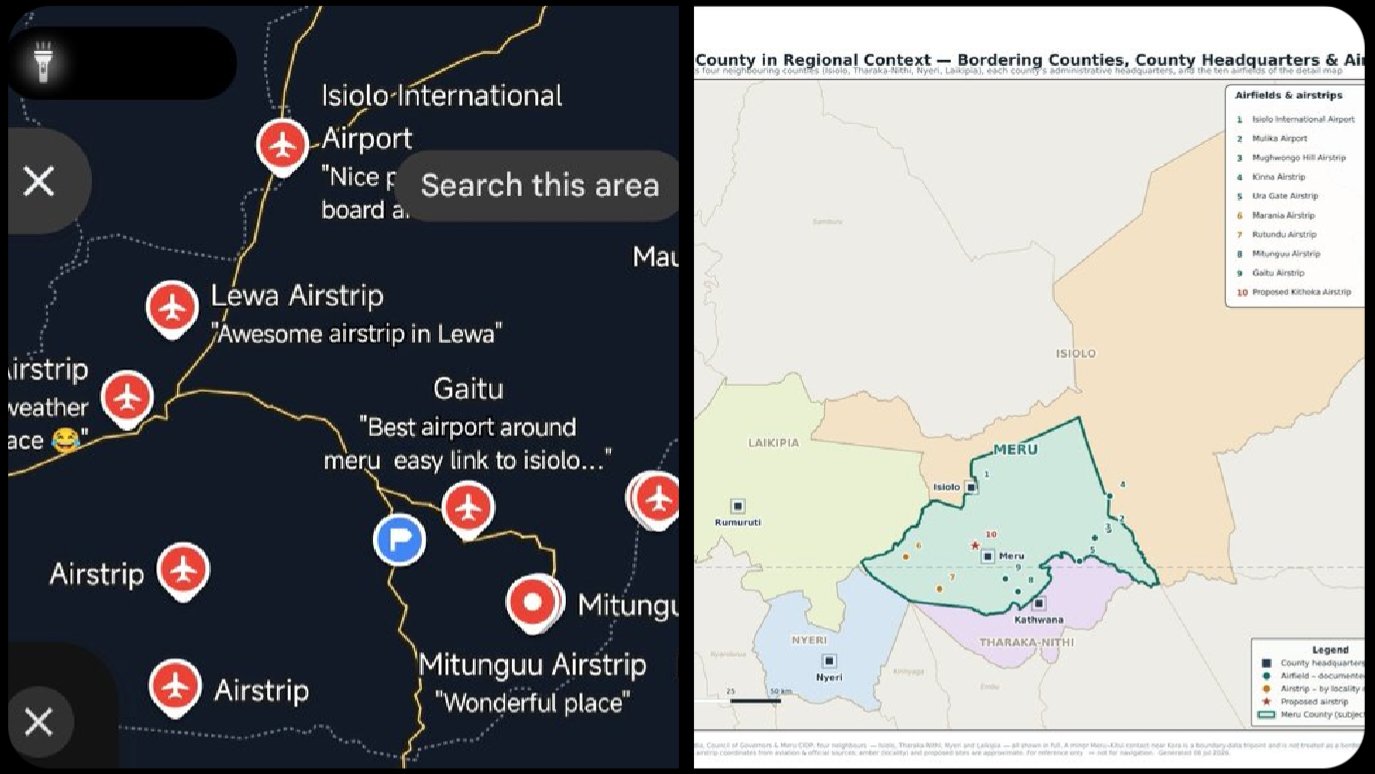

A public audit of aviation infrastructure in Meru County reveals a network of ten operational airfields distributed across its agricultural and conservation zones. This network includes a mix of private agricultural facilities, tourism-focused strips, and a major regional gateway.
The mapping underscores the region's connectivity, which has recently drawn national attention regarding public infrastructure distribution. Disagreements among state officials over the availability of functional runways have prompted closer inspection of these facilities.
According to regional geographic logs, the ten identified airfields are:
1. Kisima farm airstrip
2. Lewa airstrip
3. Marania airstrip
4. Rutundu airstrip
5. Mitunguu airstrip
6. Gaitu airstrip
7. Mulika airstrip
8. Kinna airstrip
9. Mughwongo hill airstrip
10. Isiolo International Airport (shared territory)
A central component of this aviation network is Isiolo International Airport, an infrastructure facility positioned directly on the boundary separating Isiolo and Meru counties. Its runway spans both territories, serving as a critical commercial transit point for agricultural exports.
The facility is managed by the Kenya Airports Authority (KAA), which oversees major public aviation hubs across the country. The airport features an asphalt runway designed to accommodate commercial regional aircraft, linking the upper eastern region directly to Nairobi.
Within the public category, Gaitu Airstrip remains an important asset situated roughly 14 kilometers from Meru town along a paved access road. Its proximity to the urban core makes it a primary candidate for logistics upgrades, which avoids the need for fresh land acquisition.
Conservation areas hold several of these airfields, particularly inside Meru National Park. The Kenya Wildlife Service (KWS) manages access to these interior strips, which support biodiversity monitoring, anti-poaching patrols, and high-end tourism logistics.
Among the park-based facilities are Mulika Airstrip, Kinna Airstrip, and Mughwongo Hill Airstrip. These runways provide immediate access for charter flights carrying international visitors into the protected savanna ecosystems, which enhances regional ecotourism.
State reports indicate that KAA allocated funds for the rehabilitation of Mulika Airstrip to improve its runway surface and passenger handling capacity. This investment aligns with broader efforts to modernise tourism infrastructure without encroaching on fragile forest reserves.
Private agricultural enterprises operate other critical strips, including the Kisima Farm Airstrip. Located in the high-altitude agricultural zones, this private infrastructure facilitates the rapid transport of horticultural products, particularly flowers and vegetables destined for European markets.
Lewa Airstrip serves the Lewa Wildlife Conservancy, acting as a crucial transport hub for community development and wildlife conservation programs. It connects private operators and conservationists to northern wildlife networks, supporting ecological research across county lines.
Marania Airstrip and Rutundu Airstrip cater to specialized agricultural and alpine tourism sectors near Mount Kenya. Their high-elevation positions require specific pilot certifications, yet they offer vital access to remote northern slopes.
Mitunguu Airstrip serves the lower, irrigated agricultural zones of Meru, offering alternative transport options for local agricultural produce. Together, these ten facilities give the county a high density of aviation access points relative to neighbouring regions.
The distribution of these airfields challenges recent political assertions regarding the isolation of the county, when aviation observers note that optimizing existing infrastructure remains far more viable than building new runways in ecologically sensitive environments.
Comments (0)
Leave a Comment
No comments yet. Be the first to share your thoughts!