
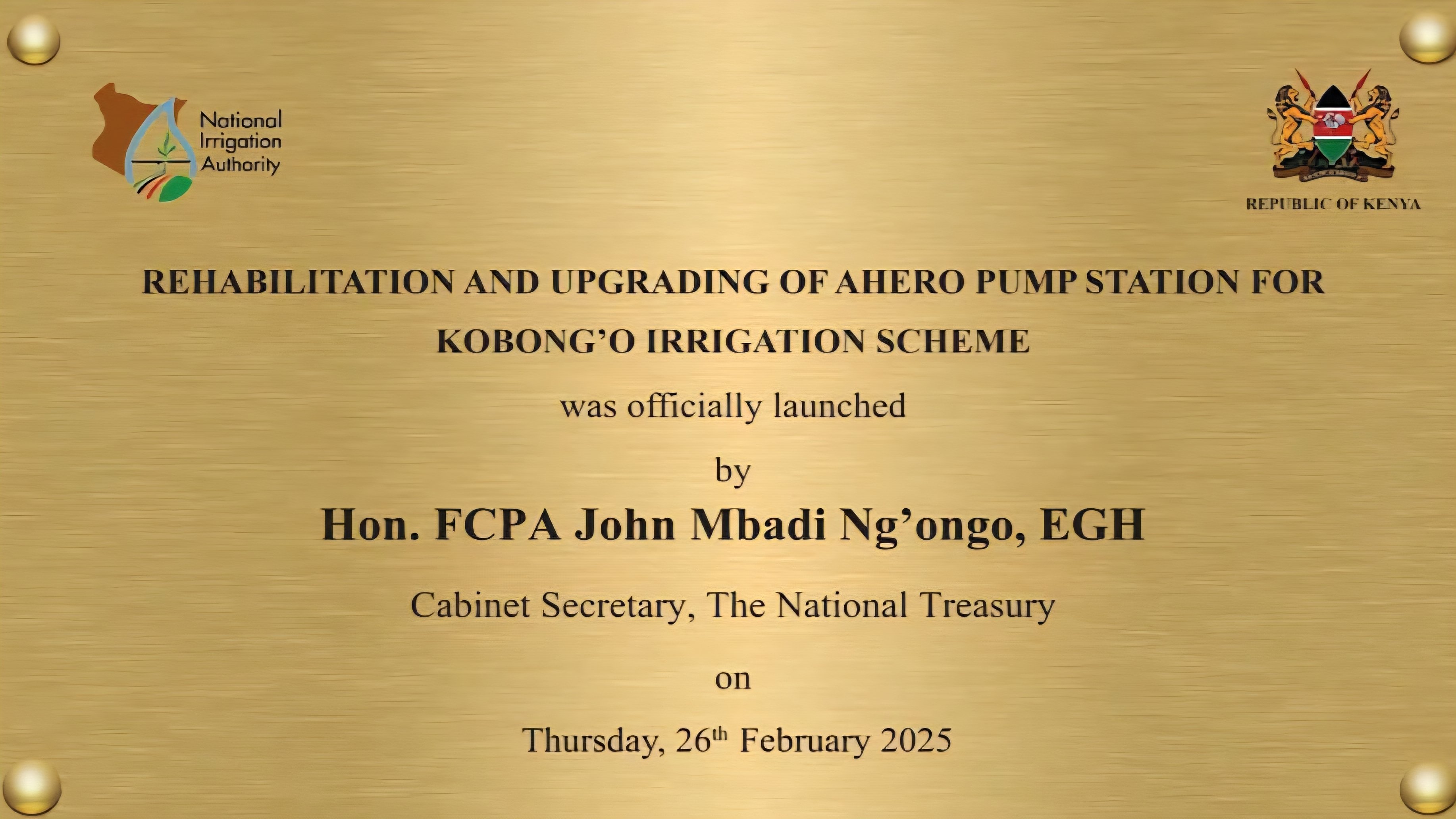

The Government of Kenya has officially commissioned the rehabilitation and upgrading of the Ahero Pump Station for the Kobong’o Irrigation Scheme, a KES 650 million investment aimed at modernizing agricultural infrastructure in Nyando, Kisumu County.
The project, which was launched on Thursday, 26 February 2025, by Cabinet Secretary for the National Treasury, Hon. FCPA John Mbadi Ng’ongo, represents a shift toward climate-resilient energy solutions within the national irrigation framework.
Managed by the National Irrigation Authority under the Ministry of Water, Sanitation, and Irrigation, the initiative will convert the existing Ahero pumping facility into a solar-powered hybrid system. By drawing water from the Nyando River, the upgraded infrastructure is designed to supply a reliable water source to approximately 1,000 acres of land in the Kobong’o and Awasi/Onjiko areas.
Economically, the project is expected to have a broad impact on the local community, which has historically relied on rain-fed agriculture. Projections from the National Irrigation Authority indicate that the scheme will support 5,000 direct jobs and 10,000 indirect roles.
The shift to a solar-hybrid model is intended to stabilize operating costs, which allows for up to 1.8 cropping seasons annually. Farmers are expected to see gross revenues of KES 250,000 per acre per season, contributing to an estimated KES 250 million in annual farm income for the region. The project is estimated to have a payback period of three years.
Work on the site is already underway, with the project currently at 40 percent completion. Physical works commenced following the official start date on 20 December 2024. The total construction and implementation period is scheduled for 26 months, with an expected completion date of 27 February 2027.
Funding for the upgrade is provided through a Tied-Aid Credit from the Government of the Republic of Hungary. This international partnership underscores the focus on climate-smart agriculture and the integration of renewable energy into large-scale infrastructure.
The Kobong’o Irrigation Scheme aligns with the Bottom-Up Economic Transformation Agenda, which prioritizes food security and poverty reduction through increased agricultural productivity. By reducing the reliance on expensive diesel-powered pumps, the project seeks to ensure that the irrigation system remains financially viable for the 240 households directly benefiting from the water supply.
Comments (1)
Leave a Comment
Joseph Aliwa
Feb 26