

A Nairobi court has drawn a firm line on land encroachment, ruling that extensive construction and decades of occupation do not automatically grant ownership rights under the doctrine of adverse possession.
The decision by the Environment and Land Court (ELC) involved a high-stakes dispute between neighbours in a prime Nairobi suburb, highlighting the legal complexities facing property developers and landowners.
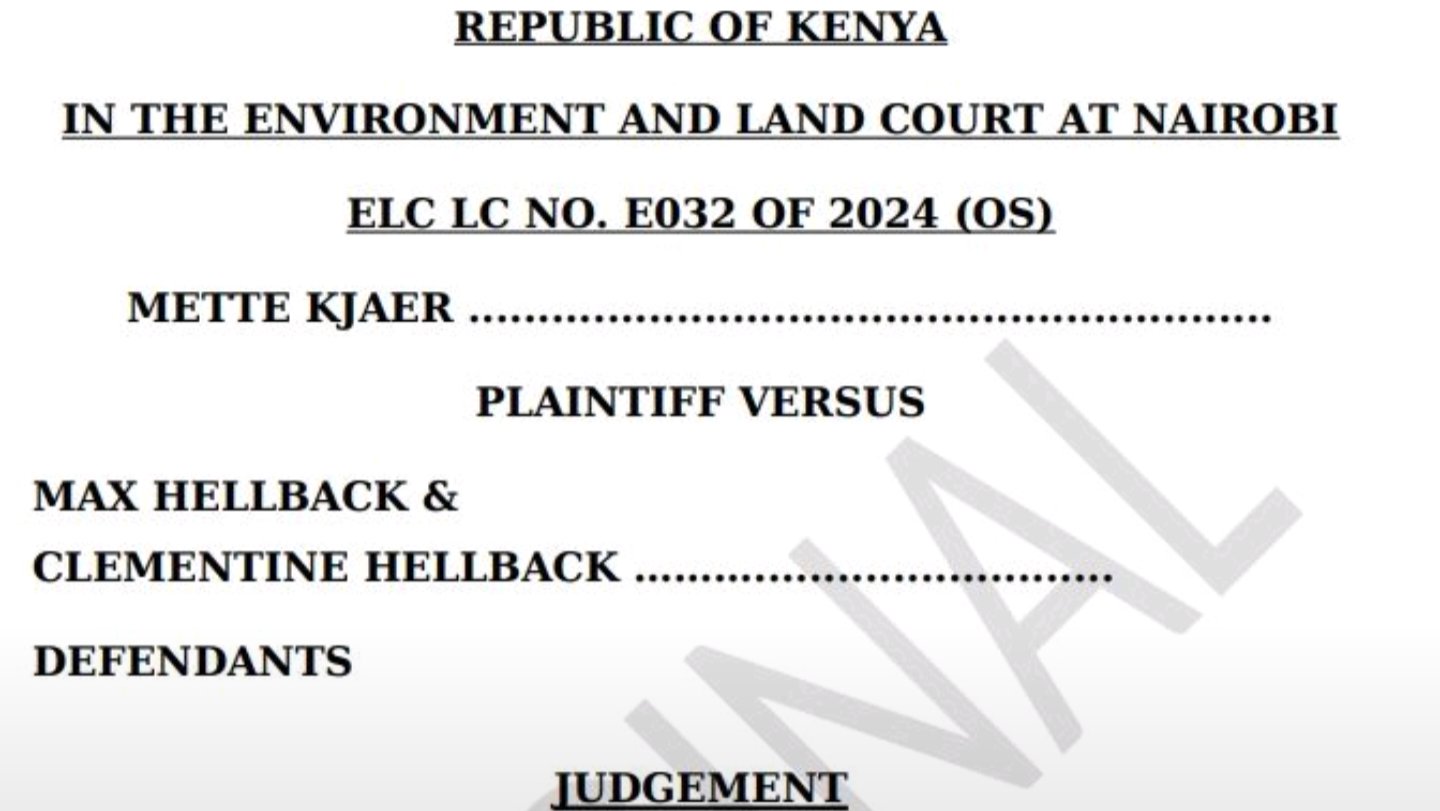
In the case of Mette Kjaer versus Max Hellback and Clementine Hellback, the plaintiff sought legal ownership of a portion of her neighbours' land.
She argued that she had occupied and developed the disputed section for nearly two decades without objection from the registered owners.
Court documents show the claimant had fenced off the area, planted a mature kei-apple hedge, erected a water tank, built a guest cottage, and laid cabro paving on the property.
The legal battle intensified when the property was earmarked for sale, and an official survey exposed the physical encroachment.
The plaintiff contended that her uninterrupted occupation since 2004 had effectively extinguished the original owners' title.
However, Justice Christine Ochieng rejected the adverse possession claim, pointing out critical inconsistencies in the timeline of the alleged occupation.
The court found that while the claimant asserted her occupation began in 2004, key physical developments like the guest cottage and paved sections were actually constructed around 2018.
The judgment also focused heavily on the unique social relationship between the disputing parties.
The court observed that the neighbours were not hostile, but were close family friends who maintained an access gate between their properties and interacted freely for years.
Justice Ochieng held that these friendly circumstances complicated any assertion that the land occupation had been openly hostile, exclusive, and adverse for the statutory 12-year period.
The statutory twelve-year period is a strict requirement under Kenyan law to successfully claim ownership through adverse possession.
The ruling reinforces that the legal doctrine is governed by strict evidential thresholds rather than sympathy, assumptions, or the simple passage of time.
The ELC judgment emphasizes that claimants must prove with precision the exact moment their occupation became unlawful, hostile, and entirely inconsistent with the registered owner's rights.
Without such definitive proof, even visible structural developments worth millions of shillings will fail to confer legal ownership.
The decision is expected to influence future boundary disputes, neighbour conflicts, and land recovery claims across Kenya.
For property developers and occupiers, the case serves as a warning that construction investments count for little if the legal timeline cannot be clearly established.
For registered landowners, the ruling provides some relief, though it underscores the risks of ignoring minor encroachments over extended periods.
Comments (0)
Leave a Comment
No comments yet. Be the first to share your thoughts!