

A version of this article appeared on The Civil Engineering Hub.
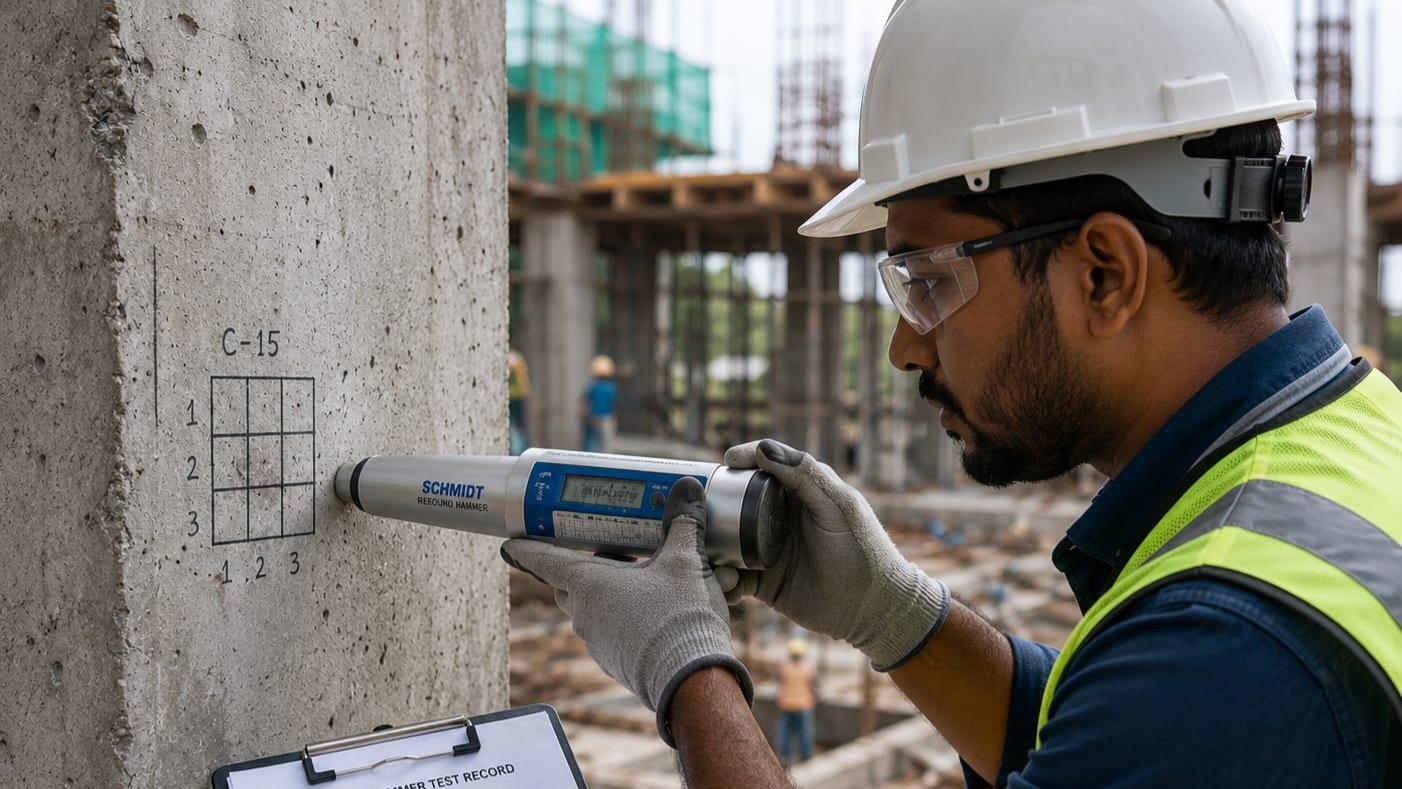
On active construction sites, verifying the integrity of hardened concrete is a daily necessity. One of the most frequently utilized methods for this task is the Non-Destructive Testing (NDT) known as the Rebound Hammer Test, which is also commonly referred to as the Schmidt Hammer Test.
The primary function of this instrument is to assess the surface hardness of hardened concrete. Because it is non-destructive, it allows engineers to evaluate a structure without causing any physical damage to the existing work.
The mechanism inside the device relies on a spring-loaded mass. When an operator presses the hammer against a concrete surface, the internal mass impacts the material and rebounds after striking the face. The device then records this rebound value on a scale.
In simple terms, a harder concrete surface typically results in a higher rebound value. However, there is a common misconception among students and junior technicians regarding what the tool actually measures.
The rebound hammer does not directly measure the compressive strength of the concrete. Instead, it evaluates the surface hardness and the general uniformity and consistency of the concrete quality.
To arrive at a strength estimate, these rebound readings are compared against standard correlation charts. These charts help translate the surface data into an estimated compressive strength value.
This means the test provides an indication of quality, but it does not offer an exact compressive strength figure. For this reason, site engineers view the results as a guide rather than a definitive laboratory grade.
The tool is widely adopted because it is fast and simple to perform. It allows for quick consistency checks across different areas of a project, making it ideal for large-scale site investigations.
Engineers typically deploy the hammer during quality assessments and existing structure evaluations. It is particularly useful when checking suspicious concrete zones where the quality of the pour is in question.
Despite its convenience, several factors can skew the accuracy of a reading. Surface smoothness, moisture conditions, and the age of the concrete all influence the final rebound number.
Other variables include surface carbonation and the specific type of aggregates used in the mix. If a surface is overly rough or saturated, the hammer may provide a misleadingly low or high value.
Experienced engineers do not rely on these results alone when making critical structural decisions. They understand that the hammer is a field tool that requires context from other diagnostic methods.
To gain a more accurate picture of structural health, other tests are often used in conjunction with the hammer. These include core testing and Ultrasonic Pulse Velocity (UPV) testing.
Concrete cube compressive strength tests also remain the industry standard for formal verification. The combination of these methods ensures that the internal and external properties of the concrete meet safety specifications.
In the field of engineering, collecting data is only half the job. The real value lies in interpreting that data correctly and recognizing the limitations of the equipment being used.
The rebound hammer remains a staple of the construction site because it balances speed with utility. It provides the immediate feedback necessary to keep a project moving while identifying areas that may require more intensive laboratory scrutiny.
Comments (0)
Leave a Comment
No comments yet. Be the first to share your thoughts!