
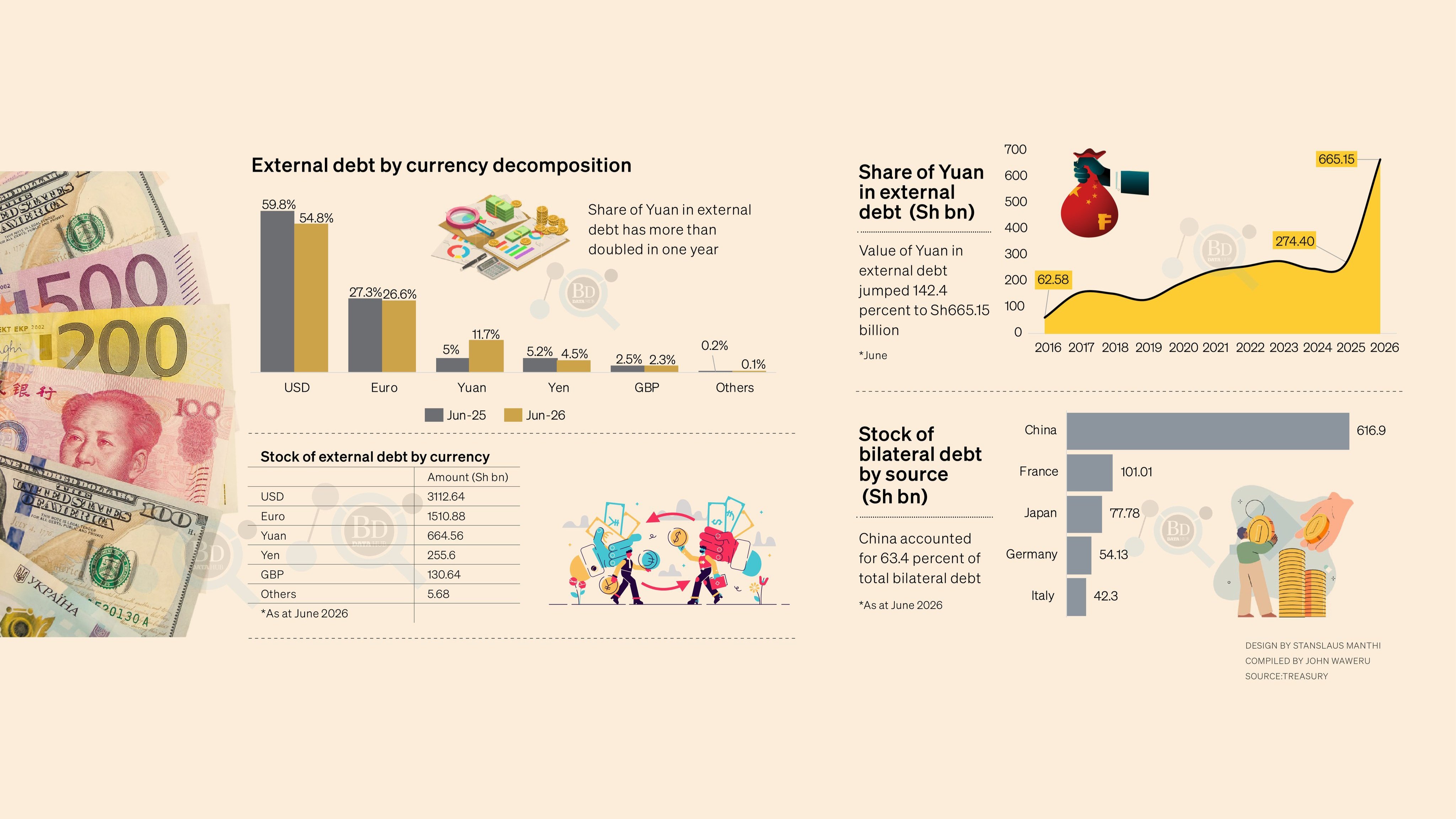

The share of Kenya foreign loans denominated in Chinese yuan has more than doubled to 11.7 percent. This increase follows the conversion of three dollar-denominated loans for the Standard Gauge Railway (SGR) into the Chinese currency.
Government figures show that developing nations are exploring alternative options to escape expensive greenback-linked financing. According to data compiled by Treasury, the value of yuan in Kenya external debt surged by 142.4 percent, rising to Sh665.15 billion as of June 2026.
External debt by currency decomposition demonstrates a clear shift in foreign exposure over a twelve-month period. In June 2025, the United States Dollar (USD) accounted for 59.8 percent of external debt, but that figure dropped to 54.8 percent by June 2026.
During the same period, the share of euro-denominated debt moved from 27.3 percent down to 26.6 percent. Conversely, the portion held in yuan expanded from 5 percent to 11.7 percent, making it the third-largest currency component in the national portfolio.
In terms of total stock of external debt by currency as at June 2026, the holdings stand as follows:
* USD: Sh3,112.64 billion
* Euro: Sh1,510.88 billion
* Yuan: Sh664.56 billion
* Japanese Yen: Sh255.6 billion
* British Pound (GBP): Sh130.64 billion
* Others: Sh5.68 billion
Other major foreign currencies experienced slight declines in their overall share. The Japanese Yen decreased from 5.2 percent to 4.5 percent, while the British Pound fell from 2.5 percent to 2.3 percent. Other miscellaneous currencies shrank from 0.2 percent to 0.1 percent.
Looking at historical trends, the share of yuan in Kenya external debt has grown steadily over the last decade. Back in 2016, the total value stood at Sh62.58 billion. By 2023, that number had reached Sh274.40 billion, before climbing sharply to its present level of Sh665.15 billion.
China remains Kenya's largest source of imports and holds the predominant share of bilateral debt obligations. Statistics show China accounted for 63.4 percent of total bilateral debt as of June 2026.
The total stock of bilateral debt by source country reflects China's dominant financing position in the local landscape:
* China: Sh616.9 billion
* France: Sh101.01 billion
* Japan: Sh77.78 billion
* Germany: Sh54.13 billion
* Italy: Sh42.3 billion
African nations continue evaluating currency restructuring strategies for major infrastructure projects. Shifting away from greenback obligations helps mitigate exchange rate volatility associated with Western currencies, especially when local economic pressures mount.
Kenya continues managing its foreign obligations through structured debt conversions, aligning currency exposure with trade patterns and long-term economic priorities.
Comments (0)
Leave a Comment
No comments yet. Be the first to share your thoughts!