
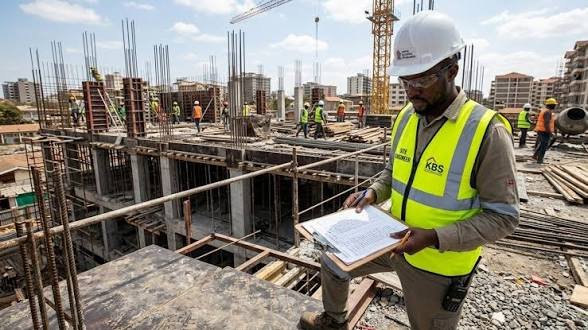

Construction is one of the few industries where a single incident can end a business overnight. A wall collapses. A worker falls from scaffolding. A neighbour's property is damaged during excavation. Without the right insurance in place, the financial and legal consequences fall entirely on the contractor.
Two policies form the foundation of any contractor's insurance framework in Kenya. Most contractors operating in the informal and mid-tier market carry neither.
The first is Contractors' All Risks (CAR) insurance. It covers loss or damage to the physical works themselves, including materials on site, partially completed structures and temporary site buildings, during the entire construction period. If a fire destroys work already completed, if flooding damages foundations, or if theft strips a site of materials overnight, a CAR policy covers the cost of reinstatement. Without it, the contractor absorbs that loss directly.
CAR insurance also includes third-party liability cover. This is the component most contractors underestimate. If a member of the public is injured on or near the site, if a neighbouring property is cracked by vibration from piling works, or if a vehicle is damaged by debris from the construction zone, the contractor is liable. Third-party liability under a CAR policy covers the legal costs of defending that claim and any compensation awarded by a court.
The sum insured under a CAR policy is based on the contract value, typically drawn from the Bill of Quantities (BOQ). The higher the contract value, the higher the premium, but also the higher the exposure without cover. Temporary site buildings, site offices, and storage structures can be included under the policy if specified at the time of purchase. Contractors should confirm this with their insurer rather than assuming automatic inclusion.
The second policy is Employer's Liability insurance, more commonly known in Kenya as a Work Injury Benefits Act (WIBA) policy. The Work Injury Benefits Act of 2007 requires all employers in Kenya to insure their workers against injury and death arising from their employment. For a construction contractor with workers on site, this is a legal obligation, not a commercial choice.
WIBA cover pays compensation to workers who are injured on site, covers medical expenses arising from work-related injuries, and provides death benefits to the dependants of workers killed during the course of their employment. The construction industry records some of the highest workplace fatality rates of any sector globally. In Kenya, research has found that the majority of construction companies allocate less than one percent of project budgets to health and safety. A serious site injury without WIBA cover exposes a contractor to civil liability, regulatory penalties and potential criminal liability under the Occupational Safety and Health Act.
WIBA policies are available from most licensed Kenyan insurers and are among the more affordable construction covers on the market. Premiums are typically calculated as a percentage of the total wages paid to workers during the policy period.
Together, CAR and WIBA represent the minimum insurance a contractor should carry before breaking ground on any project. For contractors bidding on formal tenders, particularly public sector and donor-funded projects, proof of both policies is a standard requirement in the tender submission documents. For those working in the private sector, they are the difference is between a manageable incident and a business-ending one.
Licensed insurers offering these covers in Kenya include Britam, Old Mutual Kenya, Liberty Kenya, Cannon Assurance, AAR Insurance and Intra Africa Assurance. Insurance agencies, including Dawit Insurance Agency, Anziano Insurance Agency and Imana Insurance Agency, offer brokerage services, allowing contractors to compare quotes across multiple providers.
When taking out either policy, confirm the exact scope of cover, the exclusions, and the claims notification period. A policy that lapses mid-project leaves the contractor fully exposed for any incident that occurs after the expiry date, regardless of when the underlying work was done.
The cost of adequate cover is a fraction of the cost of a single serious claim. For any contractor serious about operating professionally in Kenya's construction market, it is not a discretionary expense.
Comments (0)
Leave a Comment
No comments yet. Be the first to share your thoughts!