
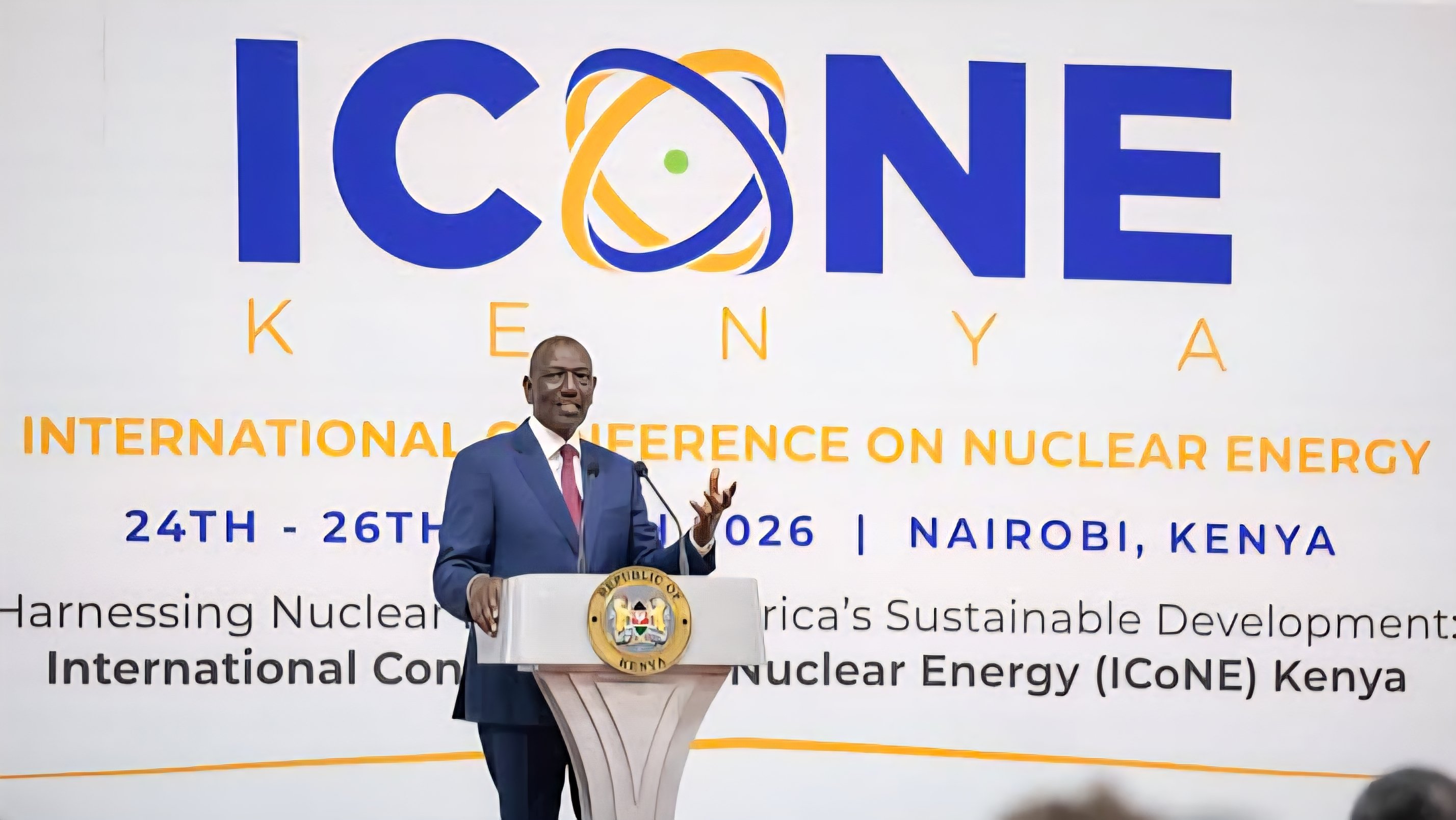

President Ruto has officially announced that Kenya will begin the construction of a 2,000 megawatt (MW) nuclear power plant in Siaya County in 2027. Speaking at the International Conference on Nuclear Energy (ICoNE) held at the KICC in Nairobi, the President detailed a roadmap that sees the facility commissioned by 2034.
The project forms a central part of a broader national strategy to expand Kenya's total installed electricity capacity. The government aims to increase the current generation from 3,300MW to at least 10,000MW over the coming seven years. Within this target, approximately 3,000MW is expected to be derived from nuclear sources to ensure a stable and diversified energy mix.
President Ruto noted that the decision to integrate nuclear energy into the national grid is a response to the growing demand for affordable and consistent power. According to technical projections shared during the summit, the introduction of nuclear power could reduce electricity costs to between 4 and 5.5 US cents per unit, providing a competitive edge for local industries.
To support this ambitious infrastructure development, the President committed to enacting comprehensive legislation. These new laws will be designed to meet global standards for nuclear safety, security, and safeguards. The goal is to establish a regulatory environment that builds domestic trust and facilitates international partnerships with global nuclear institutions.
The Kenya Electricity Generating Company (KenGen) has been designated as the owner-operator for the upcoming plant. KenGen is currently focusing on building the necessary technical and institutional capacity to oversee the full lifecycle of the project, from initial ground-breaking to long-term operations and maintenance.
During the peak construction phase, the Siaya project is expected to create significant employment. Estimates provided by the President suggest the site will require between 5,000 and 12,000 workers. These roles will range from manual labor provided by the locals to highly specialized engineering positions required for nuclear systems.
Justus Wabuyabo, CEO of the Nuclear Power and Energy Agency (NuPEA), confirmed that Kenya is following the International Atomic Energy Agency (IAEA) Milestones Approach. The country is currently in Phase 2 of this framework, which involves establishing the functional specialized organizations and the legal structures necessary for a national nuclear programme.
While acknowledging public concerns regarding nuclear technology, President Ruto emphasized that the transition is necessary for national resilience. He stated that nuclear energy provides a stable supply that fossil fuels cannot match in the current volatile market, while also contributing to the country's carbon reduction goals.
The three-day conference in Nairobi has attracted regulators, technical experts, and investors from across the globe. Discussions have focused on financing large-scale energy projects and the transfer of advanced technology to the African continent. This gathering marks a pivot in how the region views its long-term energy security and industrial growth.
Comments (0)
Leave a Comment
No comments yet. Be the first to share your thoughts!