

Miwani, located at the foot of the Nandi Escarpment in Muhoroni Constituency, was once a thriving agricultural and industrial zone whose growth revolved around the operations of Miwani Sugar Company. For years, the factory sustained thousands of livelihoods and supported an extensive local economy, with transport infrastructure playing a central role. The road linking Chemelil roundabout through Miwani to Kibos and onward to Mamboleo in Kisumu served as a vital corridor for cane transport, trade, and the daily movement of people.
The collapse of Miwani Sugar Company marked a turning point for the region. Following years of mismanagement and the eventual looting of factory assets, the once vibrant economic ecosystem disintegrated. Businesses closed, employment opportunities disappeared, and the area slipped into prolonged decline. As economic activity slowed, investment in public infrastructure also diminished. The Chemelil–Miwani–Kibos road, once busy and well-maintained, gradually deteriorated into a narrow, uneven, and unreliable route, becoming increasingly impassable during rainy seasons.
For years, residents and road users endured poor travel conditions with vehicles frequently breaking down and transport costs rising due to prolonged travel times and frequent repairs. The state of the road not only hampered movement but also discouraged investment, isolating Miwani from Kisumu and other surrounding economic hubs. Farmers struggled to access markets, traders faced delays, and social services became harder to reach.
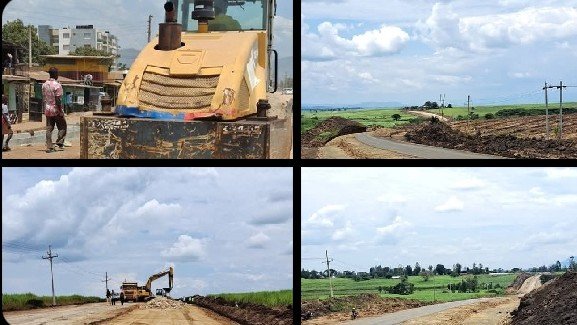
Recent developments, however, suggest that the long-neglected corridor may finally be receiving attention. Photographs circulating widely show road maintenance equipment on site, including graders and compactors with visible earthworks along several sections of the route. These images indicate that rehabilitation efforts may be underway, sparking renewed optimism among residents and stakeholders who have long called for intervention.
Early signs point to grading and leveling works aimed at improving road alignment and drainage. Such preparatory activities are often the first stage in restoring road usability, particularly for routes that have suffered years of erosion and neglect. Improved drainage in particula,r is expected to reduce flooding and surface damage during the rainy seaso,n making the road more reliable throughout the year. un
If sustained, the ongoing works could significantly improve connectivity between Chemelil, Miwani, Kibos, and Mamboleo. Better road conditions would ease the movement of agricultural produce, lower transport costs, and enhance access to Kisumu’s commercial and industrial markets. For Miwani, improved infrastructure could catalyze broader economic recovery, encouraging private investment and supporting efforts to revive agricultural productivity in the region.
Despite the visible activity, caution remains warranted. Past initiatives in the area have sometimes stalled before completion, leaving roads only partially improved. Stakeholders emphasize the need for consistent funding, proper supervision, and timely completion to ensure the works translate into a durable, all-weather road rather than temporary relief.
Local leaders and residents alike view the current developments as an opportunity to correct years of infrastructural neglect. The rehabilitation of the Chemelil–Miwani–Kibos road is widely seen as more than a transport project; it represents a chance to restore dignity to a community that once played a critical role in Kenya’s sugar industry.
As works progress, attention will focus on the scope and quality of the improvements, particularly whether the project advances beyond grading to include proper surfacing and long-term maintenance measures. The success of the initiative will ultimately be judged by its impact on mobility, safety, and economic activity.
For Miwani, the renewed focus on road infrastructure offers a cautious but meaningful sign of change. Should the improvements be completed as anticipated, the corridor may once again support growth and reconnect the region to its historic role as a vital link between agricultural heartlands and urban markets.
Comments (0)
Leave a Comment
No comments yet. Be the first to share your thoughts!