
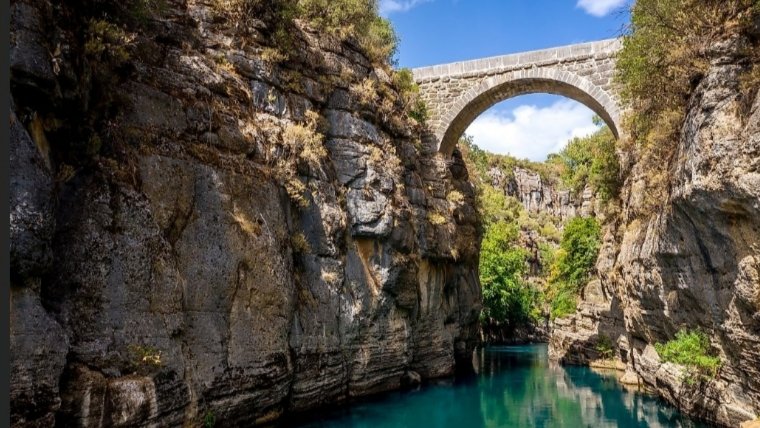

Roman bridges continue to fascinate engineers and historians. Many have survived for nearly two thousand years.
Modern bridges often show serious deterioration after just fifty years. The Alcántara Bridge in Spain, built in the early second century CE, remains standing and functional.
Roman bridge building reached its peak during the Empire. This was particularly evident under Emperor Trajan.
The civilisation, which began in the 7th century BCE, developed advanced skills. These skills covered roads, aqueducts and bridges.
These structures supported military campaigns, trade and daily life. They stretched across vast territories of the Roman Empire.
The circular arch formed the foundation of Roman bridge design. Engineers arranged wedge-shaped stones called voussoirs in a semicircle.
A central keystone locked the arch together. This design distributed weight evenly through compression rather than tension.
Strong piers provided additional stability. These vertical supports carried the weight down to the riverbed or bedrock.
To build piers in fast-flowing rivers, Roman engineers developed cofferdams. They created temporary dry spaces for concrete to set properly.
The materials they used contributed greatly to longevity. Roman concrete incorporated pozzolana, a volcanic ash mixed with lime.
Recent research shows that high-temperature mixing created lime clasts. These particles give the concrete self-healing properties.
When cracks form, moisture dissolves the lime. It then fills and strengthens the damaged areas.
Roman bridges typically carried lighter loads than modern structures. They supported foot traffic and horse-drawn carts.
This reduced long-term stress on the bridges. In contrast, many contemporary bridges use steel-reinforced concrete that can corrode.
The legacy of Roman engineering continues to influence modern construction. Some engineers study these ancient techniques today.
These ancient structures remind us of an important lesson. Effective engineering depends on thoughtful design and quality materials.
Comments (0)
Leave a Comment
No comments yet. Be the first to share your thoughts!