

The government digitization drive in Kenya has triggered an increase in annual non-tax revenue collections, with state records showing inflows climbing from 20 billion shillings in 2022 to 539 billion shillings in 2026.
This multi-billion-shilling surge follows structural shifts initiated three years ago, when the state consolidated public payment channels to seal revenue leakages, and optimize service delivery across multiple sectors.
Official data released during a state briefing in Karen, Nairobi City County, indicates that 16.5 million adult citizens currently use the e-Citizen platform to pay for various public services.
The platform has become the central pillar of the digital transformation strategy introduced by the government in 2023, which is aimed at eliminating manual processing risks, and making public services universally accessible.
Building on these financial gains, the Executive Office of the President Cabinet Office has outlined a new phase of expansion targeting key administrative, security, and resource sectors.
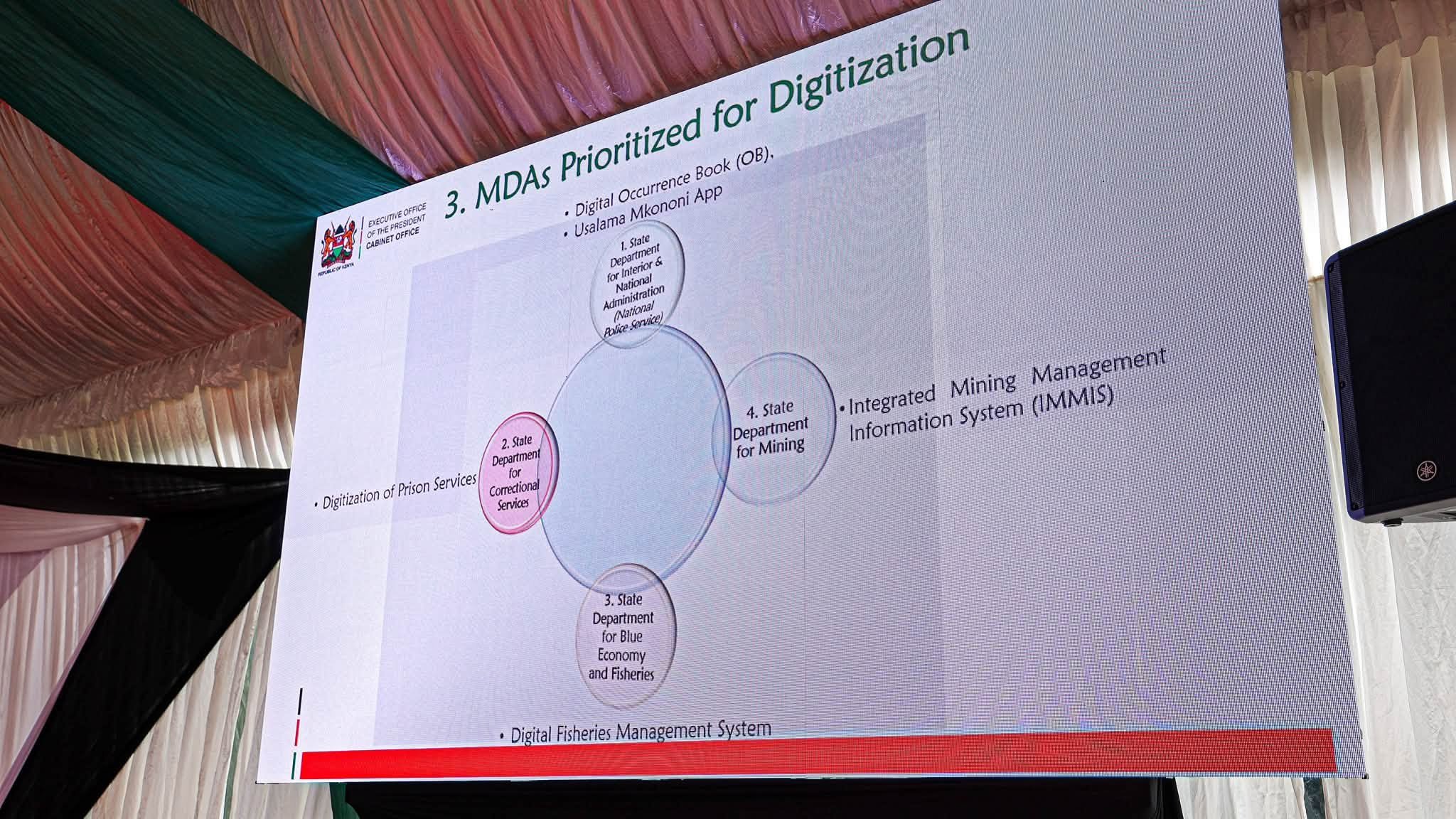
According to official planning documents, specific Ministries, Departments and Agencies (MDAs) have been prioritized for immediate system automation to streamline state infrastructure operations.
Among the primary areas scheduled for modernization is the State Department for Interior and National Administration, specifically focusing on operations under the National Police Service.
The upcoming system upgrades will introduce a digital Occurrence Book (OB), alongside a dedicated mobile platform named the Usalama Mkononi App, which will transition police record-keeping away from physical ledgers.
The digitization framework also covers the State Department for Correctional Services, where administrative processes will undergo comprehensive automation.
Under this directive, the digitization of prison services will focus on modernizing inmate tracking, administrative communication, and institutional reporting structures to improve accountability.
Resource-dependent sectors, which are vital to the broader economy, are similarly scheduled for immediate technological overhauls under the new directives.
The State Department for Blue Economy and Fisheries is currently developing a specialized Digital Fisheries Management System, which is intended to optimize regulatory oversight, and track maritime economic activities.
Simultaneously, the State Department for Mining is moving forward with the deployment of the Integrated Mining Management Information System (IMMIS).
This portal will manage licensing, mineral tracking, and revenue compliance, which will provide a transparent framework for a sector often hampered by manual bureaucracy, and complex supply chains.
The scaling up of these administrative systems reflects a broader policy under President Ruto to embed digital infrastructure into every layer of public administration.
By targeting extractive industries, maritime resources, and national security data systems, the administration seeks to replicate the revenue collection successes observed in civilian registries, and transport services.
As more state organs transition to the central platform, government engineers face the ongoing task of ensuring system uptime, and protecting user data.
The upcoming months will test the capacity of the national digital infrastructure as millions of additional transactions from the police, mining, and maritime registries migrate into the unified public ledger system.
Comments (0)
Leave a Comment
No comments yet. Be the first to share your thoughts!