
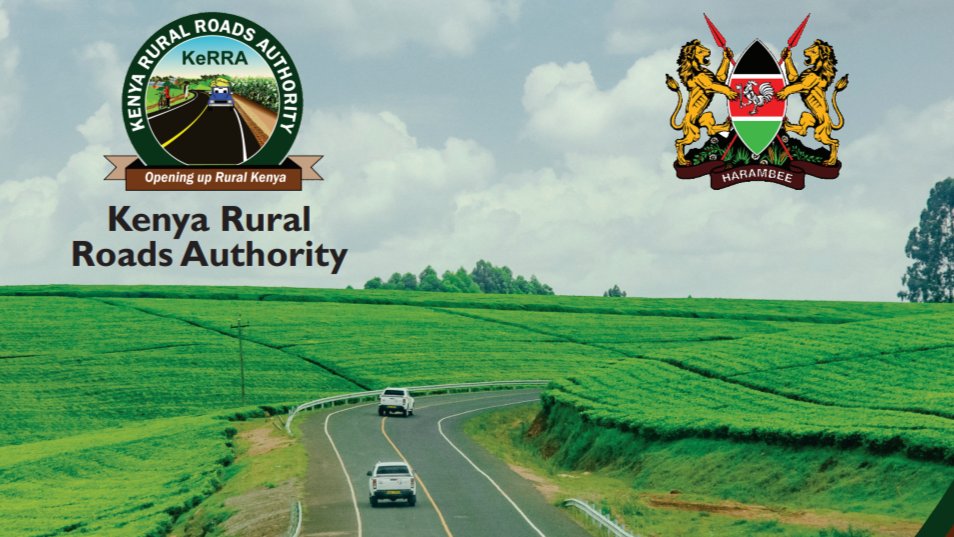

The Kenya Rural Roads Authority, known as KeRRA, has announced a massive nationwide tender, and this move signals an unprecedented commitment to upgrading the country's vital rural infrastructure. The official notice which was released on October 7, 2025, details plans for the tarmacking and significant upgrading of hundreds of local roads. "KeRRA is a crucial state corporation because it is responsible for the management and maintenance of this vast rural road network and this tender represents its largest infrastructure plan to date," reports the Star Newspaper. Many of the listed projects are intended to bring these essential pathways up to modern bitumen standards. This vital work will ensure far greater durability and accessibility for communities and commerce for many years to come. The goal is to build a road network that successfully withstands all weather conditions.
In total, the comprehensive plan encompasses over 500 individual road segments and necessary bridge constructions. This immense, large-scale initiative forms a core part of the government’s ambitious national strategy, which is aptly named “Connecting Devolved Kenya.” The primary objective of this program is to drastically improve rural connectivity and this development in turn supports robust economic growth across all counties. The project is specifically designed to align with broader national development policies because it serves as an engine for the country's future. These policies include the long-term goals of Vision 2030 and the immediate priorities of the Bottom-Up Economic Transformation Agenda, or BETA. Both of these frameworks heavily rely on large-scale infrastructure investment to drive inclusive development and sustainably uplift communities throughout the entire nation.
Improved roads will naturally yield transformative and widespread benefits for agricultural communities and all local businesses. Better infrastructure significantly enhances the efficiency of agricultural value chains since produce can be reliably transported from farms to markets much faster and with significantly less spoilage. This systemic change will drastically reduce overall transport costs for both goods and essential services. Moreover, the extensive construction work itself is expected to create a substantial number of immediate job opportunities, directly boosting employment in the crucial construction sector and creating a powerful multiplier effect across local economies. Furthermore, reliable roads are absolutely essential for public safety and the efficient delivery of critical public services. They facilitate prompt disaster response when needed and they ensure that essential services like health and education can reach even the most remote populations without undue delay, thus improving the quality of life for millions of citizens.

Funding for this massive undertaking is secured from multiple sources, demonstrating a strong and multifaceted financial commitment from the national government. A substantial portion comes directly from the Exchequer, which is the government’s central financing body. Another key source is the Road Maintenance Levy Fund, or RMLF. This fund is critically important for the country’s entire road maintenance ecosystem because it provides a consistent and dedicated source of revenue. The RMLF is derived from the levies collected directly on fuel sales and this consistent revenue stream is strategically redistributed among the various road agencies.
The project distribution ensures that the positive impact will be felt everywhere in the nation, so the tender lists projects across every single county. Kiambu County has notably received the highest number of allocated projects for upgrading. Following closely behind are Murang'a, Homa Bay and Siaya, all of which have a significant number of road improvements planned. Other counties with double-digit allocations, indicating major infrastructure investments, include Nakuru, Uasin Gishu, Migori, Kericho, and Mandera. Even the Coastal region, spanning Mombasa, Kwale, Kilifi, and Taita Taveta, collectively benefits from twenty-two dedicated projects hence a broad geographical reach.
KeRRA has established a modern, transparent process for contractor participation. All eligible and interested contractors are strongly invited to download the necessary tender documents online from the official website. The submission of all bids must occur exclusively through the official e-procurement system, because this digital platform is designed to ensure maximum fairness and efficiency in the tendering process. The authority clearly stated that all Invitation Notices for tenders, regardless of the specific funding vote or source, would be systematically uploaded directly to its official website for public access. The government expects this major investment to achieve much more than just improving daily mobility. It is viewed as a foundational effort, and it is intended to catalyze long-term economic transformation by seamlessly connecting remote areas to the national trade routes and essential services to unlock the full potential of Kenya’s rural heartland.
Comments (0)
Leave a Comment
No comments yet. Be the first to share your thoughts!