
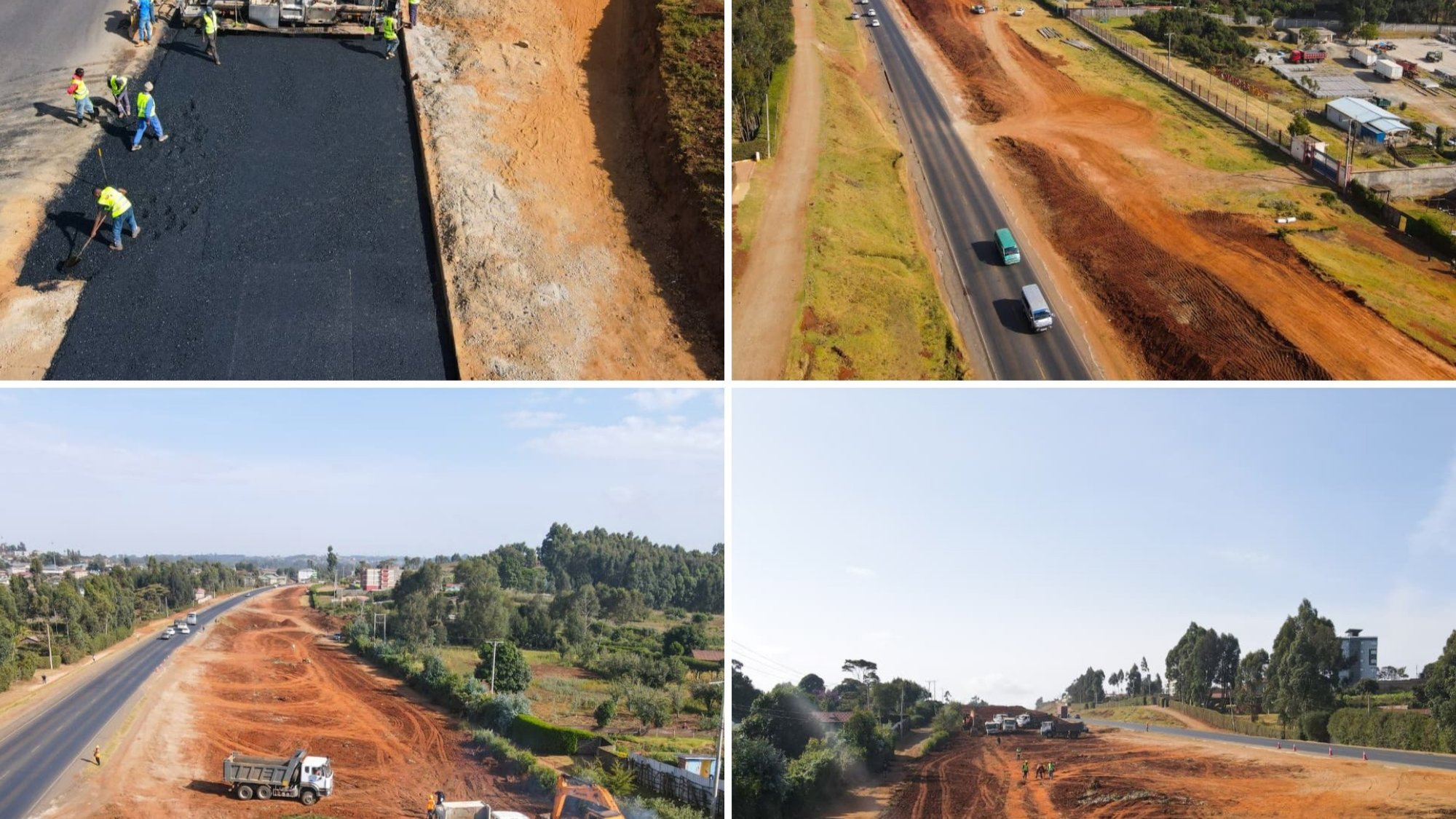

Latest images and videos depict steady progress on the Rironi-Mau Summit Road project, a key highway upgrade in Kenya's transport network. The collage captures various stages of work, from asphalt laying by crews using pavers and rollers to aerial views revealing cleared and graded sections alongside existing lanes. Dump trucks and excavators appear handling fill material, while workers in safety gear manage site activities under clear skies.
The project involves duplicating the A8 highway from Rironi in Kiambu County to Mau Summit in Nakuru County, spanning about 175 kilometers. Launched in 2023 under a public-private partnership, the initiative aims to create a four-lane dual carriageway to ease congestion on one of Kenya's busiest routes. The French consortium of Vinci Highways, Meridiam, and Egis leads the effort, with a concession period of 30 years including design, build, finance, operate, and transfer.
Construction began in phases after financial close in mid-2023, with initial focus on earthworks and drainage. The images suggest advancement in surfacing near urban stretches, possibly around Naivasha or Gilgil, where red soil and green verges match the terrain. One photo shows a paver applying blacktop next to an unpaved shoulder, with traffic flowing on the adjacent lane. Another overhead shot displays a long strip of prepared subgrade, indicating preparation for base layers.
The upgrade addresses longstanding issues on the corridor, which handles heavy truck volumes between Nairobi and western Kenya. Narrow sections and poor shoulders have contributed to accidents, with National Transport and Safety Authority data showing over 300 fatalities annually on similar highways. Dualing should improve safety, reduce travel times from four hours to under two, and support trade with Uganda and beyond.
Funding totals around KES 160 billion, blending private investment and government contributions. The Kenya National Highways Authority oversees the public side, ensuring compliance with environmental standards. Works include bridges, interchanges, and service roads to minimize disruptions. Local communities have benefited from jobs, with over 2,000 workers employed at peak, many from nearby counties.
Challenges have included land acquisition delays, resolved through compensation for over 1,000 affected households by 2024. Weather impacts, like heavy rains eroding cuts, require ongoing mitigation. The project incorporates sustainable features, such as wildlife underpasses in wildlife-prone areas and erosion control with vegetation.
Recent milestones mark the first 50 kilometers under active construction, with completion targeted for 2028. The images align with reports of accelerated pacing in early 2026, following equipment mobilization. KeNHA has conducted public forums in towns like Limuru and Nakuru to address concerns over dust and traffic diversions.
The corridor forms part of the Northern Corridor, linking Mombasa Port to landlocked neighbors. Upgrades complement the Nairobi Expressway, opened in 2022, and the Standard Gauge Railway, operational since 2017. Enhanced capacity could boost logistics for exports like tea and horticulture from the Rift Valley.
Online reactions to the shared images vary. Some users praised the visible progress, while others questioned timelines or confused sections with nearby Waiyaki Way repairs. Skeptics referenced past project delays, but supporters highlighted government commitments under the Bottom-Up Economic Transformation Agenda.
As works continue, monitoring focuses on quality control. Asphalt mixes must meet specifications for durability against heavy loads and tropical conditions. Independent auditors review progress quarterly.
The Rironi-Mau Summit upgrade represents a shift toward PPP models in Kenya's infrastructure, following successes like the Nairobi Expressway. If completed on schedule, it could unlock economic potential in agriculture and tourism along the route.
Local firms participate in subcontracts for civil works, fostering skills transfer. Safety protocols, evident in the photos with vested workers, adhere to Occupational Safety and Health Act requirements.
With sections opening progressively, drivers may soon experience smoother travel. The full dual carriageway promises to transform connectivity in central Kenya.
Comments (0)
Leave a Comment
No comments yet. Be the first to share your thoughts!