
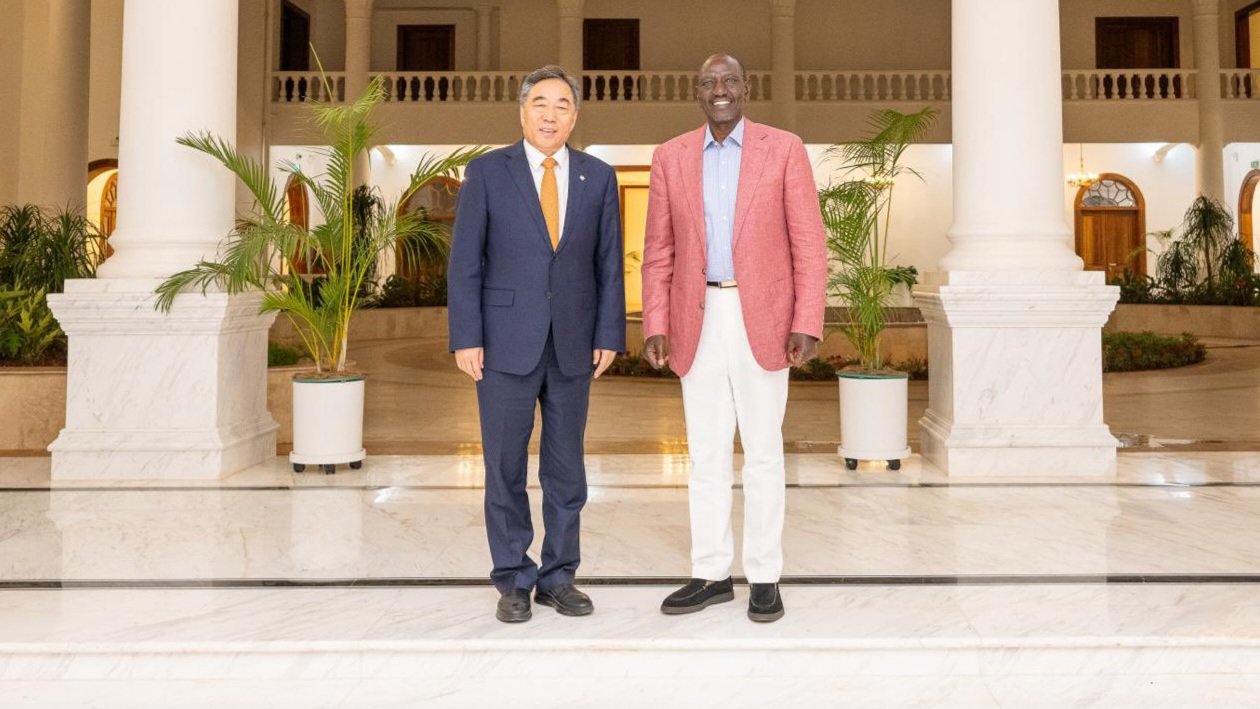

President William Ruto hosted Song Hailiang, the Chairman of China Communications Construction Company (CCCC), at State House on Wednesday. The meeting comes just days before the scheduled start of construction for the Standard Gauge Railway (SGR) extension, which is designed to connect the existing rail head to the lakeside city of Kisumu and onwards to the Malaba border.
The discussions focused on the logistical and technical readiness for the project launches scheduled for Thursday and Saturday. These events will mark the commencement of Phases 2B and 2C of the national railway network, extending the modern line from its current terminus in Naivasha through Narok and eventually to the border with Uganda.
The planned extension to Kisumu, designated as Phase 2B, involves complex engineering works across the Rift Valley and into the Lake Victoria basin. Technical specifications for this section include the construction of 79 railway bridges and eight tunnels, covering a total distance of approximately 264 kilometres. The line is expected to facilitate easier movement of bulk cargo to the Kisumu Port, which is also undergoing modernization to handle increased regional trade.
Following the Kisumu leg, Phase 2C will extend the tracks to Malaba. This segment is viewed as a critical link for the Northern Corridor, providing a high-capacity transport solution for landlocked neighbors such as Uganda, Rwanda, and the Democratic Republic of Congo. The government has indicated that the project will be completed within a 12-month construction window, with the aim of having the line operational by mid-2027.
During the meeting at State House, the President emphasized the role of the railway in positioning Kenya as a regional logistics hub. The project is anticipated to lower the cost of doing business by reducing the reliance on long-distance trucking, which currently dominates the transport of goods from the Port of Mombasa to Western Kenya and the wider East African region.
The China Communications Construction Company, through its subsidiary China Road and Bridge Corporation (CRBC), was the primary contractor for the initial phases of the SGR from Mombasa to Naivasha. The current phase represents a continuation of that partnership, with the government exploring various financing models, including the utilization of the Railway Development Levy, to support the multi-billion shilling investment.
Preparations at the launch sites in Narok and Kisumu are reportedly complete. The Saturday event in Kisumu is expected to be a joint ceremony, with regional leaders invited to witness the groundbreaking. Local authorities in the affected counties, including Bomet and Nyamira, have already begun coordinating with the National Land Commission to ensure that land acquisition and compensation processes do not delay the construction timeline.
Once fully integrated, the SGR will form a continuous modern rail link from the Indian Ocean to the border of Uganda, significantly shortening transit times for both passengers and freight. The new stations along the route, including intermediate stops at Mulot and Ahero, are designed to serve as new economic nodes for the western region.
Comments (0)
Leave a Comment
No comments yet. Be the first to share your thoughts!