
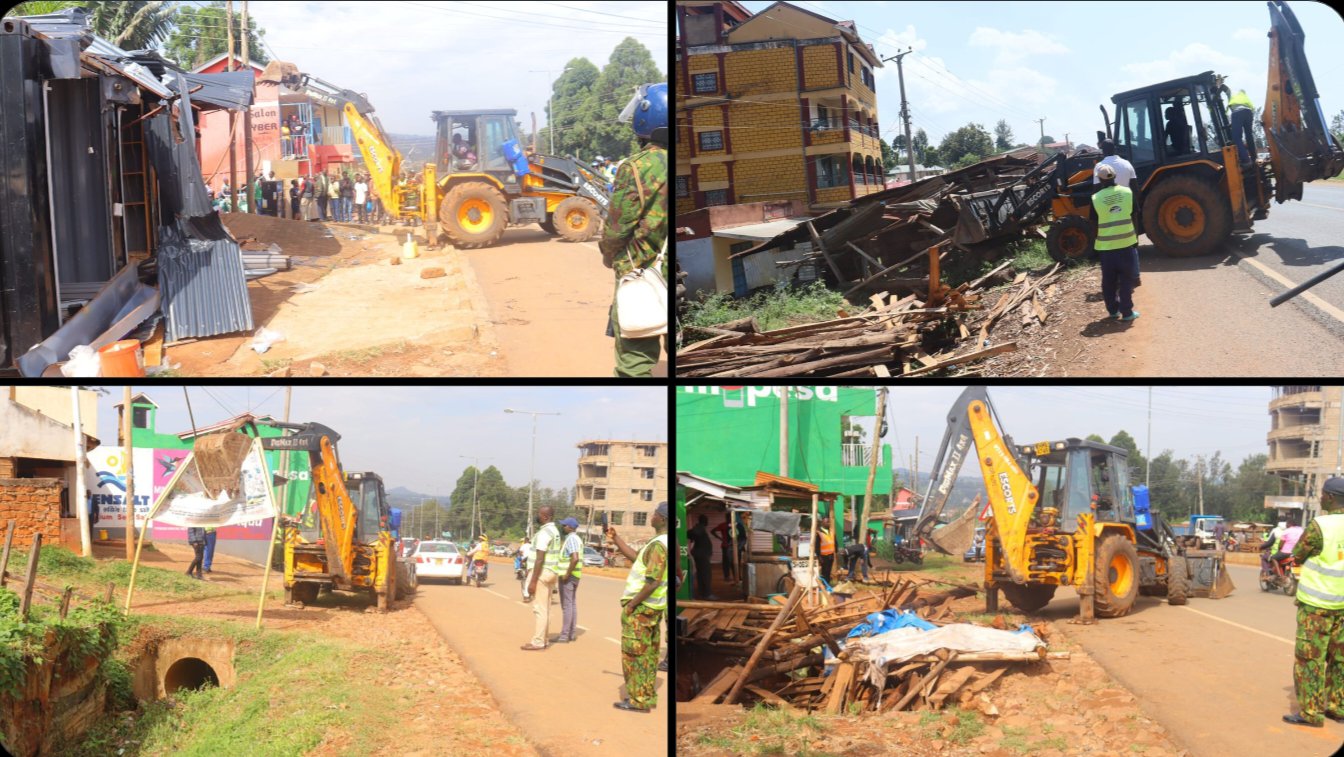

The Kenya National Highways Authority (KeNHA) Corridor D Management Team has executed a coordinated enforcement operation to clear illegal encroachments along its network. The rapid exercise targeted unauthorized business structures, commercial signage, and unapproved access culverts built directly within the protected road reserve boundary.
Heavy earthmoving machinery, including hydraulic backhoes and excavators, moved through the designated sections to dismantle informal kiosks, perimeter walls, and retail stalls. Armed security personnel escorted the technical teams to ensure order during the demolition of the structures, which were largely fabricated from timber and corrugated iron sheets.
According to official communications from the state agency, these unauthorized developments directly violate statutory provisions governing national infrastructure assets. Encroachment on public road reserves remains a severe operational bottleneck for the country, frequently obstructing vital highway expansion projects and complicating routine engineering maintenance routines.
Engineers from the authority noted that illegally installed access culverts severely compromise highway drainage systems by restricting the natural flow of stormwater runoff. When drains become blocked by substandard structural modifications, water spills onto the main asphalt surface, which rapidly accelerates pavement deterioration and leads to costly structural failures.
Furthermore, the removal of unapproved advertising billboards and localized retail signage forms part of an ongoing campaign to enhance motorist safety. The state corporation maintains that unregulated visual installations close to high-speed lanes create dangerous distractions for drivers, thereby increasing the probability of traffic accidents on major transit corridors.
As a strategic statutory body established under the landmark Kenya Roads Act, KeNHA possesses the absolute legal mandate to manage, develop, and safeguard all national trunk roads. The agency administers its massive transport network through ten regional hubs alongside specialized corridor management units tasked with tracking specific transport arteries.
Corridor D represents a vital segment of this national infrastructure network, handling substantial commercial traffic volumes that connect diverse economic zones. The high concentration of vehicular movement frequently attracts informal traders and private developers, who set up businesses on public land without obtaining mandatory regulatory clearances from the national government.
Officials from the highways body have repeatedly warned property owners that public road reserves are explicitly preserved for future expansion, public utility lines, and essential safety buffers. Individuals seeking to construct access roads or install utilities near highways must follow formal application protocols to secure valid wayleave permits.
This latest enforcement drive highlights the national government's aggressive stance against the private appropriation of public infrastructure land. Similar clearing operations are expected to continue across other key transport corridors, as the state moves decisively to protect its multibillion-shilling road assets from unauthorized modification and structural damage.
Traders affected by the operation expressed frustration over the sudden loss of their business premises. Engineering teams remained firm on the clearance, but they emphasized that public safety and the structural integrity of national corridors would remain the primary priority for the roads agency.
The agency reiterated that regular inspections will be carried out to prevent traders from returning to the cleared locations. Property owners who fail to comply with wayleave regulations risk facing heavy fines and legal prosecution under the existing framework governing national transport systems.
Comments (0)
Leave a Comment
No comments yet. Be the first to share your thoughts!