
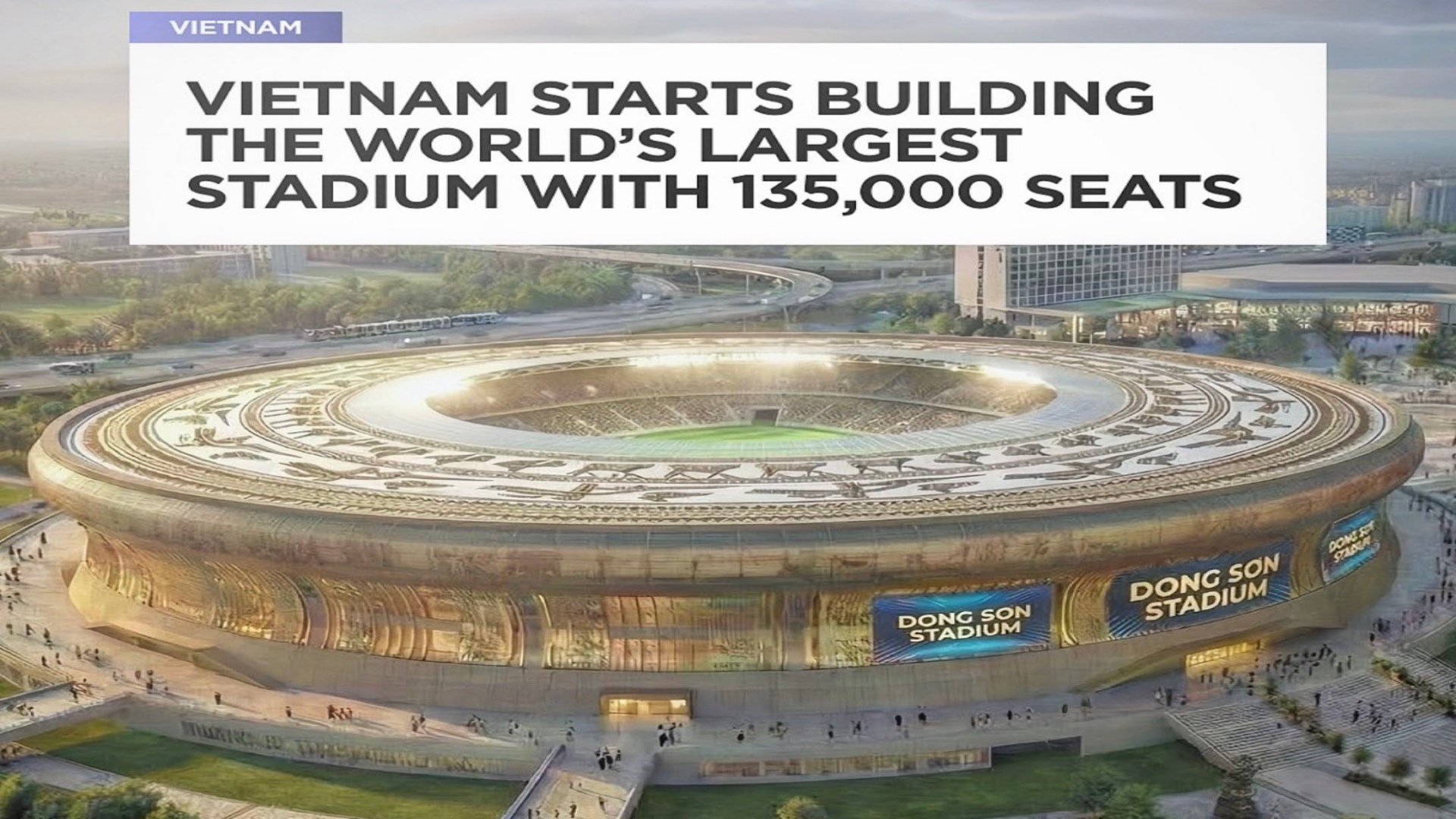

Authorities in Hanoi have officially commenced construction on the Trong Dong Stadium, a massive infrastructure project designed to hold 135,000 spectators. The groundbreaking ceremony, held in late December 2025, marks the start of a development that aims to shift the hierarchy of global sporting venues. Located in the southern district of Thuong Tin, the stadium is the anchor of the broader Olympic Sports Urban Area, a 9,000-hectare megacity project valued at approximately 925 trillion VND.
The architectural design of the stadium draws heavily from Vietnamese cultural heritage, specifically the Dong Son bronze drums. Its circular form and tiered facade incorporate the Lac bird motif, a legendary symbol in local history. Beyond its cultural significance, the technical specifications released by the developers, Vingroup and the Ministry of Public Security, indicate a focus on high-specification engineering and sustainable utility.
Once completed, the Trong Dong Stadium will surpass the capacity of major global venues such as the Narendra Modi Stadium in India and Michigan Stadium in the United States. While some international rankings place it as the second-largest in the world behind North Korea’s Rungrado 1st of May Stadium, several industry analysts suggest it could claim the top spot depending on the final configuration of its flexible seating and total area.
Engineering plans for the site include the installation of what is described as the world’s largest fully automated retractable roof. This system is intended to allow the venue to operate year-round regardless of monsoon conditions. Additionally, the project will feature a modular turf system designed to allow for a complete pitch replacement in under ten hours, facilitating a rapid transition between sporting matches and large-scale cultural performances.
The stadium is situated on a 73.3-hectare plot within Zone B of the Olympic Sports Urban Area. This wider district is planned to house over 180,000 residents and will include a Global Aquatic Arena, training facilities, and commercial hubs. The project is part of a strategic effort by the Vietnamese government to establish the infrastructure necessary to host major international events, including the Asian Games and potentially a future Olympic Games bid.
Connectivity to the site will be supported by the construction of Ring Road 4 and a planned high-speed rail link to central Hanoi. Developers have also integrated 5G-enabled smart seating and AI-driven crowd management systems into the stadium’s design to handle the logistical challenges of its massive capacity. Environmental features include natural ventilation and water recycling systems intended to reduce the facility's clean water consumption by 70 percent.
Construction is scheduled for completion in August 2028. The project has drawn significant attention across Southeast Asia, with regional observers noting that the scale of investment represents a significant shift in Vietnam’s approach to national infrastructure and international sports positioning.
Comments (0)
Leave a Comment
No comments yet. Be the first to share your thoughts!