
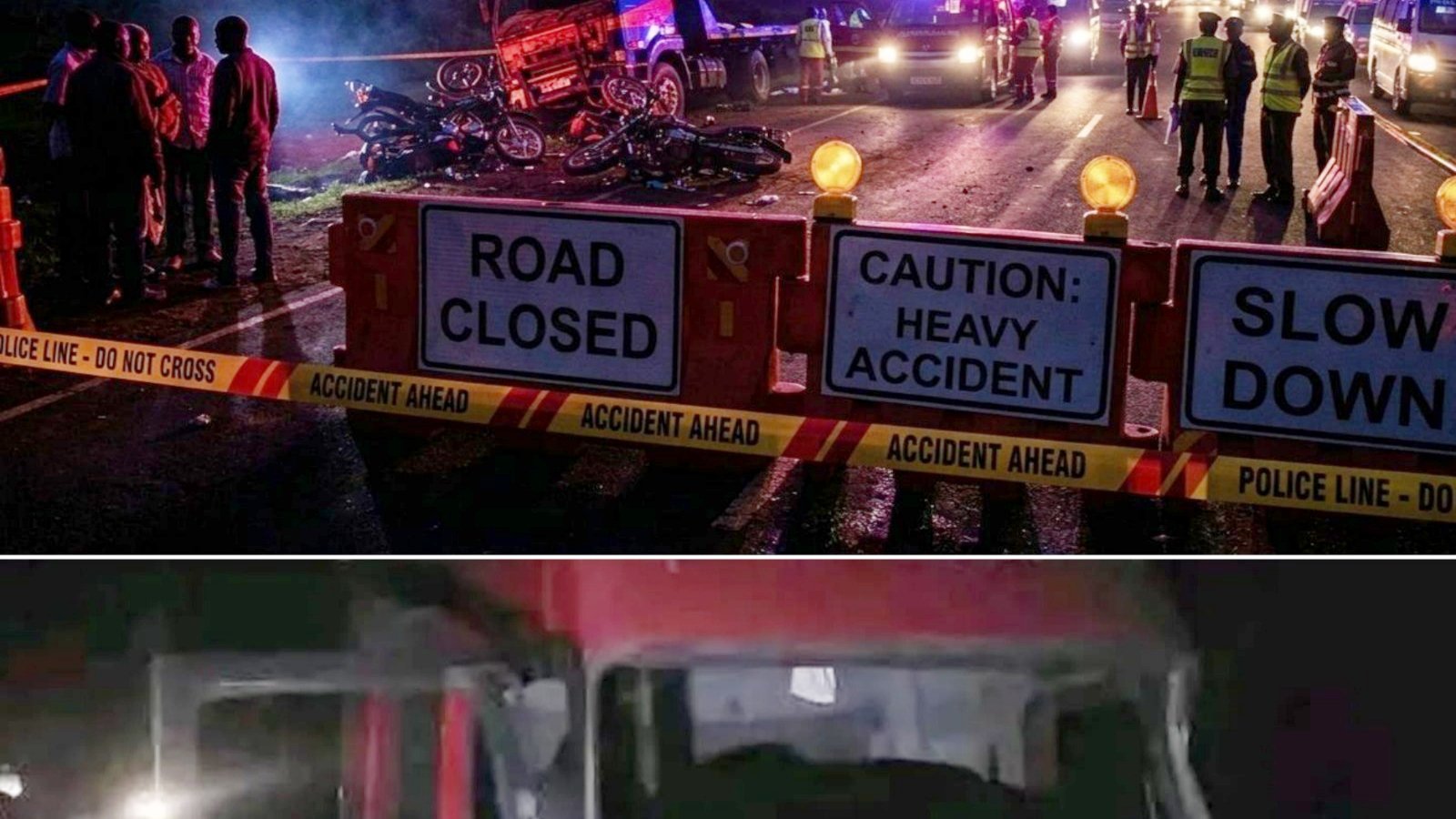

Police in Webuye are piecing together the sequence of events that led to one of the deadliest road accidents in recent months on the busy Webuye-Kitale highway. The crash, which unfolded around 8 p.m. at Malaha trading centre just two kilometers from Webuye town, claimed 14 lives and left 16 others seriously hurt. Eyewitness accounts and initial reports point to a chain reaction starting with two motorcycles slamming into each other head-on.
The riders of both bikes died instantly in the impact, drawing a crowd of villagers who rushed to the scene out of curiosity. Moments later, a transit trailer descending a hilly section of the road lost control and barreled into the gathering, striking additional motorcycles, passenger vehicles, and bystanders. Ten people, including the two motorcyclists, perished right there amid the wreckage. Four more succumbed to their injuries while being transported to Webuye Sub-County Hospital.
Webuye police boss Rosemary Odeke, speaking to reporters, described the chaos: "Two motorcycles, which were heading in different directions, collided head-on resulting in the death of the two riders. The accident attracted curious villagers who rushed to the scene. They were however crashed after a trailer driver reportedly lost control of his vehicle while descending a section of the highway." She added that the driver of the trailer fled immediately after the incident, and efforts to locate him are underway.
The injured, many with fractures and deep lacerations, remain under care at the hospital. Medical staff there worked through the night to stabilize patients, some of whom required emergency surgeries. Bodies of the deceased were moved to the facility's mortuary for identification and post-mortems, a process that has already begun as families arrive to claim their loved ones.
This stretch of the Webuye-Kitale highway, part of the larger A1 road linking Eldoret to the Ugandan border through Malaba, handles heavy traffic from trucks hauling goods across western Kenya. It's a vital artery for trade, connecting agricultural hubs in Bungoma and Trans Nzoia counties to markets in Nairobi and beyond. Farmers in the region rely on it to transport maize, sugarcane, and other produce, while commuters use it daily for work and school.
The road itself has a history of upgrades aimed at improving connectivity. Back in the early 2010s, the Kenya National Highways Authority, with funding from the World Bank under the Kenya Transport Sector Support Project, rehabilitated the 60-kilometer Webuye-Kitale section as part of a broader 150-kilometer corridor from Kisumu through Kakamega. That effort widened lanes, added shoulders, and installed climbing lanes on hilly parts to handle the terrain better. The project wrapped up around 2014, cutting travel times and vehicle operating costs significantly for heavy trucks that once struggled with the old, potholed surface.
Yet accidents like this one underscore persistent challenges. The highway's gradients, combined with high speeds from long-haul drivers, have contributed to similar incidents in the past. In 2022, a multi-vehicle pileup near the same area injured over a dozen people when a lorry overturned. Nationwide, Kenya's roads see thousands of fatalities each year, with the National Transport and Safety Authority reporting over 4,000 deaths in 2025 alone, many tied to speeding, poor vehicle maintenance, and roadside hazards.
Local residents have long voiced concerns about safety at Malaha trading centre, where informal markets spill onto the road shoulders during evenings. Pedestrians and cyclists mix with fast-moving traffic, and without dedicated footpaths or barriers, minor mishaps can escalate quickly. The authority has installed some signage and rumble strips in recent years, but enforcement remains spotty, especially at night when visibility drops.
In the wake of Monday's tragedy, officials towed the mangled trailer to the Webuye weighbridge for inspection. Investigators are examining whether mechanical failure, such as brake issues, played a role, or if driver fatigue was a factor. The police have appealed for witnesses to come forward with any dashcam footage or details that could help track the escaped driver.
This incident comes amid a government push to revive stalled road projects across the country. Last year, the administration announced plans to resume over 580 delayed infrastructure works, including enhancements in western Kenya. The Nyanza and Western regions stand to benefit from upgrades to the 180-kilometer Busia-Siaya-Kisumu route, which intersects with the A1 network. Such investments aim to boost economic links, but they also highlight the need for parallel safety measures.
For communities along the Webuye-Kitale corridor, the crash is a stark reminder of the human cost when things go wrong on these essential routes. As inquiries continue, questions linger about how to prevent crowds from forming at accident sites and ensure quicker emergency responses in rural areas. Hospital records show that delays in getting the injured to care may have worsened outcomes for some victims.
The highway, while improved over the decade, still demands vigilance from all users. Trucks like the one involved often carry loads from ports in Mombasa to inland depots, pressing drivers to meet tight schedules. Regulatory checks at weighbridges help, but overloading remains a common violation that can lead to loss of control on descents.
As Kenya expands its infrastructure footprint, with projects like the Leseru-Kitale-Morpus-Lokichar road underway to link with South Sudan, lessons from events like this could shape future designs. Better drainage, wider medians, and technology for real-time monitoring might reduce risks, drawing from global best practices in highway engineering.
Families of the deceased now face the grim task of burials, while the injured recover. The community at Malaha has started informal collections to support those affected, a common response in such tight-knit areas. Police have increased patrols in the interim, but long-term fixes will require coordinated action from transport authorities.
Praying that more victims do not succumb. May the souls of the comrades lost rest in peace.
Comments (0)
Leave a Comment
No comments yet. Be the first to share your thoughts!