
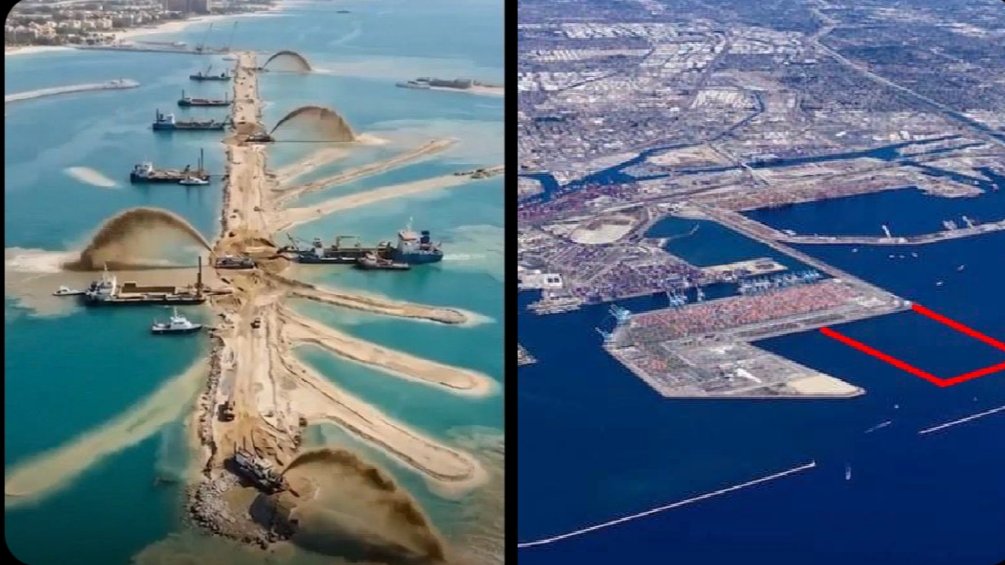

Human activity is expanding the Earth’s landmass each year. Since the 1990s the United Arab Emirates alone has created about 50 square miles of new land and 200 miles of new coastline. Globally, new land is being formed faster than rising sea levels reclaim existing shores.
The scale is striking. Humanity creates new land from the sea at a rate equivalent to two Manhattans every year. The majority of this work is concentrated in China, Singapore and the UAE. Over 70 percent of the new land is linked to port developments.
These reclaimed areas rank among the most economically productive on the planet. Deepwater quays equipped with power and transport infrastructure act as epicentres of GDP. A large share of national economies focuses on these facilities before goods and activity diffuse into the hinterland.
The Port of Los Angeles, for example, handles $350 billion in trade annually. It is currently developing Pier 500, also known as Terminal Island, a 200-acre container laydown area. Similar projects elsewhere demonstrate the technical feasibility and commercial value of seaward expansion.
Land reclamation technology is well established. Once plans, environmental assessments and financing are in place, the engineering is relatively straightforward. Dredging, filling, stabilisation and construction of quays follow known methods refined over decades.
The practice offers clear advantages for countries with limited coastal real estate. Singapore and the Maldives have invested heavily in reclamation to expand capacity for trade and tourism. These nations treat the activity as a rational response to physical constraints rather than a risky gamble.
Critics sometimes frame land creation solely through the lens of environmental risk or sea level rise. The data presented here suggest a more nuanced picture. Net land gain is occurring, and the new territory is often put to intensive economic use.
Port-led reclamation carries particular strategic weight. Modern container terminals require large, flat, well-connected sites close to deep water. Reclaiming land allows cities to expand capacity without consuming scarce inland space. The resulting facilities support regional and global supply chains.
Kenya and other East African nations have also explored reclamation options around major ports. Lamu and Mombasa have seen proposals and limited works aimed at increasing berth capacity and logistics space. The global track record shows that carefully planned projects can deliver high returns.
Opportunities remain substantial. Locations with growing trade volumes and constrained coastal land could benefit from systematic reclamation programmes. The technology exists, the economic case is strong, and the volume of activity already underway demonstrates both demand and capability.
The discussion challenges the assumption that land is only being lost. In several of the world’s busiest maritime hubs, the opposite is true. New land is being made, and much of it underpins the flow of goods that sustains modern economies.
Comments (0)
Leave a Comment
No comments yet. Be the first to share your thoughts!