
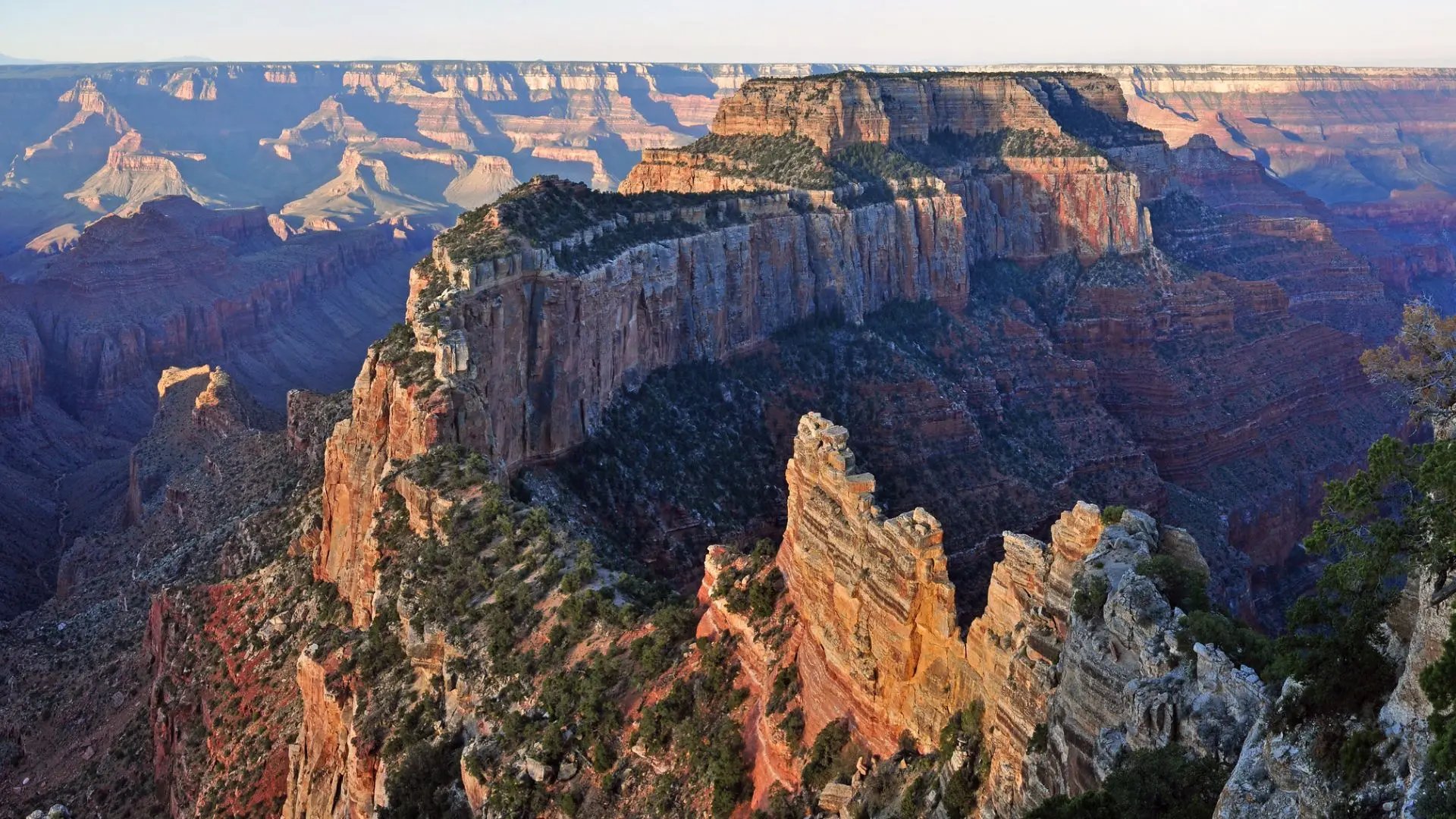

Researchers at the University of Southampton have proposed that an ancient escarpment could explain the mysterious billion-year gap in the rock record of the Grand Canyon.
Known as the Great Unconformity, the geological boundary marks a point where ancient crystalline basement rocks lie directly beneath much younger sediment layers, leaving over one billion years of history unaccounted for.
The study suggests that a colossal cliff structure, named the Great Escarpment of Laurentia, developed around 800 million years ago during the breakup of the supercontinent Rodinia.
Towering roughly one kilometer high, this rift-edge feature stretched thousands of kilometers across ancient North America, spanning regions that now form states from Arizona to Illinois.
According to the team, progressive erosion caused this massive wall of rock to gradually retreat inland over tens of millions of years.
This process stripped away up to eight kilometers of surface rock in certain areas, exposing the deeply buried basement rocks long before the Colorado River began carving the modern landscape.
The researchers utilized landscape evolution modeling to analyze how tectonic uplift associated with continental rifting created the steep slopes necessary to drive such extensive erosion.
They noted that the positioning of the Grand Canyon relative to the ancient rift edge mirrors modern active escarpment landscapes observed today in regions across South Africa and Brazil.
This long-lived landscape feature provides a key mechanism for understanding why erosion patterns across the southwestern United States vary so significantly.
The findings, published in the journal Geology, offer a unified perspective on how continental breakup shapes regional geology over vast spans of Earth history.
Comments (0)
Leave a Comment
No comments yet. Be the first to share your thoughts!