
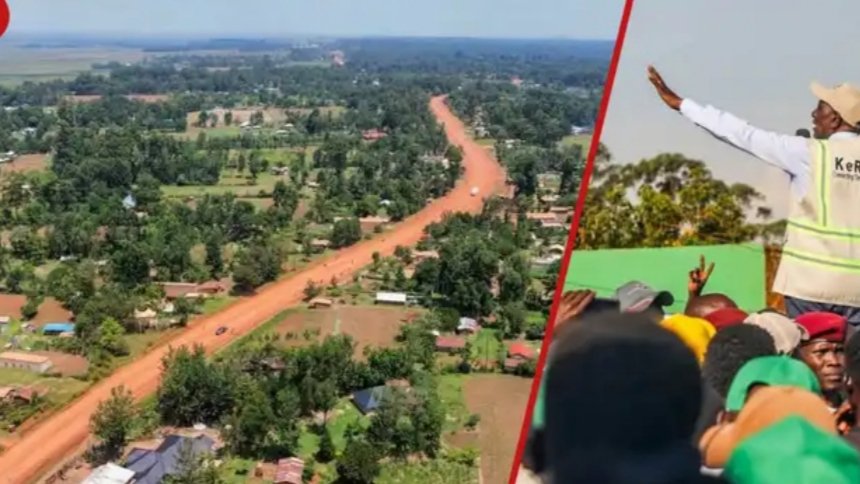

Mandera County has no paved rural roads whatsoever, according to the Economic Survey 2026. The county sits at the bottom of a national ranking that highlights sharp differences in road infrastructure across Kenya.
The survey found that Kenya’s total Class C rural road network grew from 18,321 kilometres in 2024 to 28,150 kilometres in 2025. Much of the increase came from the identification and mapping of previously unrecorded roads.
Unpaved roads rose from 13,467 kilometres to 22,987 kilometres. Paved roads increased only marginally, from 4,854 kilometres to 5,163 kilometres. That left just 18.3 percent of the rural network tarmacked.
Class C roads are national trunk roads that connect regionally important centres to each other or to higher-class A and B roads. They are managed by national authorities such as the Kenya Rural Roads Authority.
Mandera’s entire 721.4-kilometre rural road network remains unpaved. It is the only county with zero kilometres of tarmac rural roads.
Turkana follows with just 0.7 kilometres of paved roads out of a total network of 1,019.4 kilometres, a paved coverage of 0.07 percent. Marsabit and Wajir each record 4.5 kilometres of paved roads.
Marsabit’s total network stands at 1,083.9 kilometres. Wajir’s reaches 1,178.6 kilometres. Both counties show paved coverage of 0.4 percent.
Kajiado County ranks in the bottom five despite its proximity to Nairobi. It has only 2.1 kilometres of paved rural roads out of 762.8 kilometres total, a coverage of 0.3 percent.
Lamu has 10.9 kilometres of paved roads out of 201.4 kilometres. Tana River records 13.9 kilometres paved out of 471.0 kilometres. Garissa has 16.2 kilometres paved out of 1,119.0 kilometres.
Taita Taveta shows 18.2 kilometres paved out of 663.5 kilometres. Kwale has the highest share among the bottom ten at 139.2 kilometres paved out of 809.8 kilometres, or 17.2 percent.
Several counties on the list recorded sharp increases in their unpaved road totals in 2025 following the Road Inventory and Condition Surveys. Those surveys mapped previously unrecorded routes.
Marsabit’s unpaved roads surged by 130.9 percent to 1,079.4 kilometres. Garissa’s rose by 89.6 percent to 1,102.8 kilometres. Turkana recorded a 71.4 percent rise to 1,018.7 kilometres.
Wajir registered a 62.4 percent increase to 1,174.1 kilometres. The increases reflect expanded mapping rather than new construction.
At the other end of the spectrum, Murang’a County has the longest paved Class C rural road network in Kenya, with 389.6 kilometres of tarmac. Kiambu follows with 387.6 kilometres.
Nakuru ranks third with 376.4 kilometres of paved roads. The national expansion of the Class C network was driven largely by the 2025 Road Inventory and Condition Surveys.
The government had projected KSh 168.7 billion in road expenditure for the 2025/26 financial year. That figure included KSh 97.7 billion for development and KSh 71 billion for maintenance and repairs.
Northern and eastern counties continue to record paved coverage well below one percent in most cases. The survey data underscores the scale of the remaining gap in rural road standards.
Comments (0)
Leave a Comment
No comments yet. Be the first to share your thoughts!