
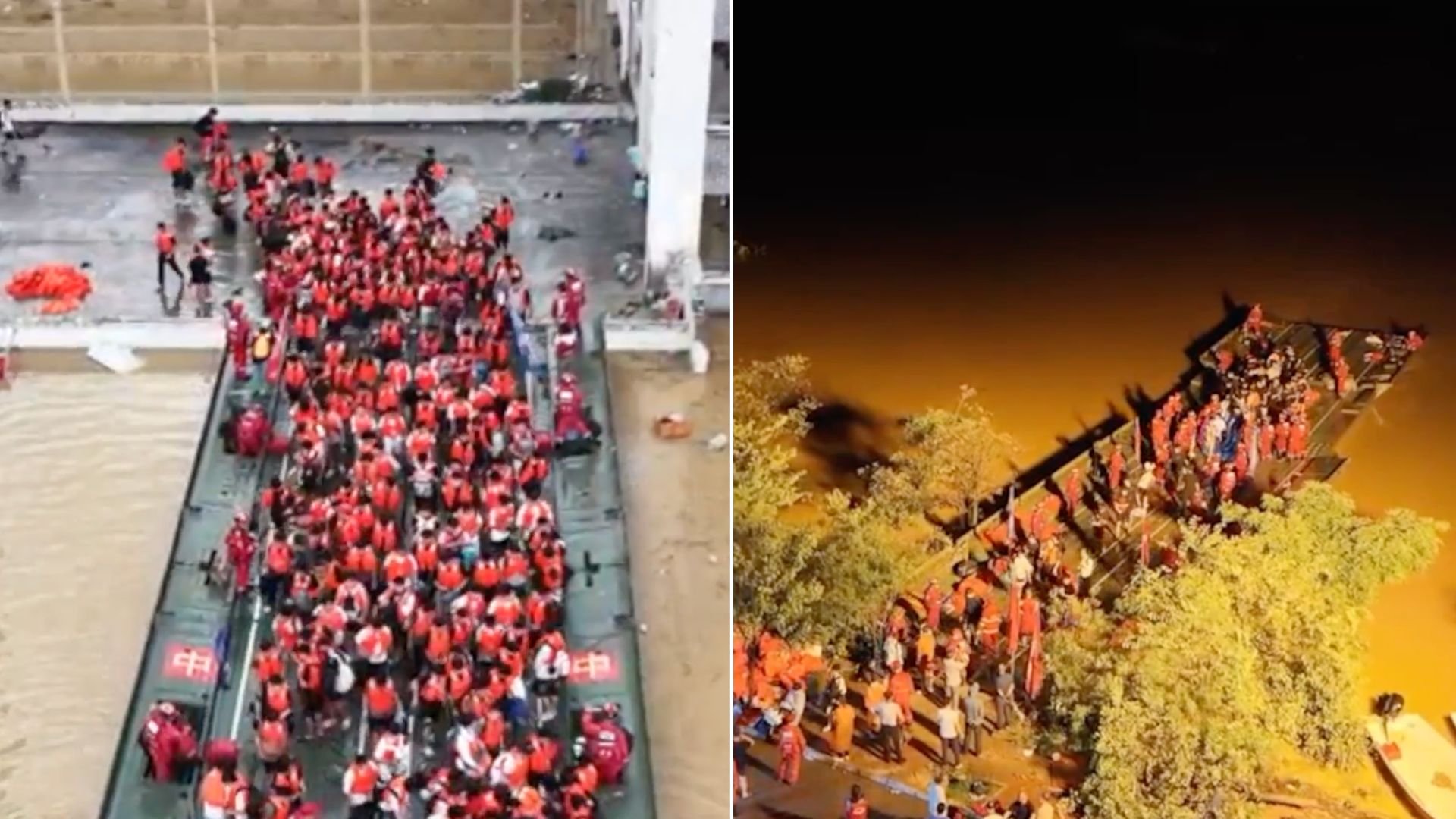

A modular, self-propelled rescue barge has evacuated thousands of stranded people from a severely flooded college campus in southern China. The emergency operation commenced after intense torrential rains triggered by Tropical Storm Maysak submerged the region. Local drainage systems quickly failed under the sudden downpour, causing widespread flash floods.
State emergency engineering agency China Anneng Construction Group (CACG) led the massive logistical operation. Rescuers deployed the specialized heavy-duty floating bridge systems to pull trapped civilians out of the disaster zone. The agency mobilized specialized engineering units to ensure continuous rescue operations throughout the crisis.
Floodwaters at the Guangxi Logistics Vocational and Technical College (GLVTC) rose rapidly, reaching a depth of nearly five meters. The sudden inundation completely cut off the institution from conventional road networks, leaving thousands completely isolated. The ground floors of dormitories were completely submerged within hours.
Over 6,000 students and academic staff members were trapped inside the campus buildings without electricity or clean water. The severe situation required an immediate, large-scale evacuation strategy. Campus administrators coordinated with municipal emergency services to monitor the safety of everyone stuck on upper floors.
Before the specialized modular vessels arrived, rescue teams used standard rubber lifeboats to ferry people to safety. These smaller assault boats could only carry six to seven passengers per trip, proving highly inefficient. The vast number of stranded individuals meant traditional boating methods would take days, prompting officials to deploy industrial engineering equipment.
The slow progress posed serious risks as weather conditions deteriorated. Rescuers needed a much faster way to move the large crowd before overnight downpours worsened the situation.
To address the emergency, engineering crews deployed three specialized powered pontoon platforms directly into the floodwaters. Manufactured by China Hazon Industry (CHI), these heavy-duty systems are designed for extreme environments. The industrial equipment can function reliably in high-altitude zones and extreme cold.
The units feature a highly advanced, foldable modular configuration. This specialized design allows emergency crews to assemble and launch a complete 60-meter platform in just ten minutes. The rapid deployment capability ensures that disaster management teams can respond to structural failures instantly.
The self-propelled platforms function effectively as temporary motorized ferries. Each vessel measures approximately 60 meters in length and eight meters in width, offering a massive 60-ton load capacity. The wide deck allows rapid boarding of massive passenger crowds under difficult conditions.
Driven by integrated propulsion systems, the massive structures can navigate tricky flood currents at speeds of 10.8 kilometers per hour. Their large deck space enables them to carry up to 500 people during a single trip. This represents a massive capacity upgrade over traditional disaster response watercraft.
The emergency operation continued without interruption through torrential downpours and overnight darkness. The massive dynamic floating bridges operated systematically, moving back and forth between the submerged campus and dry ground. Floodlights mounted on the vessels allowed the operators to navigate around submerged debris.
Over a grueling eleven-hour period, the three motorized vessels successfully transported all 6,000 stranded individuals to safety. Witnesses on site cheered as the massive platforms systematically cleared the flooded campus buildings. Evacuated students were immediately transferred to designated emergency shelters equipped with medical supplies.
Comments (0)
Leave a Comment
No comments yet. Be the first to share your thoughts!