
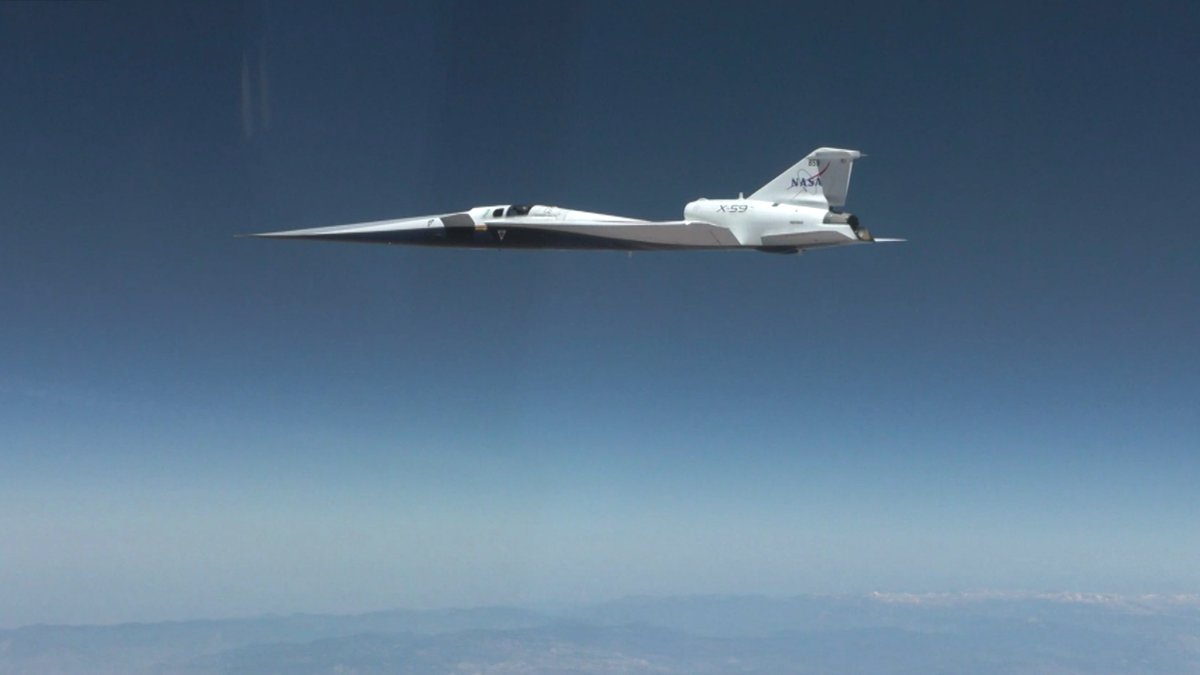

An experimental aircraft designed to eliminate loud sonic booms has successfully traveled faster than the speed of sound.
The X-59 research aircraft completed its first supersonic flight on June 5, 2026, over Edwards Air Force Base in California, according to the National Aeronautics and Space Administration (NASA).
NASA test pilot Jim Less took off at 11:08 a.m. Pacific Daylight Time (PDT) for the 81-minute flight, pushing the aircraft to a top speed of approximately Mach 1.1 at an altitude of 43,400 feet.
The test focused on evaluating flying qualities at both subsonic and supersonic speeds as the engineering teams expand the aircraft's flight boundaries.
The project serves as the centerpiece of the Quiet Supersonic Transport (Quesst) mission, an initiative aiming to establish new data-driven noise standards for commercial aviation.
An F-15 chase plane flew alongside the experimental craft to monitor performance, though loud booms from the accompanying F-15 temporarily obscured the acoustic signature of the new aircraft.
Engineering teams plan to increase speeds to Mach 1.4 and reach an altitude of 55,000 feet in the coming days, which will represent baseline mission conditions.
"The team has made tremendous progress, flying 16 times in the last 90 days and getting into a steady test rhythm," said NASA Administrator Jared Isaacman, noting the plane first flew on October 28, 2025.
Subsequent testing phases will measure how communities perceive the sound profile of the craft, which is engineered to produce a quiet thump rather than a disruptive boom.
The accumulated acoustic data will be delivered to international regulators, potentially opening the door for legal commercial supersonic transport over land surfaces worldwide.
The technology uses a elongated airframe developed alongside Lockheed Martin Skunk Works to prevent shockwaves from coalescing into loud booms.
The agency will validate these design tools through ongoing flight testing to provide private aircraft manufacturers with verified concepts for future quiet supersonic airliners.
Comments (0)
Leave a Comment
No comments yet. Be the first to share your thoughts!