
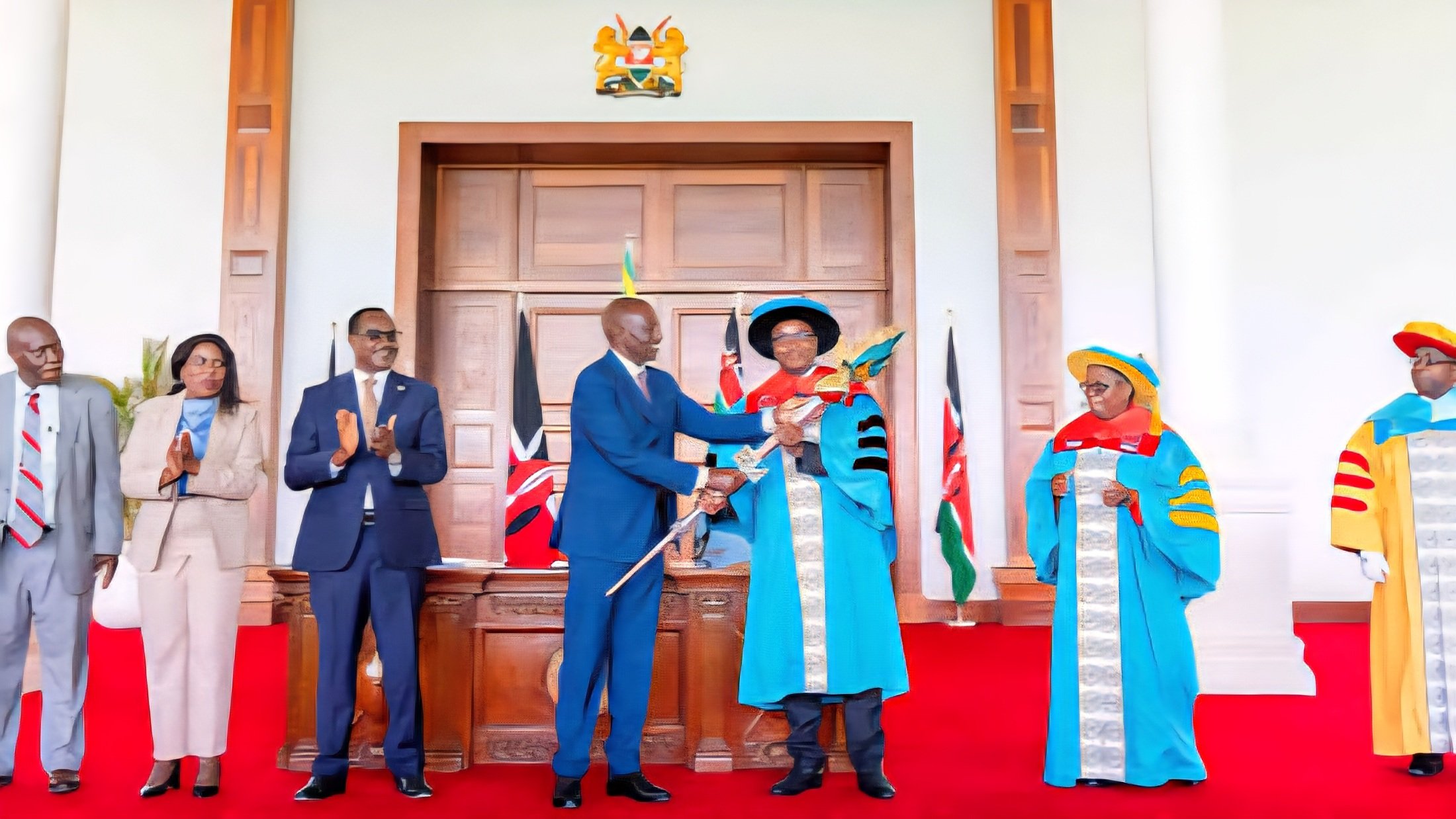

President William Ruto has officially granted university charters to the Kenya Advanced Institute of Science and Technology (KAIST) and the Kenya Medical Research Institute (KEMRI), elevating them to full degree-awarding status.
The executive action, taken during a formal ceremony at State House in Nairobi, transitions the specialized state bodies into postgraduate universities under Section 24(1)(a) of the Universities Act.
Parliament previously approved the status change, designating the centers as institutions of strategic national importance.
Prior to the declaration, the institutions conducted advanced specialized training but relied on external universities to approve and award degrees to their students.
The Commission for University Education (CUE) conducted the final assessment and accreditation process before the executive approval.
KAIST is modeled after the Korea Advanced Institute of Science and Technology (KAIST) of South Korea, and it forms part of the infrastructure framework at Konza Technopolis.
The graduate-only institution focuses on advanced science, technology, engineering, and mathematics (STEM) fields.
Its educational curriculum covers mechanical engineering, electrical and electronics engineering, information and communications technology (ICT), chemical engineering, civil engineering, and agricultural biotechnology.
To support its initial rollout, the technological university plans to provide funded scholarships for its first intake of master's and doctoral students.
The newly chartered KEMRI graduate school will now independently award advanced degrees in biomedical sciences, epidemiology, and public health research.
President Ruto noted that the institution has historically contributed to global research frameworks for malaria, HIV, tuberculosis, and maternal health care.
The institute was also recognized for its recent work in diagnostic development, genomic sequencing, and the clinical evaluation of the malaria vaccine.
Speaking at the Nairobi ceremony, President Ruto stated that the charters form part of a structural plan to expand specialized higher learning and build a knowledge-driven local economy.
According to the president, the two institutions will function as specific pillars to support health care management and industrial production.
One facility is designated to manage medical research and disease response, while the other is structured to provide high-level engineering skills for upcoming infrastructure projects.
Comments (0)
Leave a Comment
No comments yet. Be the first to share your thoughts!