
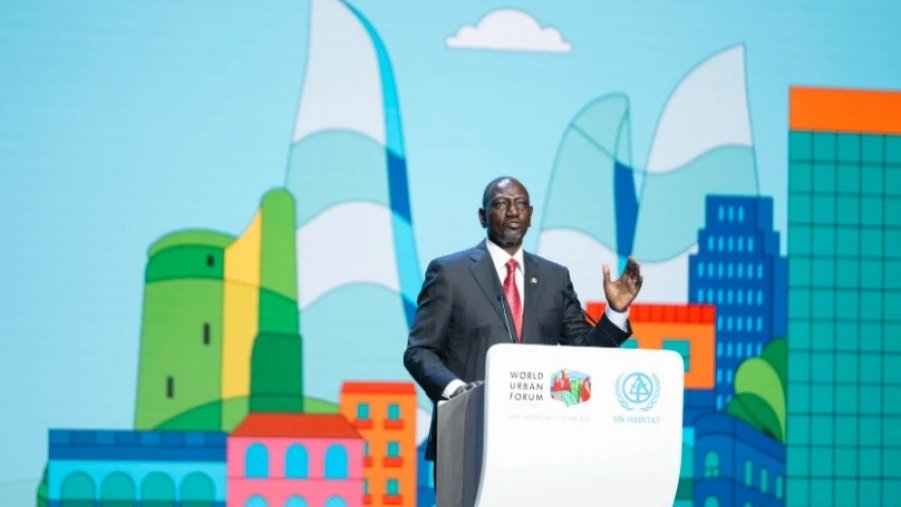

African cities are expanding at a pace that outstrips current infrastructure investment. President William Ruto stated that the provision of adequate, affordable housing is being actively undermined by structural inequalities in the international financial system.
Speaking via the Presidential Communication Service (PCS), the President highlighted that African nations face disproportionate constraints when accessing development capital.
Many African countries pay up to five times more for credit than developed nations. This happens despite the continent possessing vast natural resources and clear economic potential. The financial disparity directly impacts urban planning and construction. Affordable housing initiatives require reliable, low-interest capital to remain viable for low-income earners.
The scale of the crisis is substantial. Globally, nearly three billion people face inadequate housing conditions. More than one billion individuals live in slums or informal settlements, while 300 million people are completely homeless.
The situation is expected to intensify across the continent. By 2050, Africa will hold 25 per cent of the world's population. Crucially, 70 per cent of those people will reside in urban centres.
Without an overhaul of how multilateral financing is distributed, municipal authorities will struggle to manage this rapid transition. Kenya is attempting to counteract these pressures through direct state intervention. The country currently handles 1,100 informal settlements, which house approximately seven million residents.
This specific demographic pressure forced the government to establish affordable housing as a primary pillar of its national transformation strategy. According to official figures, the state housing fund has signed agreements for projects valued at $5 billion, which translates to roughly KSh650 billion.
These funds cover both completed and ongoing construction projects executed over the past 35 months. The domestic injection of capital has kept local construction firms active and supported manufacturing sectors, including steel and cement production.
President Ruto noted that this aggressive rollout has given Kenya the largest single housing programme currently running across Africa. However, local resource mobilisation cannot completely replace systemic global changes.
The President coupled his economic critique with a political demand, calling for reforms within the United Nations Security Council (UNSC). He noted that it is structurally unfair for 1.5 billion people spread across 54 African nations to lack permanent representation on the council.
Geopolitical exclusion mirrors financial exclusion, as both systems limit how African nations manage their internal developmental challenges. Without access to fair concessional financing, building sustainable cities will remain an uphill battle for developing states.
Comments (0)
Leave a Comment
No comments yet. Be the first to share your thoughts!