
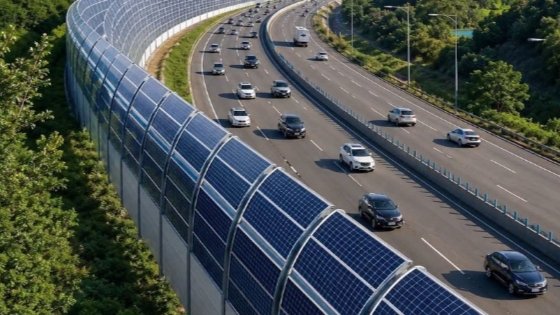

In South Korea, some highway noise barriers now carry solar photovoltaic panels. The installations generate electricity while still blocking traffic sound for communities living nearby.
The approach uses existing roadside structures rather than new land. Electricity from the panels can supply streetlights, traffic signals, electronic signs, CCTV systems and other roadside equipment. Surplus power can feed the grid.
One example is a 479-metre solar sound barrier on Seoul’s Dongbu Expressway. It carries more than 3,300 solar panels and produces about 830,000 kWh of electricity a year. That output is enough for hundreds of households and reduces carbon emissions by an estimated 147 tons annually.
South Korea has also fitted solar panels over bicycle paths. The covered routes generate power while offering cyclists shelter and a safer surface. These dual-use paths form part of a wider effort to extract more value from linear transport corridors.
The projects treat infrastructure as multi-purpose. Noise barriers become both acoustic shields and renewable energy assets. Roads and paths produce electricity without competing for extra space in dense urban areas.
Designers and planners increasingly ask what additional functions a structure can deliver over its lifetime. The South Korean examples show one practical answer: combine noise control with clean power generation on the same footprint.
Maintenance, ownership and grid connection still require clear rules. Technical standards for safe installation, wind loading, glare control and performance monitoring are being developed so the dual-purpose barriers remain reliable over decades.
Similar ideas have appeared in other countries, yet the scale of deployment along South Korean expressways stands out. The Dongbu Expressway project remains a frequently cited reference for integrating solar modules into linear transport infrastructure.
The electricity is used locally where possible. This reduces transmission losses and supports the day-to-day operation of the highway network itself. In some cases the power supplies nearby facilities such as recycling centres.
Visuals accompanying the original post show panels mounted on both faces of the barriers in places. Engineering details such as orientation, bifacial capability and structural reinforcement determine how effective each installation proves in practice.
South Korea continues to expand the concept. New standards from the Korea Expressway Corporation aim to make solar-equipped barriers a routine option for future road projects and upgrades of existing walls.
The result is infrastructure that performs two jobs at once. Noise protection continues without interruption. Clean electricity is added without the need for separate solar farms or additional land acquisition in crowded cities.
Officials and industry observers note that the model could spread further if technical and regulatory hurdles are cleared. The combination of proven noise reduction and measurable energy output makes the barriers an attractive option for urban planners balancing multiple demands on limited space.
Comments (0)
Leave a Comment
No comments yet. Be the first to share your thoughts!