
The skyline of Nairobi’s central business district has seen significant transformation over the last quarter-century, yet for a specific group of citizens, the clock remains fixed on a Friday morning in August 1998. Twenty-eight years after the terrorist attack on the United States Embassy, victims and their families are still seeking financial restitution for a tragedy that reshaped the city's architectural and social fabric.
On August 7, 1998, a truck bomb exploded outside the former US Embassy building located at the junction of Haile Selassie Avenue and Moi Avenue. The blast was so powerful that it completely leveled the neighboring Ufundi Cooperative House, a five-story office building. It also caused extensive structural damage to the Cooperative Bank House, a landmark 25-story skyscraper known locally as the "Bell Bottom" building due to its unique flared base. The secondary damage to surrounding structures left thousands injured and resulted in 213 deaths in Nairobi alone.
Since that day, the site where the embassy once stood has been transformed into the August 7th Memorial Park. It serves as a landscaped green space amid the dense concrete of the CBD, featuring a memorial wall engraved with the names of the deceased. While the physical site has been rehabilitated into a place of reflection, the legal and financial aftermath for the survivors remains a complex and ongoing struggle.
Recent reports highlight the persistent efforts of the victims to secure compensation through various legal channels. Many survivors have spent decades writing letters to both the Kenyan and the United States governments, citing the long-term medical costs and loss of livelihoods resulting from the blast. The core of their argument rests on the fact that while the US government has provided some assistance and settled claims with certain groups, many Kenyan victims feel they have been left out of large-scale settlement funds.
The construction and real estate implications of the 1998 blast were profound. At the time, it was the most significant structural failure caused by a man-made event in Kenya’s history. The rebuilding process for the affected area took years. The Cooperative Bank House underwent a massive renovation to restore its glass facade and structural integrity, eventually reopening as a symbol of the city's resilience. Meanwhile, the US Embassy was relocated to a highly fortified, purpose-built compound in Gigiri, a move that shifted the diplomatic hub of the city northward and set new standards for embassy construction worldwide.
Despite the modernization of the surrounding streets and the rise of new office towers in the vicinity, the survivors maintain that justice is a missing piece of the city's recovery. Their plight involves navigating international law and diplomatic negotiations, often facing hurdles regarding which entities are held liable for the damages.
In the years following the attack, legal proceedings in US courts targeted the assets of state sponsors of terrorism. While some funds have been allocated to victims of various attacks, the distribution remains a point of contention. The Nairobi survivors argue that the severity of their injuries and the permanent impact on their lives warrant a more comprehensive and inclusive compensation package.
As Nairobi continues to expand its infrastructure with new rail links and high-rise developments, the vacant space where Ufundi House once stood and the Memorial Park next to it remain as reminders of the 1998 events. For the aging survivors, the goal is to see their claims settled before another decade passes. They continue to advocate for a resolution that recognizes their suffering and provides the financial stability that was stripped away when the buildings around them collapsed.
The Long Shadow of August 7 Over Nairobi's Urban Landscape
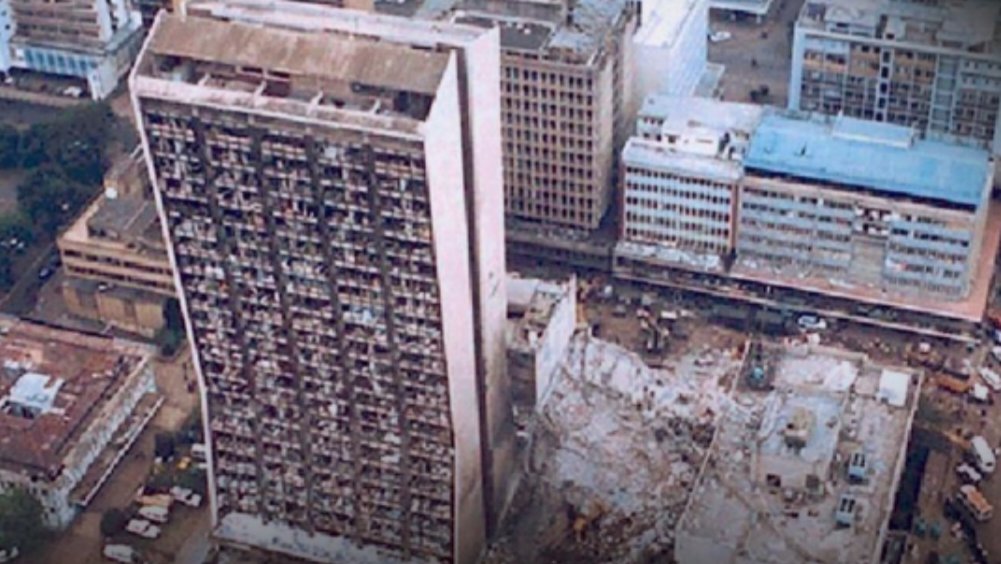
The aftermath of the August 7, 1998, bombing in Nairobi showing the structural damage to the Cooperative Bank House and the leveled site of the Ufundi Cooperative House.
|
Daily Nation

Survivors of the 1998 US Embassy bombing continue their decades-long push for compensation as the site remains a stark reminder of the blast's impact on Nairobi's central business district.
Comments (0)
Leave a Comment
No comments yet. Be the first to share your thoughts!