
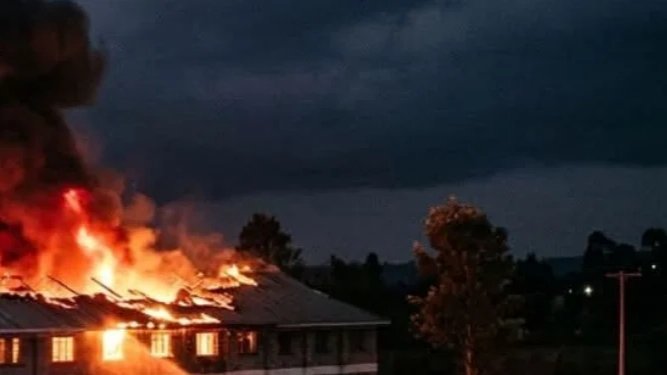

Fresh panic spread across Kenya’s education sector this weekend as two more school dormitories caught fire, reigniting concerns over the safety of boarding facilities following last week’s deadly tragedy in Nakuru County.
The latest incident occurred late Saturday night at St. Joseph’s Seminary Senior School in Molo, Nakuru County. Flames engulfed part of a Form Two dormitory block sometime between 1am and 5am. Emergency responders from the county fire service arrived and contained the blaze before it could spread to other structures.
School authorities confirmed all students were evacuated safely. No injuries or fatalities were reported. Videos from the scene showed thick smoke and flames rising from the affected wing of the boys’ boarding school.
The extent of the damage to the dormitory building remains unclear. Property losses, including students’ belongings, are expected to run into millions of shillings. Police and fire officials have launched an investigation into the cause.
Hours earlier, another dormitory fire broke out at St. Paul Githakwa Secondary School in Tetu, Nyeri County. The girls’ dormitory was affected around 2am. Quick action by teachers and staff, alerted by a student, helped limit the spread. About 20 beds were destroyed in a block housing 43 students.
The school principal, Margaret Wambugu, described a swift response that prevented worse outcomes. Four students have been taken into custody as authorities probe possible arson linked to planned strike action.
These events follow the tragic fire at Utumishi Girls Academy in Gilgil, Nakuru County, on May 28, where 16 students lost their lives. That dormitory was reportedly locked from outside, complicating escape efforts. The contrast in outcomes this weekend highlights how rapid response can make a difference, but also underscores persistent vulnerabilities.
From a construction perspective, the cluster of incidents draws attention to fire safety provisions in Kenyan school infrastructure. Many older boarding facilities were built decades ago with limited consideration for modern fire compartmentalisation, escape routes, or use of fire-resistant materials. Dormitory designs often feature long corridors and high-occupancy sleeping areas that can accelerate smoke and flame spread if not properly mitigated.
Current Kenyan building regulations under the National Construction Authority and fire safety codes require adequate exits, fire alarms, extinguishers, and non-combustible elements in institutional buildings. However, enforcement varies, particularly in schools facing budget constraints. Recent fires have exposed gaps in retrofitting older structures with sprinklers, smoke detectors, and proper electrical wiring standards.
The Molo seminary, a Catholic boys’ school, and the Nyeri institution now join a growing list of schools dealing with fire damage this term, including previous cases at Miranda Boys, Nguumo Boys, and Magereza Academy. While causes differ, the pattern suggests systemic issues around maintenance and risk assessment of sleeping quarters.
Education stakeholders have called for urgent audits of boarding infrastructure nationwide. Questions linger about whether many dormitories meet basic fire safety engineering standards, especially in high-density rural and peri-urban settings.
As investigations continue into the weekend’s fires, the focus is likely to shift toward what building improvements could prevent similar close calls. For now, the quick containment at both Molo and Nyeri prevented loss of life, but the damage to physical structures adds to the mounting costs schools face in maintaining safe learning environments.
Kenyan schools have faced recurring fire incidents over recent years, often linked to electrical faults, arson, or inadequate safety features in aging buildings. Construction professionals note that many facilities predate stricter modern codes, leaving gaps in passive fire protection such as compartment walls and emergency lighting.
Comments (0)
Leave a Comment
No comments yet. Be the first to share your thoughts!