
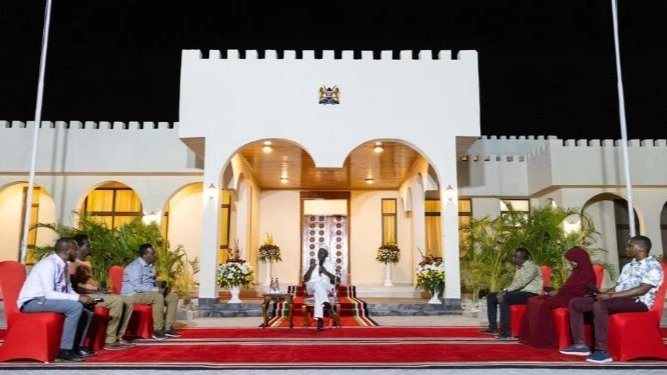

President William Ruto has outlined the reasons behind his decision to greenlight a health facility at Laikipia Air Base in Nanyuki. The centre, intended as an Ebola quarantine site, stems from a direct request linked to former US President Donald Trump and fits within Kenya's broader cooperation with the United States on public health matters.
Ruto addressed the issue during a media roundtable at Wajir State Lodge on June 1. He described the approval as straightforward, rooted in long-term bilateral ties that span 30 to 40 years of joint work in health and security.
"When President Trump asked the government of Kenya to support them by having a centre at Laikipia Air Base, I gave the okay because it was an agreement and a partnership with friends who have worked with Kenya for 30 or 40 years," Ruto stated.
The facility forms part of national efforts in disease surveillance and emergency response. Similar setups already operate at multiple sites, including Kenyatta National Hospital, Moi Teaching and Referral Hospital in Eldoret, the Police Hospital in Nairobi, and centres in Thika and Busia. Ruto emphasised that the Laikipia installation mirrors these existing ones rather than representing a new departure.
US support to Kenya has included HIV/AIDS programmes, outbreak preparedness, and collaborative research during the COVID-19 period. Kenyan institutions took part in vaccine studies, highlighting the depth of technical exchange.
From a construction viewpoint, repurposing or expanding facilities at an established air base like Laikipia raises practical questions about infrastructure adaptation. Military airbases in Kenya typically feature robust runways, perimeter security, and logistical support structures built to handle heavy equipment and rapid deployment needs. Adding a medical quarantine wing would require modifications such as isolated wards, decontamination zones, and controlled access points to meet biosafety standards.
These upgrades often involve specialised partitioning, HVAC systems with negative pressure for infection control, and waste management infrastructure. Such work aligns with international health regulations for handling high-consequence pathogens like Ebola, where containment takes precedence over standard hospital design.
Local protests erupted on June 1 as residents blocked roads leading to the site, voicing safety worries over the planned 50-bed quarantine unit. Security forces used tear gas to disperse crowds. The development also faces legal pushback after a High Court order on May 29 temporarily suspended the project due to claims of inadequate public consultation.
A follow-up court hearing is listed for June 2. Reports suggest US aircraft have already landed at the base with associated personnel despite the suspension.
Laikipia Air Base itself sits in a strategically located region of central Kenya. Its existing infrastructure, including hangars, administrative blocks, and support buildings, provides a ready platform for health-related additions. Construction timelines for such quarantine centres can move quickly when leveraging military sites, as they often bypass some civilian planning layers while still needing to satisfy health ministry and WHO-aligned specifications.
Kenya has expanded its health infrastructure network in recent years to manage emerging disease threats, particularly with Ebola risks from the Democratic Republic of Congo. Facilities at airbases offer advantages in terms of isolation and transport links, allowing faster movement of medical supplies or personnel.
Critics, including some local leaders, question the placement and potential risks to nearby communities. Yet Ruto framed the decision as reciprocal, noting America's consistent role in Kenya's health programmes.
For the construction sector, projects like this underscore the intersection of defence infrastructure and civilian health needs. Retrofitting airbase buildings demands contractors experienced in both secure environments and medical-grade standards. Material choices focus on durability, ease of decontamination, and integration with existing power and water systems.
Details on the exact scope of works, contractor involvement, or budget for the Laikipia centre remain limited. The emphasis from government statements rests on continuity of partnership rather than project specifics.
As the court case proceeds, attention may turn to how such hybrid facilities balance national security assets with public health goals. Kenya's experience with rapid infrastructure deployment during past outbreaks suggests the Laikipia site could become operational once legal and community issues are addressed.
The episode highlights ongoing reliance on international collaborations to strengthen Kenya's disease response capabilities, with physical infrastructure forming a key pillar.
Comments (0)
Leave a Comment
No comments yet. Be the first to share your thoughts!