
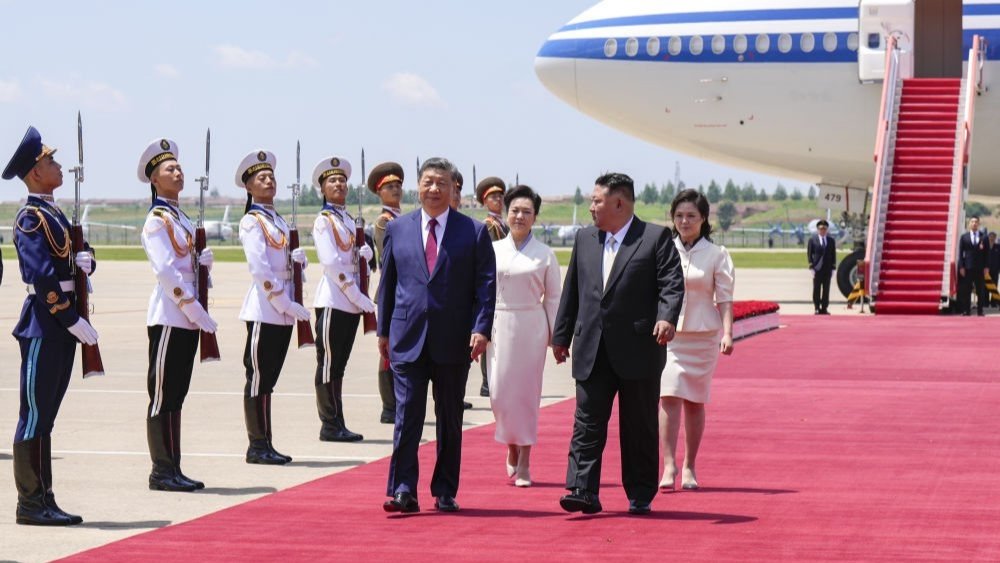

Chinese President Xi Jinping arrived in Pyongyang on Monday for a two-day state visit, greeted with elaborate ceremonies that included a personal welcome from North Korean leader Kim Jong Un and his wife Ri Sol Ju. The summit comes as Beijing seeks to reassert influence over its neighbor amid Pyongyang's growing nuclear capabilities and closer ties with Russia.
Xi and Kim proceeded to Kim Il Sung Square for a formal welcoming event featuring a 21-gun salute and banners highlighting the "unbreakable" friendship between the two countries. State media described the atmosphere as one of high symbolism, with flags lining the streets and crowds turning out for the occasion.
During their discussions, Xi emphasized the need for both nations to collaborate on preserving peace in the region. The message arrives against a backdrop of heightened tensions on the Korean Peninsula and shifting alliances that have seen North Korea deepen military cooperation with Moscow.
North Korea has expanded its nuclear arsenal in recent years while building economic bridges through arms-related activities. This has somewhat reduced Pyongyang's traditional dependence on Chinese support, presenting Beijing with a more emboldened partner.
The visit marks Xi's first trip to North Korea since 2019 and his initial overseas journey of 2026. It follows recent high-level engagements in Beijing with leaders including US President Donald Trump and Russian President Vladimir Putin, underscoring China's central role in Northeast Asian diplomacy.
Observers note the timing coincides with the 65th anniversary of the Sino-North Korean Treaty on Friendship, Cooperation and Mutual Assistance. Both sides are expected to review bilateral relations and address shared concerns over security and economic matters.
Kim has drawn a firm line on his country's nuclear program, viewing it as essential for deterrence. For China, the priority lies in preventing further escalation that could destabilize the region and complicate its own strategic interests.
The summit also touches on broader geopolitical currents, including the impact of conflicts elsewhere, such as developments in the Middle East, on global energy transitions and supply chains. Stability on the Korean Peninsula holds implications for trade routes, investment flows, and infrastructure projects across East Asia.
In Pyongyang, preparations reflected the importance attached to the occasion. Streets displayed dual national flags, and official coverage highlighted the enduring alliance despite evolving dynamics.
Analysts suggest Xi aims to reinforce Beijing's leverage while acknowledging North Korea's increased autonomy gained through its partnership with Russia. This includes reported troop deployments and arms exchanges that have aided North Korea's economy, which posted notable growth in 2024.
For construction and infrastructure sectors, any thaw or sustained tensions carry ripple effects. Regional stability influences funding for major projects, cross-border connectivity initiatives, and investor confidence in related markets. Disruptions on the peninsula have historically affected shipping, energy security, and development timelines in neighboring economies.
The two leaders are scheduled for further meetings on Tuesday, with potential joint statements expected on cooperation areas. Details on specific agreements remain limited as talks continue.
This high-profile engagement highlights the delicate balancing act China performs in managing alliances while promoting its vision of regional order. How the discussions translate into policy will be closely monitored by governments and industry players alike.
This report draws from coverage by Bloomberg.
Comments (0)
Leave a Comment
No comments yet. Be the first to share your thoughts!