
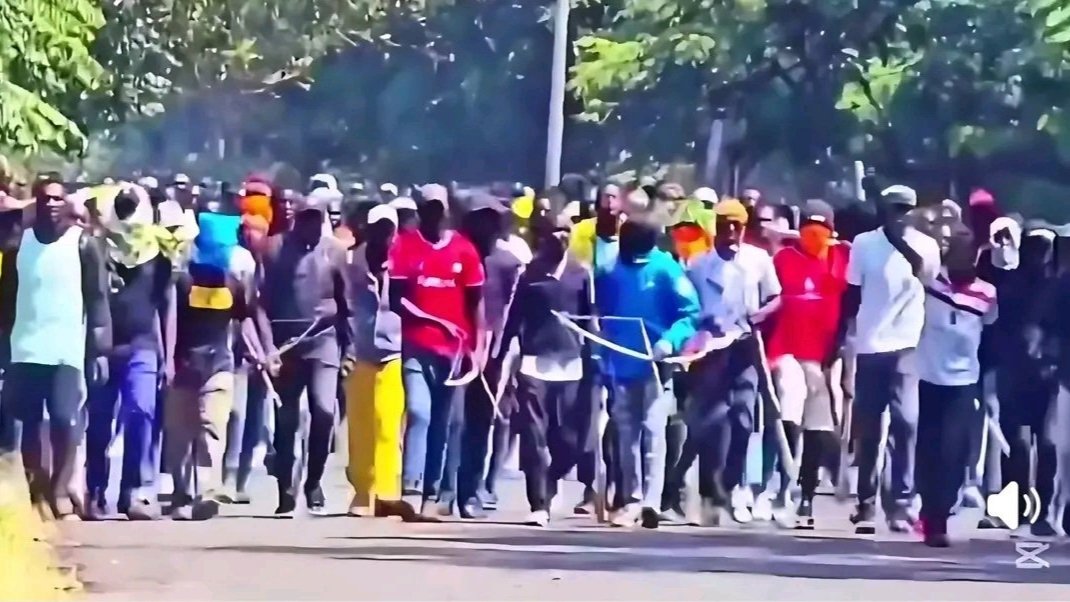

The conversation around "goons" has dominated Kenyan political discourse this week. Ol Kalou by-elections and the early campaigns for the 2027 elections have lit a fire in the political environment.
In Kenyan political usage, a goon typically refers to a hired or mobilised individual, often a young person, deployed by politicians or their allies to intimidate voters, disrupt rival gatherings or cause violence during campaigns and elections.
The issue took a deadly turn on July 12, when suspected goons armed with machetes, rungus and bows and arrows attempted to storm St Stephen's ACK Cathedral in Kisumu, where senior opposition leaders were attending a church service. One person died and several others were injured in the ensuing clashes, and police arrested eight suspects. A separate disruption at a political rally in Nyahururu Town led to six more arrests the same day.
Even members of the clergy, whose churches and congregations have increasingly found themselves caught in the crossfire of political violence, have said the scale of the goon problem has become a serious concern for the country.
Beyond the immediate toll in lives and injuries, the recurring violence carries a broader economic cost. No society can attract investment, create jobs or guarantee prosperity where insecurity and lawlessness prevail, as public confidence in security is essential to any region's economic ambitions.
Independent Electoral and Boundaries Commission (IEBC) Chairperson Erastus Ethekon addressed the matter directly on July 13, telling Kenyans not to dismiss the commission as toothless. "Record these acts of goonism and electoral malpractice and file complaints with us. It is on the basis of such evidence that we will be able to take action," Ethekon said.
Inspector General of Police Douglas Kanja issued a parallel warning a day earlier, telling goons and gangs across the country that they would be dealt with under the law. "I am sounding a warning to goons and gangs across the country that they will be dealt with in accordance with the law and will have no space to operate," Kanja said on July 12.
Interior Cabinet Secretary Kithure Kindiki also weighed in, posting that violence has no place in the political process. "Hapana jameni, violence is a NO," Kindiki wrote on July 12.
Amid the back and forth, one proposal has gained traction among commentators calling for a permanent, structural response rather than case by case arrests. The idea centres on a national goons registry, modelled loosely on a sex offenders list, that would bar identified offenders from government jobs, tenders and any form of public office or service for life.
Under the proposal, individuals confirmed through investigation, including facial recognition evidence gathered from police cameras, would be entered into the register and made permanently ineligible for public sector opportunities.
Supporters of the proposal argue that arrests and prosecutions alone have not been enough to break the cycle of political violence, since many suspects are quickly released or shielded by political and legal connections. They say the government should be open to structural solutions like a registry, which would carry consequences that outlast any single election cycle or court case.
For a facial recognition based approach to work at scale, the underlying technology needs to reliably identify masked individuals, since goons could otherwise cover their faces to avoid detection. This is no longer the limiting factor it once was.
Testing by the United States National Institute of Standards and Technology found that facial recognition algorithms developed after the COVID-19 pandemic cut error rates on masked faces by as much as tenfold compared to earlier software, with the best performing systems now misidentifying masked faces only 2.4 to 5 percent of the time, roughly on par with where unmasked facial recognition stood in 2017.
Any rollout in Kenya would still need to establish which algorithms meet that standard and how the resulting matches would hold up as evidence.
The proposal has also floated a possible ban on face coverings in public as a companion measure to reduce reliance on facial recognition altogether. Proponents acknowledge this would need to account for legitimate use of medical face masks before any such policy could move forward.
The global issue of mass surveillance would also come up, and the state coukd extend it's evidence collection to social media posts. State and public goodwill would be imperative.
Political commentator Morara Kebaso framed the stakes in stark terms on July 12, warning that unchecked goon networks could evolve into something far more organised. "Goons will become gangs. Gangs will become rebel armies controlling regions of Kenya. We should urgently remove politics from national security, or else there will be no place to run," Kebaso said.
Nakuru Senator Nelson Koech took a different tone on July 13, placing responsibility for the phenomenon on the political class itself. "As leaders, we are the ones breeding goons. There is no leader who doesn't have goons. All of us," Koech said.
Kisumu County governor Prof. Anyang Nyong'o has continued to advise candidates and ground mobilizers against the goon culture.
The IEBC has previously said it will not hesitate to disqualify candidates found culpable of sponsoring violence ahead of 2027, pointing to unrest recorded during recent by-elections in Mbeere North, Malava and Kasipul as evidence of a pattern the commission wants to break before the next general election.
Can they do it?
Comments (0)
Leave a Comment
No comments yet. Be the first to share your thoughts!