
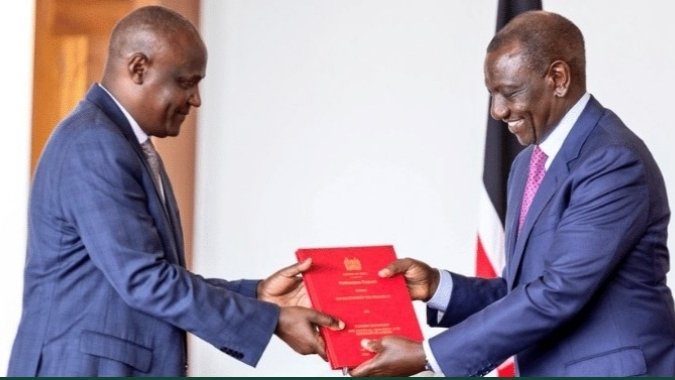

Treasury’s record spending plan comes as government prioritises development projects, pending bills and new financing mechanisms.
Article Content
Kenya’s proposed 2027/28 national budget has crossed the KSh5 trillion mark for the first time, with Treasury projecting total expenditure of about KSh5.3 trillion for the financial year.
The Draft 2026 Budget Review and Outlook Paper places total expenditure and net lending at KSh5.323 trillion, compared with the KSh4.746 trillion approved budget for the current 2026/27 financial year.
The size of the proposed budget comes as government prepares its next medium-term spending framework, with the construction industry among the sectors watching how development priorities and financing plans eventually translate into projects.
Treasury has projected development expenditure at KSh958 billion, compared with KSh3.887 trillion in recurrent expenditure. The proposed figures will be refined through the budget-making process before final allocations are approved.
For contractors and other players in construction, one of the most closely watched issues will be how development resources are distributed across ongoing and planned government programmes.
Treasury has directed ministries, departments and agencies to prioritise completion of ongoing projects, stalled projects and payment of verified pending bills when preparing their 2027/28 programmes.
That could have a direct bearing on contractors already engaged on public projects, particularly where works have continued while certified payments remain outstanding.
The proposed framework also comes as Kenya develops alternative mechanisms for financing major projects. The National Infrastructure Fund is among the initiatives being pursued to mobilise additional capital for infrastructure development.
Another proposed mechanism is the Sovereign Wealth Fund, which forms part of wider government efforts around long-term public investment and management of state resources.
For the construction industry, the significance of these mechanisms lies in their potential role alongside conventional budget allocations and project financing arrangements.
The government is also pursuing affordable housing as part of its development agenda. Affordable housing projects require construction activity across housing estates, supporting infrastructure and related facilities, making the sector an important component of public development spending.
Treasury has further identified building materials among nine priority value chains that government spending is expected to support. The list also includes leather, cotton, dairy, edible oils, tea, rice, the blue economy and natural resources.
The focus on building materials is relevant to construction companies, manufacturers and suppliers, particularly as public housing and infrastructure programmes continue to generate demand for locally produced construction inputs.
The proposed budget also includes a projected fiscal deficit of KSh1.321 trillion, equivalent to 5.7 percent of gross domestic product.
Treasury expects to finance the deficit through KSh1.085 trillion in net domestic financing and KSh235.9 billion in net external financing.
The scale of the financing requirement will be closely watched as government balances development spending with other obligations within the national budget.
For construction companies, the final allocations will matter more than the headline figure. They will determine which projects receive funding, which stalled works can resume and how much money is available for new development programmes.
Payment of verified pending bills will also remain important for contractors and suppliers that have already delivered work to government agencies.
The budget process is not yet complete. Treasury has invited public comments on the Draft 2026 Budget Review and Outlook Paper before the figures proceed through the subsequent stages of budget preparation.
The final 2027/28 allocations will therefore provide a clearer picture of the construction pipeline, including public works, affordable housing and projects supported through alternative financing arrangements such as the National Infrastructure Fund.
Comments (0)
Leave a Comment
No comments yet. Be the first to share your thoughts!