
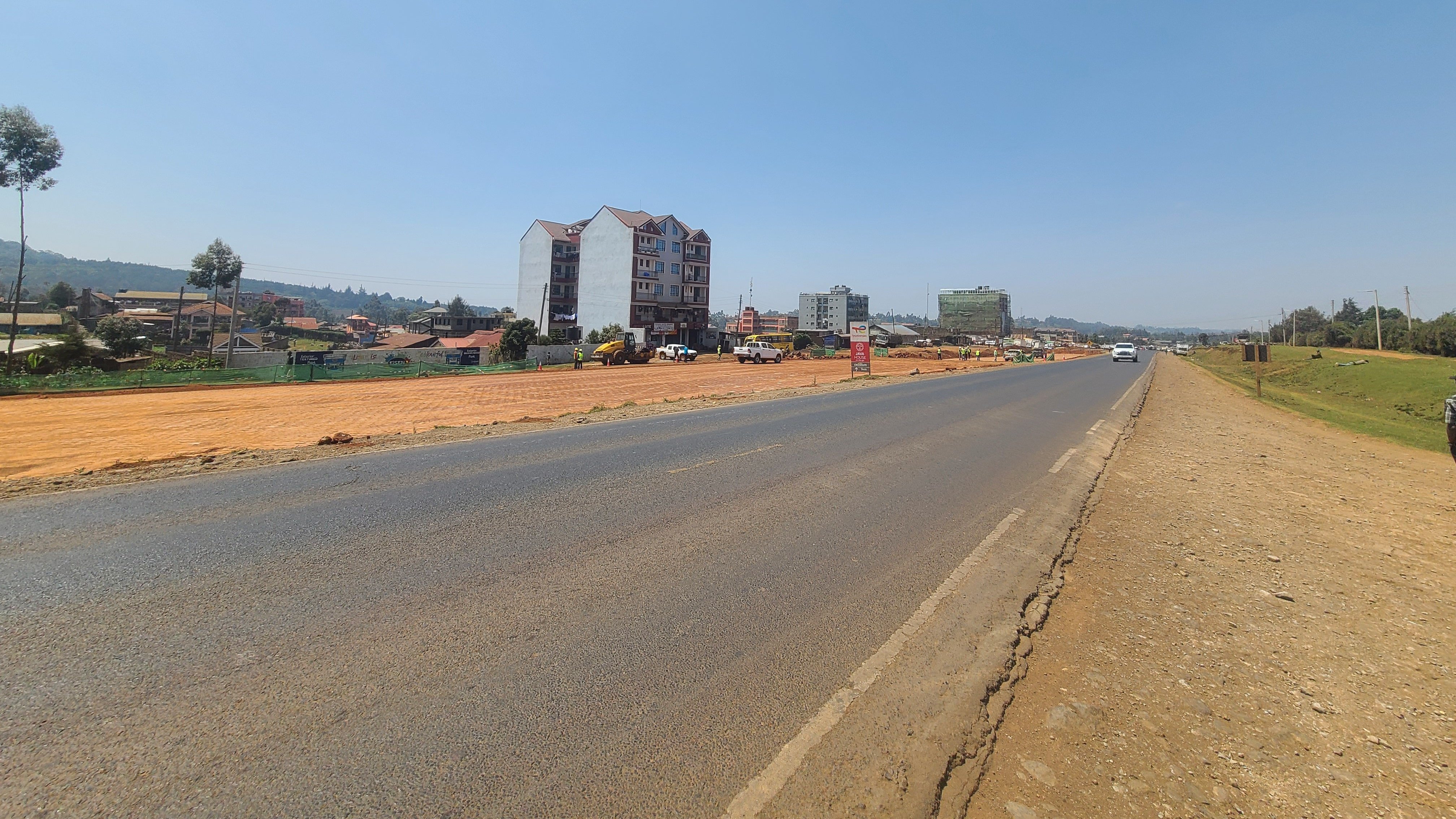

At the present, most construction on the Rironi-Mau Summit dualing project remains at earthworks, site excavation and early subgrading.
Manpower and machinery are clearly mobilised along the corridor, and it is impressive to say the least. Businesses beside the road continue to experience disruption while the works proceed.
China Road and Bridge Corporation (CRBC) and Shandong Hi-Speed Road and Bridge International are the contractors handling the respective sections of the dual carriageway. Both firms have delivered large and complex projects elsewhere. Their ability to accelerate once foundations are complete remains an open factor.
All said, the works at hand are of a significant magnitude, dualing Rironi to Mau Summit A8 and the A8 south which is the hilly Mai Mahiu route.
Technical elements introduce additional time requirements. Through the centre of Nakuru the design includes an elevated viaduct to carry through-traffic above the urban area and reduce congestion.
Elevated structures of this kind demand sequential foundation work, pier construction and deck placement. These stages cannot be compressed without affecting long-term performance.
Sections of the corridor also cross escarpment terrain. Steeper gradients and variable ground conditions require more extensive earthworks, stabilisation and drainage than flatter lengths.
Even if dual carriageway paving advances across many sections, major elements such as the Nakuru viaduct could still stand incomplete or only partially finished by the 2027 elections.
Comments responding to the ground observations noted that the original schedule was tight for a project of this scale. It is a highly politicized project but from the engineering side, we are excited to see what is actually achievable when finance is not an issue since this is a public private partnership (PPP) project with a design, build, finance, operate, maintain and transfer (DBFOMT) model.
The Nairobi Expressway (27.1km) under the same model and the same contractor took about 18 months to complete. It had a lot of elevated sections so it cannot be compared directly, at least.
Meeting the 2027 target for the 174km Rironi - Mau Summit upgrade would require sustained high daily rates of paving once the formation is ready. Starting activity across the full length at once spreads resources rather than concentrating them on successive packages. We are yet to independently confirm the number of sections the contractor is working with on the ground.
Road construction follows a fixed sequence. Earthworks and formation must reach the required standards before subbase, base course, asphalt and structural works can follow.
The combination of current early-stage progress on key lengths, the engineering demands of the Nakuru viaduct, and the challenges of escarpment terrain explains the practical limits on full dual carriageway completion before the elections.
Motorists continue to rely on the existing road while the new lanes take shape beside it. How quickly the present foundation works convert into finished pavement and structures will determine the eventual delivery picture.
Comments (0)
Leave a Comment
No comments yet. Be the first to share your thoughts!