
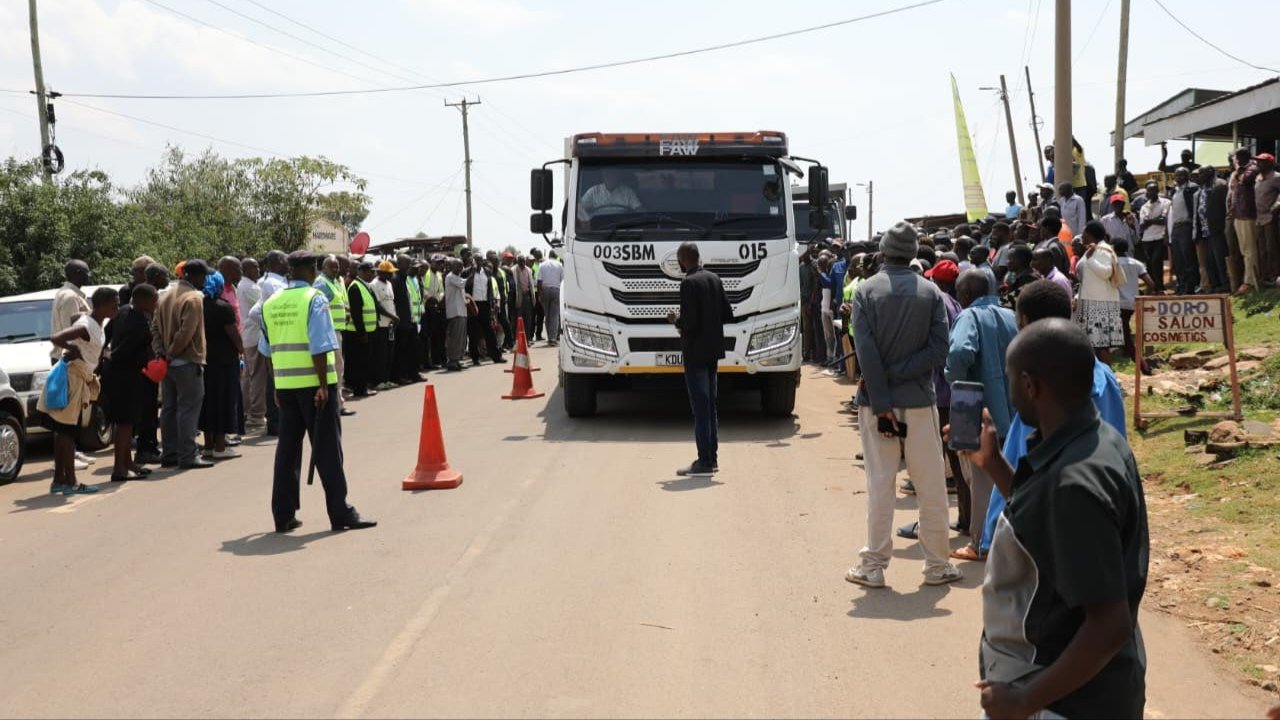

The Kenya Rural Roads Authority’s Axle Load Control Unit has conducted a sensitisation drive in the Ainamoi area along the Kericho-Kipchimchim–West Valley Road. The exercise aimed to educate stakeholders on permitted load limits and the damage caused by overloaded trucks.
The event brought together officials from the National Government Administration Office, the Office of the Director of Public Prosecutions, the truckers association and members of the public. It was led by Kericho County Commissioner Mr Omar Ali and KeRRA’s Kericho Regional Director, Eng. Gibson Nyamota.
Overloaded vehicles remain one of the biggest threats to rural road networks in Kenya. Excessive weight accelerates pavement deterioration, creates potholes and shortens the lifespan of roads that are expensive to construct and maintain.
KeRRA has intensified such sensitisation campaigns as part of its broader mandate to manage, develop and maintain rural roads. The authority believes that compliance with axle load regulations offers a cost-effective way to preserve existing infrastructure.
Participants at the Ainamoi drive were taken through the legal limits for different vehicle configurations. Officials also highlighted the penalties for non-compliance and the role of enforcement agencies in curbing the practice.
Rural roads carry increasing volumes of heavy commercial traffic, especially in agricultural regions like Kericho. Protecting these routes is critical for farmers, traders and communities that depend on them for moving produce and goods.
The sensitisation comes at a time when many counties continue to grapple with the high cost of road maintenance. Overloading significantly increases repair frequency and diverts funds that could otherwise be used for new construction or rehabilitation.
KeRRA’s approach combines enforcement with public education. By engaging truckers directly and involving county administration and prosecutors, the authority hopes to build a culture of compliance rather than relying solely on punitive measures.
Similar drives have been conducted in other regions with mixed results. Persistent challenges include weak enforcement capacity and pressure on transporters to maximise loads for profitability.
The Kericho exercise underscores the authority’s determination to safeguard rural infrastructure. Roads built or rehabilitated with public funds can only deliver value when they are used within design limits.
Stakeholders present welcomed the initiative, noting that clear communication on the rules helps avoid misunderstandings at weighbridges. They called for continued engagement and fair enforcement across the network.
As KeRRA continues to expand its axle load control operations, such sensitisation exercises are expected to increase. The long-term goal remains the preservation of rural road assets that are vital to Kenya’s agricultural economy and connectivity in underserved areas.
Comments (0)
Leave a Comment
No comments yet. Be the first to share your thoughts!