
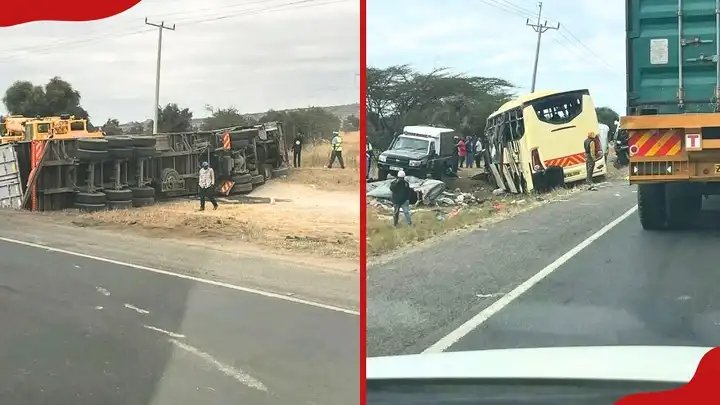

Six people died and seven others were injured in the early hours of Tuesday when two lorries and a Tahmeed passenger bus collided near Kapiti Plains in Machakos County. Police said a lorry travelling from Mombasa lost control after hitting an oncoming vehicle, then crashed head-on into the bus.
The bus driver, one lorry driver and four passengers died at the scene. Survivors were rushed to Machakos Level Five Hospital, while investigators towed the wreckage to Kyumbi Police Station to establish what triggered the crash.
This is not an isolated tragedy. Similar fatal collisions involving buses, matatus and heavy trucks have occurred on Kenyan highways in recent weeks. The pattern points to problems that go beyond any single driver's error, even as driver behaviour remains the most immediate cause in most cases.
Overnight bus and truck schedules put drivers under sustained pressure to make up time, and that pressure shows up in the form of reckless overtaking on blind corners, tailgating, and pushing speeds well past what darkness and road conditions allow. Investigators reviewing crashes on this corridor routinely cite overtaking as a contributing factor.
Fatigue compounds the risk. Drivers running the Nairobi-Mombasa route through the night often work long hours with limited rest between trips, and reduced alertness at 1am or 2am, exactly when Tuesday's crash occurred, is a well-documented factor in highway collisions worldwide.
Glare from oncoming headlights adds another layer of danger on a road still mostly limited to single carriageways. Drivers meeting oncoming traffic in the dark, on a narrow road with no median barrier, have less room to react if a vehicle drifts or swerves unexpectedly.
It is not only bus and truck drivers who are exposed. Motorcyclists, pedestrians crossing at unmarked points near trading centres, and cyclists sharing narrow shoulders with speeding freight traffic face some of the highest risk on this corridor, often with no protective barrier between them and oncoming vehicles.
This is the reasoning behind Mjengo Hub's Share Barabara campaign, which asks all road users, from truck drivers to boda boda riders to pedestrians, to recognise that the highway does not belong to any single group. Slowing down, giving way and staying alert are choices within every driver's control, regardless of what state the tarmac is in.
Mechanical failure adds a further layer of risk. Brake failures and poorly serviced vehicles remain a recurring theme in preliminary investigations along this corridor, though authorities have not yet confirmed a mechanical cause in Tuesday's collision specifically.
Infrastructure gaps make these human and mechanical risks harder to absorb. For long stretches, the Nairobi-Mombasa Highway (A8) remains a single carriageway in each direction, forcing buses, matatus, private cars and heavy freight trucks to share the same two lanes for hundreds of kilometres.
The long-promised Usahihi Expressway, meant to add dedicated four-lane capacity, remains stalled. The Public-Private Partnership (PPP) Committee rejected the project's development report in mid-2025, and the developer has since faced friction from financiers over a partner's ties to a Chinese state contractor.
Progress is visible closer to the coast. At the Kwa Jomvu interchange, the main flyover is complete and already carrying traffic, while paving crews are finishing the adjacent service lanes that will connect toward Magongo. Engineers have designed the junction as a T-junction rather than a roundabout, with work currently confined to one side of the road to keep traffic flowing.
Further inland, the government has listed the Machakos Junction-Mariakani corridor among roads earmarked for dualing under a wider ten-year, 2,500-kilometre expansion programme, with works expected to begin in phases from early 2026. A formal groundbreaking specific to this section has yet to be confirmed.
Road surface quality compounds the capacity problem in the meantime. Motorists frequently report that sections between Voi and Mtito Andei have deteriorated to the point of feeling more like murram than tarmac, and climbing lanes remain absent from several steep sections that force slower trucks and faster vehicles into the same lane.
Taken together, a narrow road, incomplete dualing works, uneven surfaces, fatigue and reckless overtaking form a combination that safety researchers describe as compounding rather than isolated risks. Better roads will help, but Mjengo Hub's Share Barabara message is that no amount of tarmac replaces the discipline of sharing the road.
Comments (0)
Leave a Comment
No comments yet. Be the first to share your thoughts!