
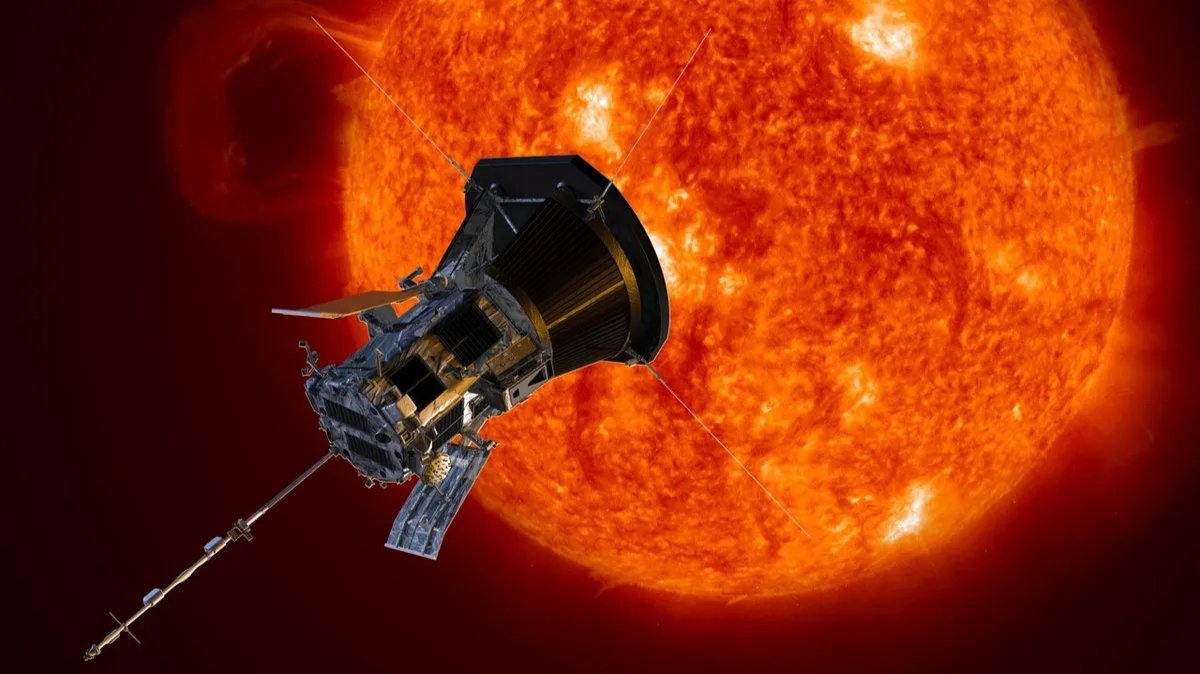

The Parker Solar Probe is moving through the Sun’s outer atmosphere at about 430,000 miles per hour. At this speed, it could travel across the continental United States in roughly 20 seconds, showing how extreme its orbit has become as it studies the Sun at close range.
This spacecraft was designed by NASA to approach the Sun more closely than any previous mission. It collects data on solar activity, helping scientists better understand the behavior of the Sun’s outer layers and how energy and particles move through space.
One of the key features of the probe is its heat shield. This shield faces the Sun directly and takes on extreme heat while protecting the instruments behind it. The shield allows the main systems to remain at near room temperature.
While the front surface of the shield can reach about 2,500 degrees Fahrenheit, the instruments stay cool and continue working. This separation between extreme heat and protected equipment is central to the spacecraft’s design and long term operation.
The probe follows an orbit that repeatedly brings it close to the Sun and then swings it back out into space. Each pass allows it to gather new measurements from different regions of the Sun’s outer atmosphere, known as the corona.
The corona is much hotter than the Sun’s surface, and this difference remains one of the key questions in solar science. By moving directly through this region, the probe helps collect information that cannot be obtained from Earth.
Its high speed is achieved through repeated gravitational assists from Venus. Each flyby adjusts its orbit and gradually pulls it closer to the Sun, increasing both its speed and the intensity of the environment it passes through.
At such speeds and temperatures, even small design errors could damage the spacecraft. Engineers built the probe with strong materials and careful shielding to ensure it can continue operating in conditions that would destroy most other spacecraft.
The data gathered includes measurements of solar wind, magnetic fields and energetic particles. These elements influence space weather, which can affect satellites, communication systems, and power grids on Earth.
By studying these processes up close, scientists can improve forecasts of solar storms. This helps reduce risks to technology and infrastructure that depend on space-based systems and electrical networks.
The mission also helps improve understanding of how stars work in general. Since the Sun is the closest star to Earth, it serves as a useful model for studying similar processes in other parts of the universe.
As the Parker Solar Probe continues its journey, it is expected to make even closer passes in the coming years. Each orbit adds more data, slowly building a clearer picture of the Sun’s outer environment and its effects on space around it.
Comments (0)
Leave a Comment
No comments yet. Be the first to share your thoughts!