

A version of this article appeared on Al Jazeera.
Large-scale cloud service providers, including Google, Amazon, and Microsoft, are warming the ground around their facilities as they race to build the infrastructure that powers artificial intelligence (AI).
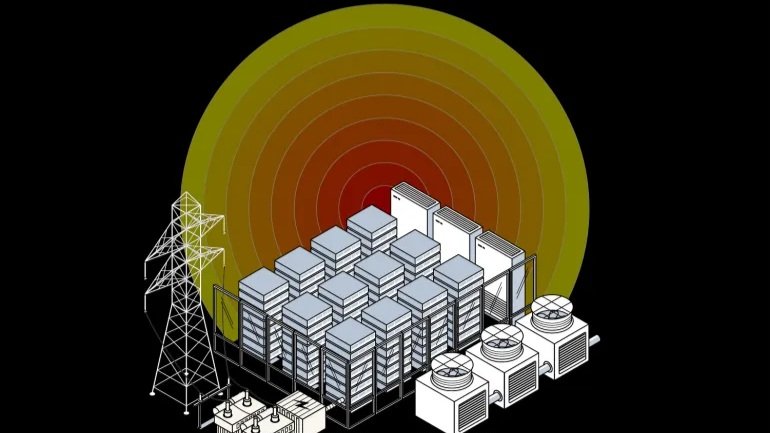
A study by Cambridge-led researchers, which included academics from Nanyang Technological University, found that land surface temperatures around AI data centres rise by an average of 2 degrees Celsius (3.6 degrees Fahrenheit).
Some areas recorded temperature increases as high as 9.1 degrees Celsius (16.38 degrees Fahrenheit), creating what researchers call a data heat island effect.
The research used National Aeronautics and Space Administration (NASA) satellite data to measure land surface temperatures globally from 2004 to 2024.
Scientists cross-referenced this historical data with more than 11,000 AI data centre locations worldwide, later narrowing their focus to 6,733 centres situated outside densely populated areas.
The researchers compared temperatures in the months after each facility opened against a five-year baseline at the exact same location, discovering that the warming effects could be detected up to 10 kilometres (6 miles) away.
More than 340 million people live within this 10-kilometre radius of a data centre, exposing communities to localized warming that can affect health, energy demand, and overall wellbeing.
These AI facilities require significantly more energy than standard web servers because they use powerful chips that perform thousands of calculations in parallel to run large models continuously.
According to the International Energy Agency (IEA), data centres consumed approximately 415 terawatt hours (TWh) of electricity in 2024, representing about 1.5 percent of the global supply.
This power demand has grown at a rate of 15 percent annually over the last five years, and the IEA projects that global data centre energy consumption will nearly double to 945 TWh by 2030.
Hyperscale data centres are the largest facilities of this type, which IBM defines as occupying a minimum of 10,000 square feet (930 square metres) and housing at least 5,000 servers.
Operating continuously at any given second, these installations require between 100 and 300 megawatts of electricity, which generates vast quantities of waste heat.
Managing this heat requires advanced liquid cooling systems that consume substantial amounts of water.
A report by the digital sustainability advisory body of the United Kingdom government found that a single 100-megawatt hyperscale facility can consume 2.5 billion litres (660 million gallons) of water annually.
This consumption is equivalent to the annual water needs of 80,000 people, increasing the ecological footprint of the sector beyond electricity and heat generation.
Most data centres are intentionally built within industrial zones away from dense population centres, yet the waste heat radiates far enough to influence regional environments.
The study authors noted that the findings demonstrate a remarkable influence on communities and regional welfare, signaling that localized warming must become part of the global conversation regarding tech infrastructure expansion.
Comments (0)
Leave a Comment
No comments yet. Be the first to share your thoughts!