
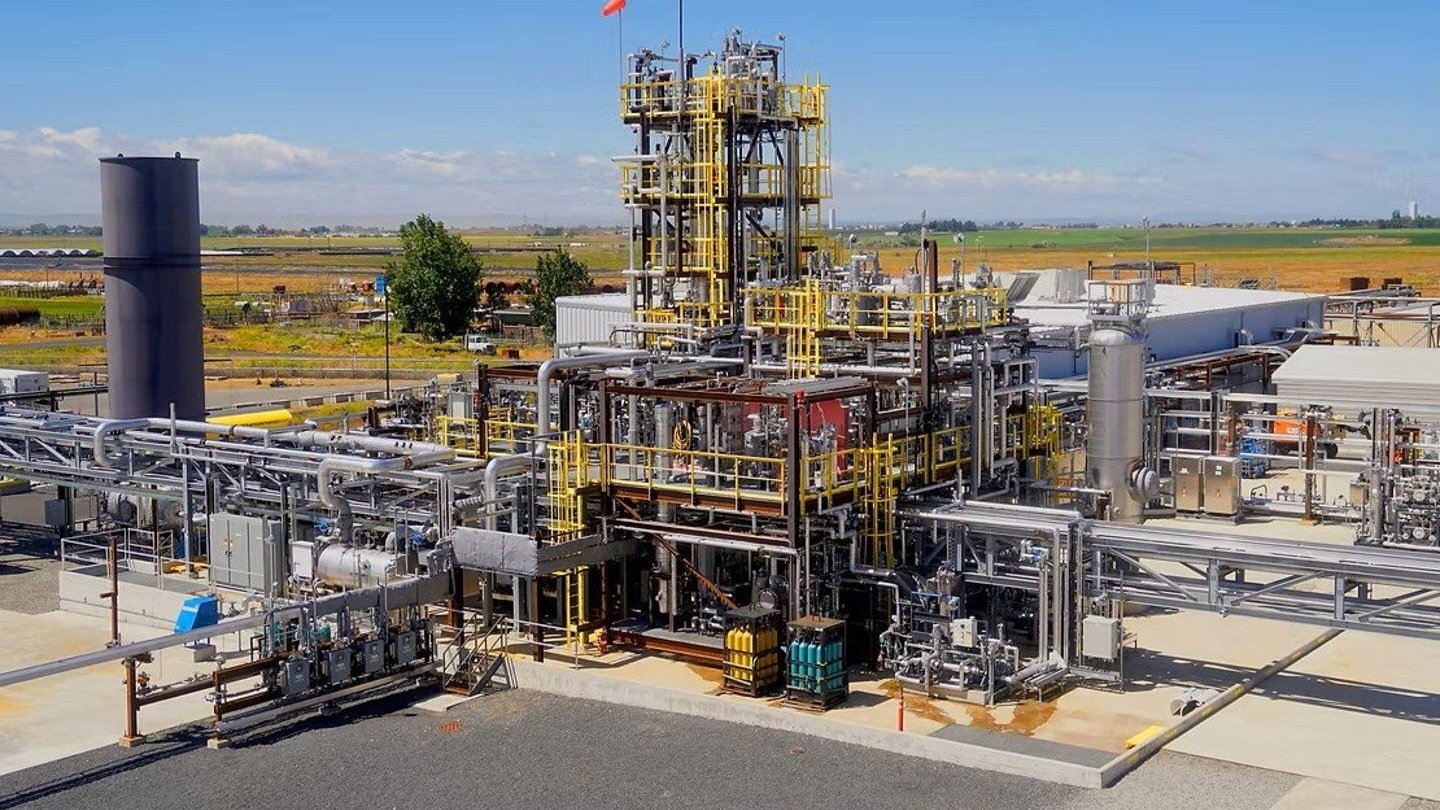

An industrial facility in the United States has commenced commercial production of synthetic fuels derived directly from captured atmospheric carbon dioxide and water.
The plant, known as AirPlant One, is located in the state of Washington and was developed by Twelve, an industrial technology company focused on engineering chemical alternatives to fossil fuels.
According to details published by Hydrogen Insight, the facility operates as the world’s first commercial-scale installation designed to extract carbon dioxide from the air to synthesize power-to-liquid hydrocarbons.
The facility focuses on the production of two distinct outputs, e-naphtha and e-sustainable aviation fuel (e-SAF).
The e-naphtha serves as a petroleum-free chemical feedstock destined for industrial manufacturing.
The e-SAF functions as a drop-in synthetic aviation fuel chemically identical to conventional fossil fuels.
Commercial off-take agreements are already established for the aviation fuel output.
Alaska Airlines has secured a contract to utilize the e-SAF for regular domestic flight operations, representing an early commercial deployment of atmospheric carbon-derived fuel in American aviation.
Technology corporation Microsoft has also signed an agreement for the fuel, supporting the scale-up via a book-and-claim procurement model.
By employing an engineering process that relies on captured carbon dioxide, water, and renewable electricity, the production method completely bypasses conventional biological feedstocks or agricultural land use.
The primary machinery relies on industrial electrolyzers to break down the captured molecules and reassemble them into the target hydrocarbon chains.
The launch establishes a baseline for power-to-liquid manufacturing infrastructure within the global energy transition framework.
Comments (0)
Leave a Comment
No comments yet. Be the first to share your thoughts!