
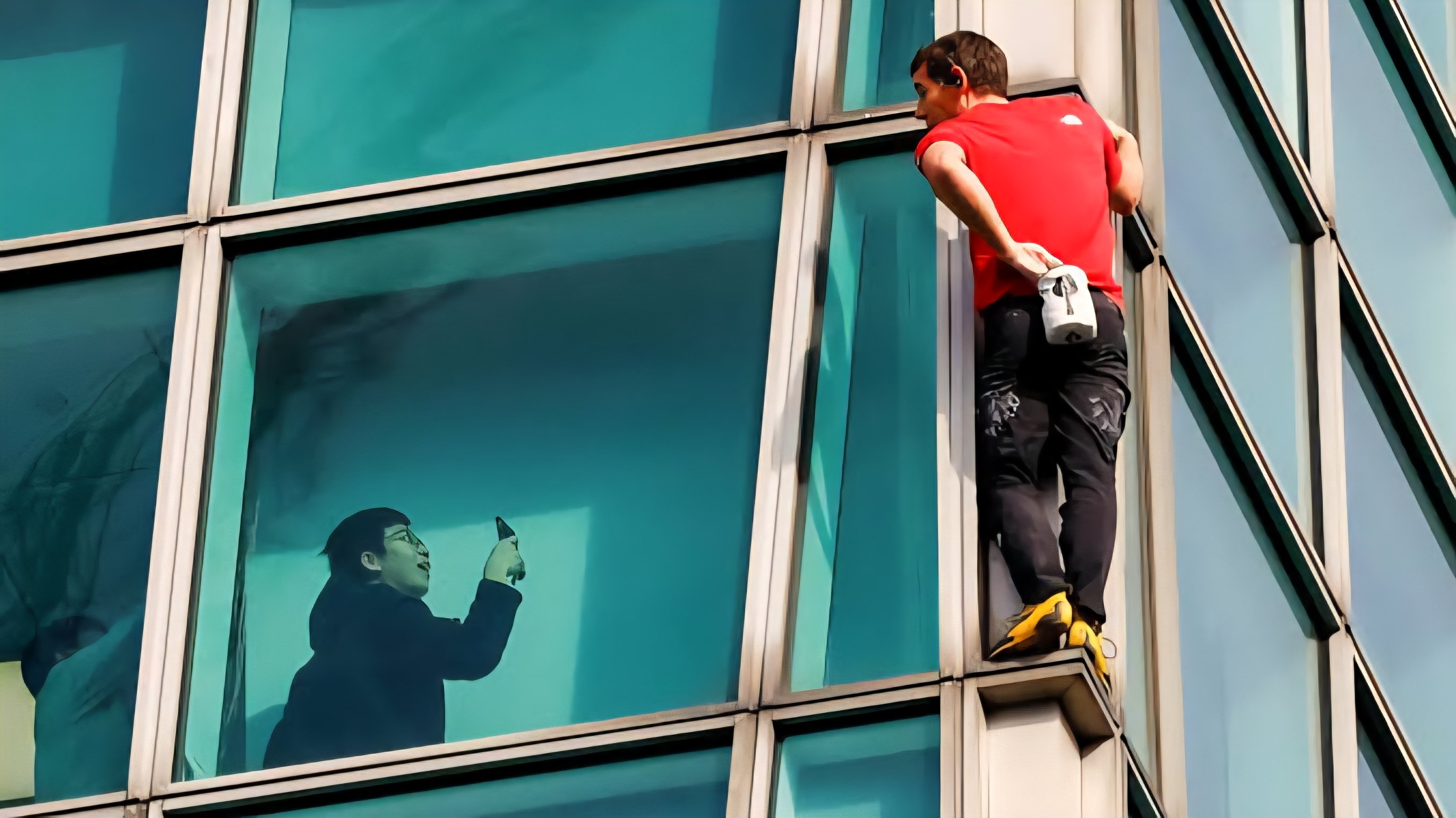

Alex Honnold, the American climber known for his rope-free ascent of El Capitan, has scaled the exterior of the Taipei 101 skyscraper in Taiwan. The climb was conducted as part of a production for an upcoming Netflix documentary titled The Last Mountain. Standing at 1,667 feet, the tower was once the tallest building in the world and remains one of the most recognizable structures in the global skyline due to its segmented, pagoda-like design.

The ascent took place under controlled conditions for filming purposes, though Honnold utilized the same free soloing technique that defined his 2017 climb in Yosemite National Park. This method involves climbing without the use of harnesses, ropes, or protective hardware, relying entirely on physical strength and grip. While Honnold has spent much of his career on natural rock faces, this urban climb represents a distinct technical challenge due to the materials and geometry of modern architecture.

Taipei 101 features a glass and steel facade with a series of eight distinct slanted sections. These structural elements provided the necessary holds for the climb, but the smooth surfaces of a skyscraper differ significantly from the granite cracks Honnold typically navigates. In a recent interview, Honnold described the experience as physically demanding, noting that the repetitive nature of the building's architecture required a different mental approach than the varied terrain of a mountain.

The project involved extensive planning and coordination with building management and local authorities. Security and safety protocols were established to manage the perimeter of the site during the filming windows. Honnold indicated that while the height and exposure were extreme, the predictable nature of the building’s structural steel provided a level of consistency not found in nature, where rock quality can be unstable.
This climb adds to a small but notable history of technical ascents on the Taiwanese landmark. In 2004, French climber Alain Robert, often referred to as the Human Spider, climbed the tower using ropes and suction cups, a feat that took nearly four hours. Honnold’s approach differs by his strict adherence to the free solo discipline, which removes all mechanical aids.
Documenting such feats has become a specialized sub-sector of the film and construction industries. The production required specialized camera crews and drones to capture the movement against the backdrop of Taipei’s financial district. These projects often highlight the engineering precision of high-rise structures, viewed from perspectives that are rarely accessible to maintenance crews or the public.
Beyond the physical feat, the climb draws attention to the structural integrity and design of Taipei 101. Completed in 2004, the tower was designed by C.P. Wang and C.Y. Lee to withstand the typhoons and earthquakes common in the region. It features a massive 660-metric-ton tuned mass damper near the top to reduce swaying. For a climber, the external ribs and structural bracing that contribute to this stability also serve as the primary path to the summit.
Honnold has previously engaged in urban climbing, including ascents in Jersey City, but the scale of the Taipei 101 project is significantly larger. He noted that the sheer verticality of the skyscraper creates a unique environment where the wind and temperature can change rapidly as one moves past the lower tiers into the higher elevations of the tower.
The documentary featuring the climb is expected to explore the intersection of human endurance and modern engineering. As urban free soloing gains more visibility through high-budget productions, it continues to spark discussions regarding the safety and legality of such activities. In this instance, the sanctioned nature of the event allowed for a technical focus on how a human body interacts with a structure of such immense proportions.
Comments (0)
Leave a Comment
No comments yet. Be the first to share your thoughts!