

This article was adopted from the The B1M/YouTube.
The global expansion of spherical entertainment venues is moving forward, despite significant financial losses at the original site in Las Vegas. Developers are pushing ahead with new projects, shifting from direct ownership to a technology licensing model.
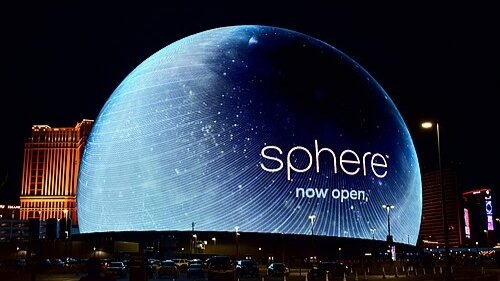
The original Madison Square Garden (MSG) Sphere in the United States (US) cost 2.5 billion dollars to build. Standing 112 meters tall, the building has struggled to achieve profitability, despite generating substantial revenue.
In its first year of operation, the Nevada venue reported losses exceeding 400 million dollars. Operating deficits continued well into 2025, revealing the intense financial pressures associated with running the massive structure.
The primary financial burdens stem from high operating costs and specialized programming. The exterior, covered in a massive Light Emitting Diode (LED) display, requires enormous amounts of energy to remain illuminated.
Furthermore, the venue can only host one show at a time. Custom content creation costs tens of millions of dollars, which limits flexibility, if a particular show fails to attract regular crowds.
To mitigate these risks, Sphere Entertainment is pivoting toward an architectural franchise system. This strategy allows the company to license its proprietary technology, while local partners handle the construction costs.
Abu Dhabi is the first confirmed international location under this model. Located on Yas Island, the project carries a 1.7 billion dollar price tag, which is significantly cheaper than the Las Vegas original.
The United Arab Emirates (UAE) venue will accommodate 20,000 people, matching the capacity of the first dome. Target completion is 2029, supporting the broader tourism strategy of the emirate.
Plans are also underway for a smaller version near Washington, D.C. Located at National Harbor, this scaled-down venue will feature 6,000 seats, representing roughly one-third the size of the original venue.
This smaller model carries an estimated cost of one billion dollars, with a targeted opening in 2030. Developers hope this smaller option proves easier to replicate across various global markets.
Another project has been proposed for Hanam, South Korea. Known locally as the Korean Pop (K-pop) sphere, the venue would form the center of a large media and entertainment district.
However, the South Korean development remains highly uncertain. Questions regarding long-term economic viability and structural feasibility have slowed the approval process, leaving the project unconfirmed.
Not all cities welcome the distinctive architecture. A high-profile proposal for Stratford in East London was officially blocked by London Mayor Sadiq Khan, after intense opposition from local neighborhood groups.
Residents raised major concerns regarding light pollution from the constantly illuminated outer shell. The local council initially approved the development, but the mayor intervened to protect the residential area.
Engineering these structures involves complex technical challenges. Foundations must support over 100,000 tons of weight, using deep piles and dense reinforced concrete bases to secure the heavy structure.
The spherical shape relies on a steel lattice shell made of hundreds of interconnected triangles. This geometric design distributes weight efficiently, preventing the roof from sagging under its own immense weight.
Comments (0)
Leave a Comment
No comments yet. Be the first to share your thoughts!