
![The moon completely covers the sun during the total solar eclipse as seen from the Javalambre Astrophysical Observatory in Arcos de las Salinas, near Teruel, Spain. [Christian Hartmann/Reuters]](/static/images/articles/8117044da6b042829dfa01a2bd82fb96_1002145506.jpg)

Parts of Europe were plunged into darkness on Wednesday, August 12, 2026, as the Moon moved directly between Earth and the Sun during a rare total solar eclipse.
The eclipse was visible in its total form along a narrow path stretching across Greenland, Iceland, the North Atlantic, northern Spain and a small part of Portugal. Much of Europe experienced a partial eclipse.
In locations along the path of totality, the Moon completely covered the Sun, temporarily turning daylight into darkness. Observers were able to see the solar corona, the outer atmosphere of the Sun that is normally obscured by the brightness of its surface.
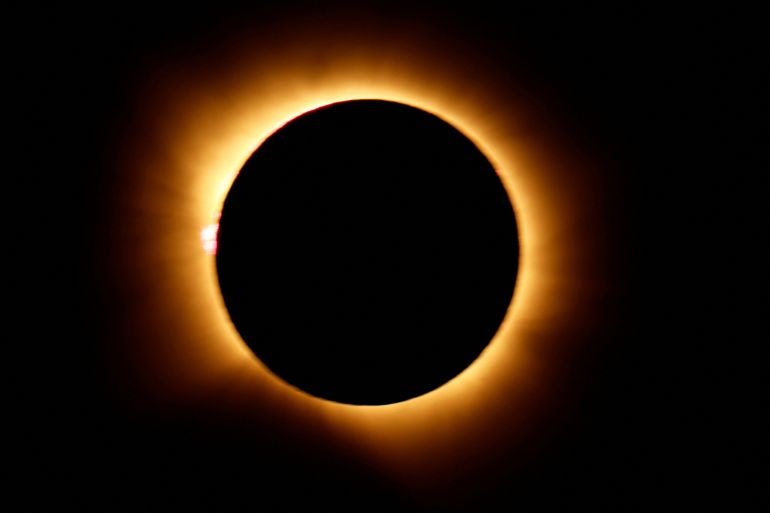
The moon completely covers the sun during a total solar eclipse as seen from Arija, Spain. [Borja Suarez/Reuters]
Northern Spain provided some of the most prominent viewing locations on the European mainland. The eclipse shadow crossed the country from the Atlantic coast towards the Mediterranean, with several regions falling within the path of totality.
Iceland was another major viewing location. Western parts of the country fell within the path of totality, making it one of the limited land areas where the total eclipse could be observed.
The event was also visible as a partial eclipse across a much wider area. Parts of Europe, Africa, Canada and the northern and northeastern United States experienced at least a partial covering of the Sun.
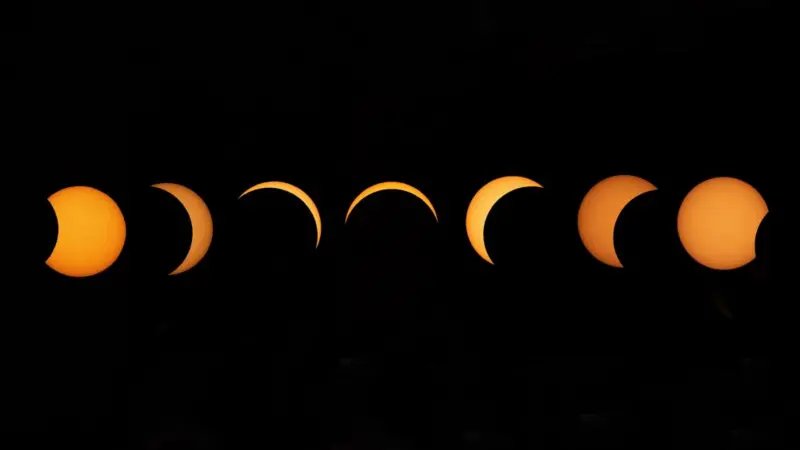
The phases captured from the eclipse. /BBC
A total solar eclipse occurs when the Moon passes between Earth and the Sun and appears large enough from Earth to completely cover the Sun's visible disc. The Moon's shadow then travels across a relatively narrow section of Earth's surface.
The August eclipse followed a path across some of the planet's northernmost regions before moving across the Atlantic towards Europe. The totality path extended from Greenland through Iceland before reaching northern Spain.
For observers outside the narrow path of totality, the spectacle was different. The Moon covered only part of the Sun, producing a partial eclipse rather than the complete daytime darkness experienced inside the totality zone.
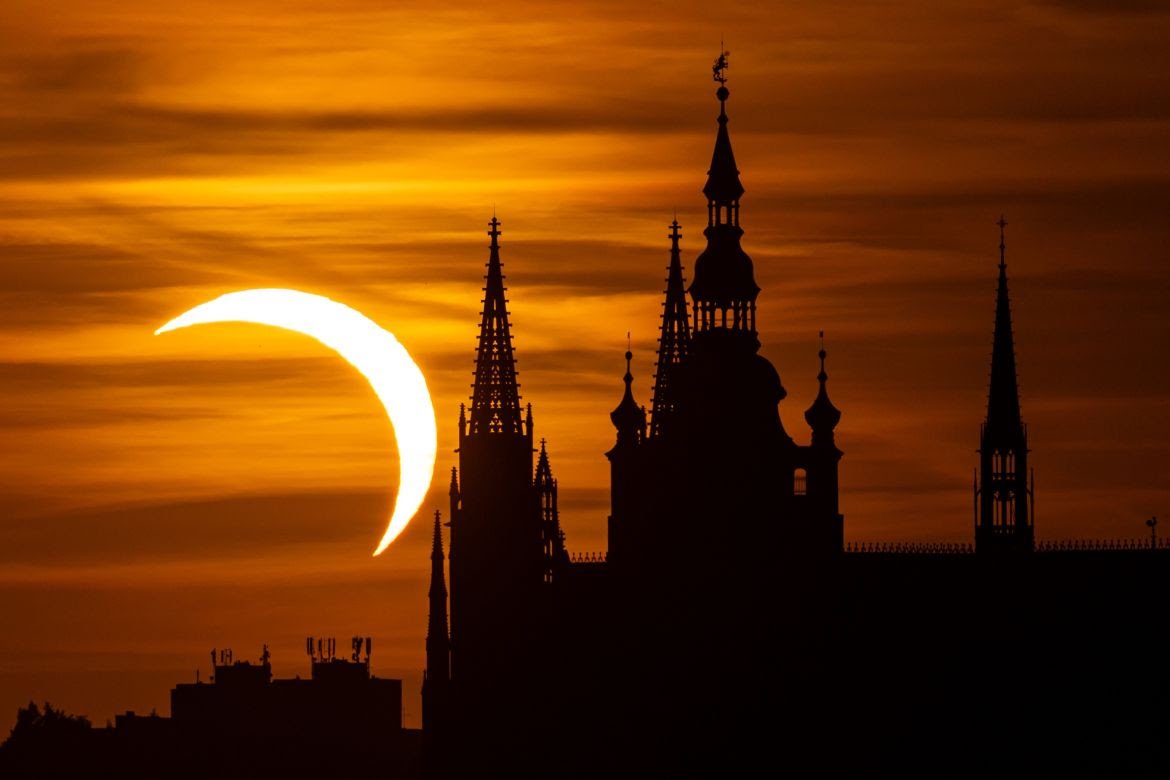
The silhouette of the Prague Castle stands against the background of a partial solar eclipse in Prague, the Czech Republic. [Martin Divisek/EPA]
The timing also made weather an important factor for viewers. Spain generally offered a better chance of clear skies than Iceland during August, according to historical cloud-cover assessments.
The eclipse attracted large numbers of observers, including residents, tourists and astronomy enthusiasts who travelled to locations along the path. Images from Spain and Iceland showed crowds gathering to watch the Moon's shadow pass across the landscape.
The phenomenon was also of scientific interest. Total eclipses provide researchers with an opportunity to observe the solar corona directly and study the Sun's outer atmosphere, which is difficult to examine against the normally bright solar disc.
NASA recorded imagery of the eclipse from Spain on August 12, including observations made as the event crossed the country.
The August 12 eclipse was part of a broader sequence of solar eclipses visible from different parts of Earth. The next total solar eclipse will be visible in parts of North Africa and the Middle East in 2027.
For Europe, however, Wednesday's event offered a rare daytime spectacle, with parts of the continent experiencing the dramatic transition from daylight to darkness as the Moon temporarily blocked the Sun.
Comments (0)
Leave a Comment
No comments yet. Be the first to share your thoughts!