
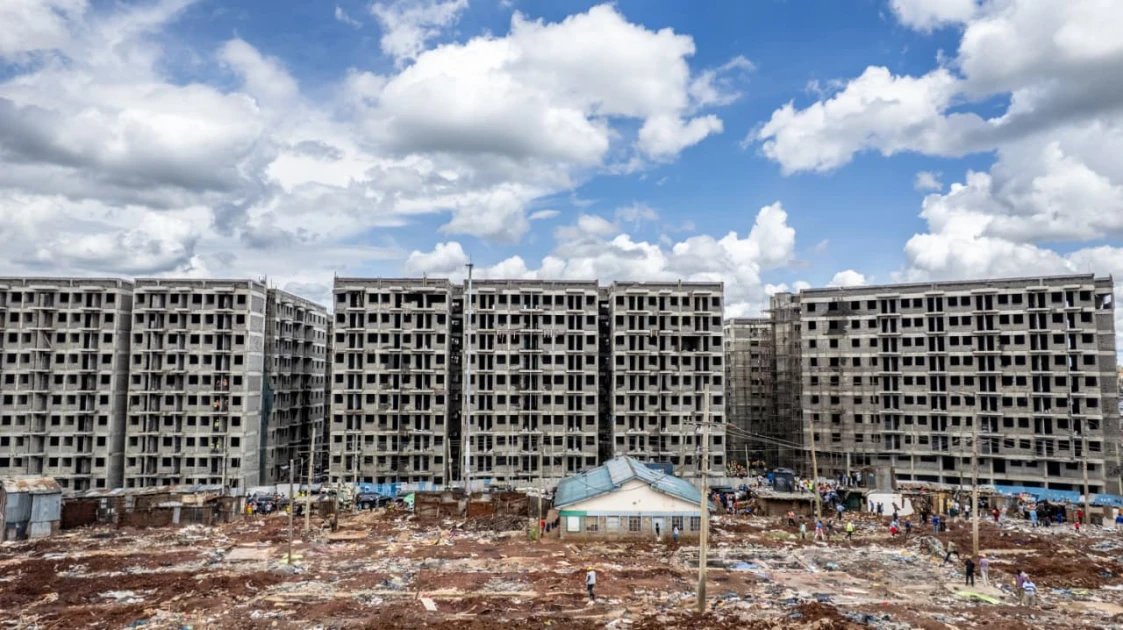

President William Ruto conducted an inspection of the Kibera Soweto East Zone B Affordable Housing Project on Tuesday afternoon, confirming that the development is entering its final phases. The Sh7.4 billion initiative is now more than 80 percent complete and forms a central part of the government's strategy to upgrade informal settlements in Nairobi.
The project is designed to deliver 4,465 housing units, a figure that includes a variety of living spaces tailored for different family sizes. Current data shows the site will provide 3,052 one-room units, 1,100 two-room units, and 313 three-room units.
Speaking at the site, President Ruto said the housing agenda would succeed despite opposition from critics. He noted that the primary goal remains building dignity for every Kenyan by providing modern, well-equipped homes with essential services.
Beyond the residential blocks, the development incorporates several social amenities intended to support a self-sustaining community. These include a primary school, a kindergarten, a health centre, and dedicated commercial and recreational spaces.
Infrastructure upgrades are also a significant component of the site’s layout. Engineers have prioritized the construction of internal access roads and a paved road linking the estate to Joash Olum Primary School. Water supply will be provided by two boreholes located within the facility, complemented by a new sewer line and a solid waste management system.
Economic impact has been felt within the local community through the creation of more than 2,500 direct jobs. This employment surge is attributed to the high demand for locally sourced materials, specifically windows, doors, and balustrades manufactured by the jua kali sector.
The President stated that the Kenya Kwanza administration is currently working on nearly 250,000 housing units across the country. In Nairobi alone, the target is 100,000 units, aimed at reducing the national housing deficit and improving livelihoods for those in low-income brackets.
Efforts are also underway through the State Department for Housing and Urban Development to unlock further capacity in Kibera. This includes plans to revive a stalled Kenya Railways Corporation project, which is expected to add another 900 units to the area’s housing stock.
The Affordable Housing Programme, frequently referred to as Boma Yangu, remains a core pillar of the Bottom-Up Economic Transformation Agenda. Government officials maintain that the project is not just about physical structures but also about stimulating local businesses and providing a path to home ownership for millions.
As the Zone B project nears its handover date, the focus remains on ensuring that the relocation of residents from the existing informal settlement into the new blocks is managed effectively to avoid the pitfalls of previous slum upgrading schemes.
Comments (0)
Leave a Comment
No comments yet. Be the first to share your thoughts!