

The Union of African Railways (UAR) settled the continental railway gauge debate over 50 years ago. In 1972, the regional organization resolved that all new mainline and strategic high-capacity regional railways should be built to standard gauge.
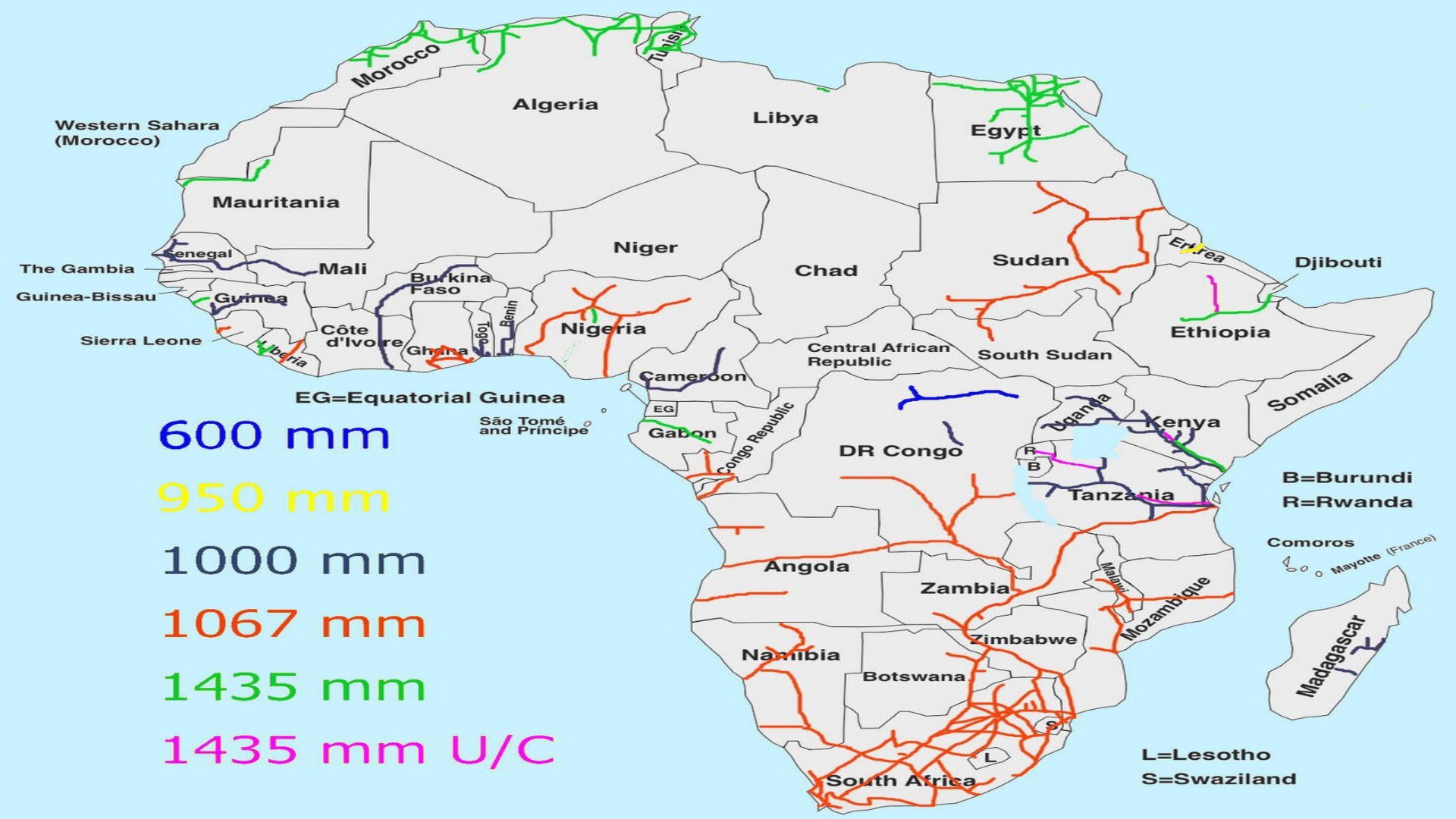
Rail infrastructure across Africa was historically constructed using a fragment of different track dimensions. Legacy networks built during the colonial era included 600 mm narrow gauge, 950 mm gauge, 1000 mm metre gauge, and 1067 mm Cape gauge.
These distinct track dimensions created significant operational challenges for cross-border rail transport, as trains could not seamlessly transition between neighboring countries without transferring cargo or altering rolling stock.
The 1972 resolution formally designated the 1435 mm standard gauge width as the unified benchmark for future rail developments across member states. The standard was selected to establish consistency across high-capacity regional links and upcoming mainline infrastructure developments across the continent.
Maps outlining the distribution of track measurements across Africa highlight the historic fragmentation. North African nations, including Morocco, Algeria, Tunisia, and Egypt, predominantly operate networks built to the 1435 mm dimension.
Central and Southern African countries feature extensive 1067 mm Cape gauge lines, while East Africa historically relied heavily on 1000 mm track lines.
Recent rail construction initiatives across various regions reflect the ongoing transition toward the 1435 mm specification. Under construction projects in East Africa and West Africa have increasingly adopted the standard gauge parameter for new trunk routes.
Despite the 1972 accord, existing regional rail systems continue to operate on legacy track configurations.
Upgrades to cross-border connectivity remain reliant on matching structural specifications or building new, standard-compliant corridors alongside historical routes.
Comments (0)
Leave a Comment
No comments yet. Be the first to share your thoughts!