
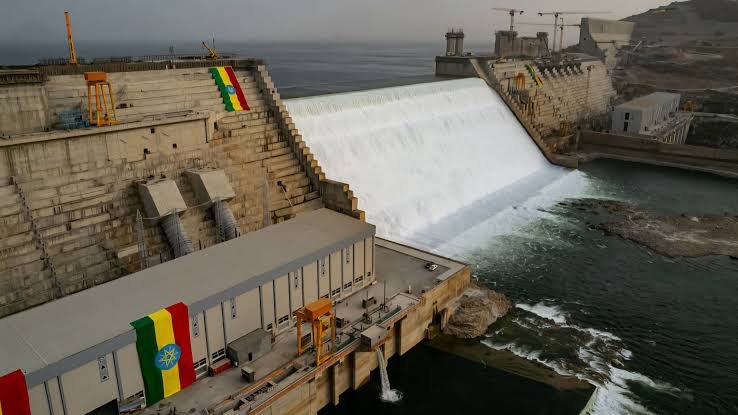

The Italian infrastructure firm Webuild has secured the Samoter Innovation Award 2026 for its construction of the Grand Ethiopian Renaissance Dam (GERD) in Ethiopia.
The accolade was presented during the SaMoTer international triennial construction machinery exhibition at the Palazzo della Gran Guardia in Verona, Italy.
The jury panel designated the project a benchmark for engineering efficiency, noting that the infrastructure introduces a significant shift in regional energy and industrial operations.
Managed under the client authority of Ethiopian Electric Power (EEP), the megaproject represents the largest hydroelectric facility on the African continent.
Structurally, the Blue Nile installation comprises a roller-compacted concrete (RCC) gravity dam spanning 1.8 kilometers in length and rising to a height of 170 meters.
The scale of the civil engineering works required complex logistical management of a 172-kilometer-long artificial reservoir, situated within highly demanding geographical and operational field conditions.
Operational data confirms the plant features an installed generation capacity of 5,150 megawatts, alongside a projected annual production capacity of 15,700 gigawatt-hours.
The engineering teams established a global sector record during the primary construction phases, successfully placing 23,000 cubic meters of roller-compacted concrete within a single 24-hour operational window.
The panel also evaluated the socio-economic impacts tied directly to the construction site management.
The project functioned as a large-scale technical training incubator, involving more than 25,000 workers. The vast majority of the workforce consisted of Ethiopian nationals who acquired specialized civil engineering and heavy equipment operation skills.
The project footprint led to the development of localized civil infrastructure, including schools, a dedicated hospital, medical clinics, and updated regional road networks.
The project was completed without international credit financing, relying instead on domestic funding mechanisms, public bond sales, and direct civil contributions within Ethiopia.
The facility is configured to double the existing electricity production capacity of the country, generating surplus power intended for cross-border export.
Power delivery arrangements have already been established with neighboring East African countries, including Kenya, Sudan, Djibouti, and Tanzania.
The dam operates with zero greenhouse gas emissions, positioning the asset as a central component of the regional renewable energy transition plans.
Comments (0)
Leave a Comment
No comments yet. Be the first to share your thoughts!