
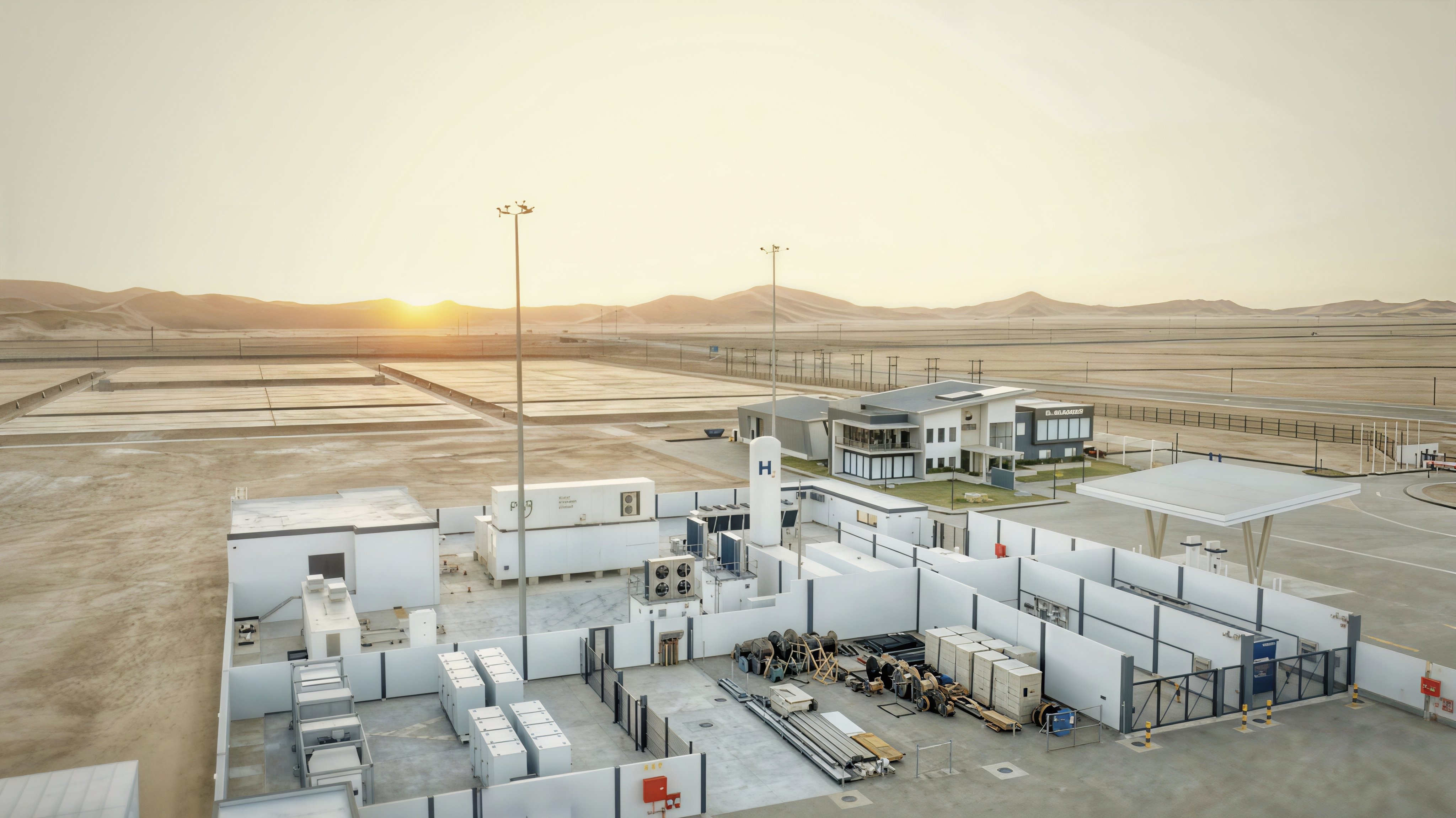

Namibia has commissioned what is being described as Africa's first fully integrated green hydrogen facility, a Walvis Bay plant that combines solar generation, hydrogen production and battery storage in a single off-grid system.
The CMB Tech Namibia facility runs on a 5 megawatt-peak solar park, a 5 megawatt proton exchange membrane electrolyser and a 5.9 megawatt-hour battery storage system. Together, these components allow the site to produce green hydrogen without drawing from the national grid.
Initial output has been earmarked for industrial and transport use, including dual-fuel trucks, generators and a hydrogen-powered freight locomotive. Siemens sub-Saharan Africa chief executive Sabine Dall'Omo said in a statement issued this week that the project shows large-scale clean energy production is achievable on the continent now, rather than a distant goal.
Solar power generated at the site feeds an electrolyser that splits water into hydrogen and oxygen (H2 and O2). The resulting hydrogen can later be combined with nitrogen to produce ammonia, a compound being explored for potential use as marine fuel.
CMB Tech chief technology officer Roy Campe described the site as a testing ground for a fully integrated hydrogen economy, noting it includes a refuelling station for hydrogen vehicles alongside an on-site academy for training local technicians and engineers.
The solar park currently holds roughly 7,000 panels across 6.5 hectares. Campe said the company plans to expand the facility considerably, with long-term capacity targets of 250 megawatts and eventually 500 megawatts, though no firm timeline was given for reaching those figures.
Campe also framed a broader ambition behind the project, saying the company wants Namibia positioned as a hub capable of exporting energy to Europe and other international markets. For now, though, the facility's focus stays domestic, with CMB Tech using the hydrogen it produces in its own industrial operations.
That arrangement gives the plant a built-in buyer from day one, addressing what Dall'Omo identified as a common obstacle facing hydrogen ventures worldwide: heavy investment in production capacity without a secured buyer lined up to absorb the output.
Plans call for the facility to eventually expand into port-related applications, including green ammonia production aimed at maritime use, a step that could extend hydrogen-derived fuels into shipping, an industry widely regarded as difficult to decarbonise.
Wiebke Polomka, senior manager for southern Africa at the German-African Business Association, said the project offers a workable model for cutting emissions across transport and logistics chains linked to the facility.
Local employment features prominently in the project's rollout. The facility employs 25 people, 24 of them Namibian, with workers trained through the on-site Hydrogen Academy. Walvis Bay mayor Johannes Shimbilinga said the training component is building a pipeline of local technical expertise that extends beyond the plant itself.
Siemens supplied the electrical, automation and safety systems running the facility, with Dall'Omo noting that seamless integration across those systems was essential to reliable operation.
The launch comes as Namibia pursues a wider green hydrogen strategy built around its solar and wind resources, aimed partly at reducing reliance on imported fossil fuels. The Walvis Bay facility remains small next to the multi-billion-dollar hydrogen projects proposed elsewhere in the country, but its value lies in demonstrating a working model that links generation, production, storage and end use within one site rather than developing each piece separately.
Comments (0)
Leave a Comment
No comments yet. Be the first to share your thoughts!