


This article was adopted from the B1M/YouTube.
Work has commenced on Africa's largest aviation project in Ethiopia, where land clearance is underway for the multi-billion-dollar Bishoftu International Airport.
The new hub aims to accommodate 110 million passengers annually, a figure exceeding the traffic of major international gateways like London Heathrow and Dubai International.
Groundbreaking occurred in January 2026, initiating a frantic schedule to level 35 square kilometers of land by December.
The massive footprint surpasses established hubs like New York's John F. Kennedy International Airport, which occupies 21 square kilometers.
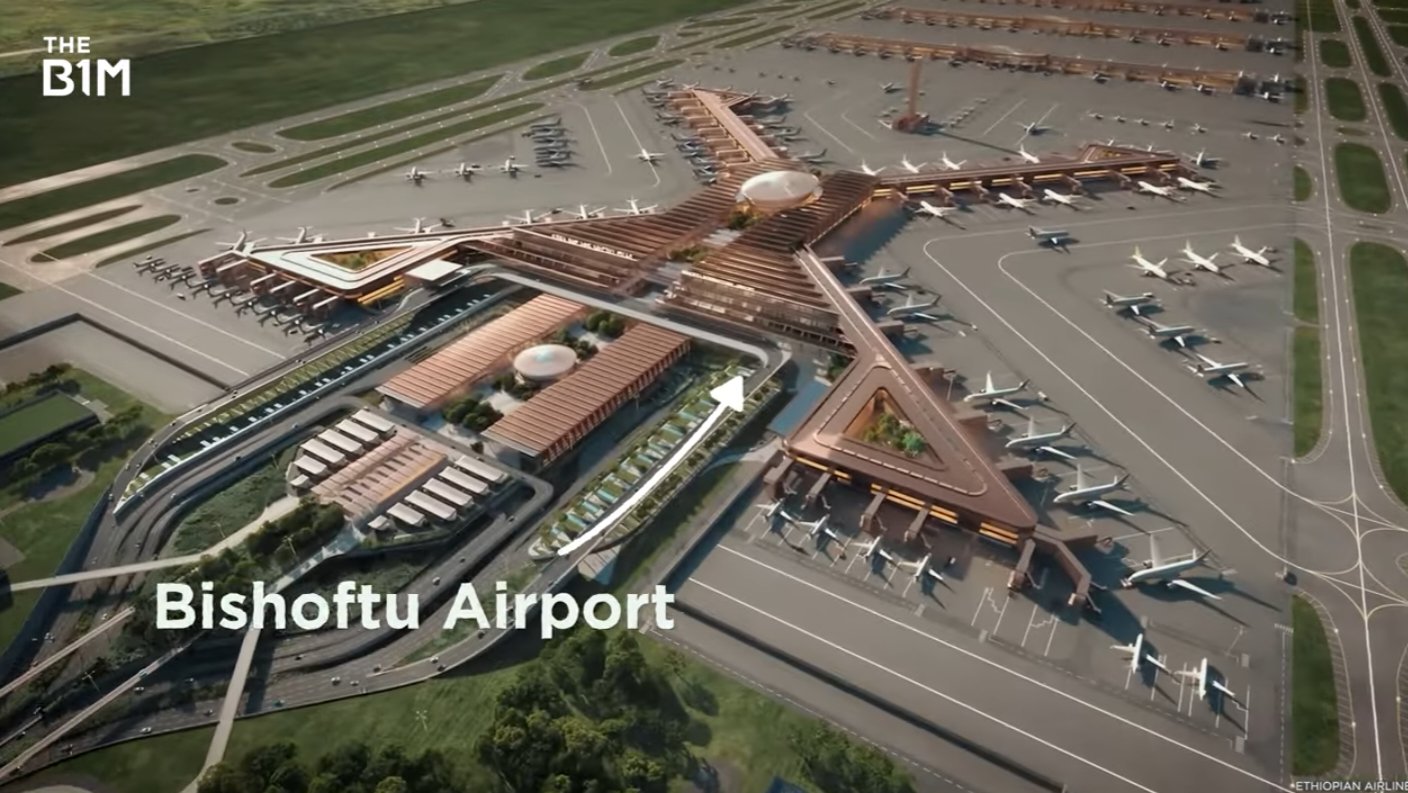
The exterior architecture of Bishoftu International Airport. Photo: The B1M/YouTube.
project addresses an imminent capacity crunch at Addis Ababa Bole International Airport, which currently handles 20 million passengers yearly but faces severe physical expansion constraints due to surrounding urban density.
Located 35 kilometers from the capital, Bishoftu offers an ideal alternative with a lower elevation of 1,900 meters above sea level.
This altitude difference provides denser air than Addis Ababa, improving jet engine thrust and aircraft lift.
According to Ethiopian Airlines, aircraft taking off from Bishoftu will require less fuel, extending their long-haul range.
The total cost is pinned at 12.5 billion US dollars, with Ethiopian Airlines providing 4.5 billion dollars in funding.
Negotiations remain ongoing with financiers in the United States and China to secure the remaining 8 billion dollars.
Designed by Zaha Hadid Architects (ZHA), the facility is envisioned as an integrated airport city rather than a simple transit terminal.

The interior architecture of Bishoftu International Airport. Photo: The B1M/YouTube.
Plans incorporate hotels, offices, retail spaces, and massive cargo processing structures alongside four code 4E runways built to handle the largest modern commercial aircraft.
The passenger terminal alone will cover nearly 700,000 square meters, doubling the size of other major global terminal projects.
Architects designed a central spine referencing the Great Rift Valley to streamline passenger movement and slash transfer distances between gates.
Efficiency is critical because approximately 80 percent of arriving travelers will use the airport strictly for connecting flights.
The master plan targets a cargo capacity of 4 million tons annually, aiming to position Bishoftu among the top five global air freight hubs.
This infrastructural shift comes amid unprecedented continental growth, with African airline capacity rising 6.7 percent between May 2025 and May 2026.
This growth far outpaces global averages and aligns with long-term regional integration goals like the African Continental Free Trade Area (AfCFTA).
Phase one of construction focuses on airfields, essential passenger facilities, and road links, targeting a capacity of 60 million travelers by 2030.
Subsequent phases will add a second terminal and a 38-kilometer rail link connecting the hub directly to Addis Ababa.
Despite high optimization, the infrastructure project faces domestic friction, as land acquisition has displaced roughly 15,000 people, including thousands of local farmers.
While Ethiopian Airlines built and handed over replacement housing to affected parents, local youths report a complete lack of resettlement support.
Financing a project of this scale also raises questions given the national economic output, though the state itself is not funding the development directly.
Bishoftu must also compete with established regional giants, including Egypt, which plans to double the capacity of Cairo International Airport to 60 million passengers.
Comments (0)
Leave a Comment
No comments yet. Be the first to share your thoughts!