

Ugandan infrastructure corridors are facing severe disruption following an announcement by the country's military chief regarding a major rail project. Gen Muhoozi Kainerugaba stated that a multi-billion-dollar contract with a Turkish construction firm is now terminated, though official government channels have not yet confirmed the development.
The statement, which was published on Tuesday via the social media platform X, targetted the €2.7 billion agreement with Yapi Merkezi. The Turkish company secured the contract in late 2024, but it now faces a sudden hurdle.
Gen Muhoozi, who serves as the Chief of Defence Forces (CDF) and leader of the Patriotic League of Uganda (PLU), declared that the nation would seek an alternative contractor. He asserted that the country requires a partner more worthy of its infrastructure goals.
The 272-kilometre electrified Standard Gauge Railway (SGR) line is designed to connect Kampala to Malaba, which sits on the Kenyan border. The project was meant to eventually link landlocked Uganda to the Kenyan coast, but this development threatens progress.
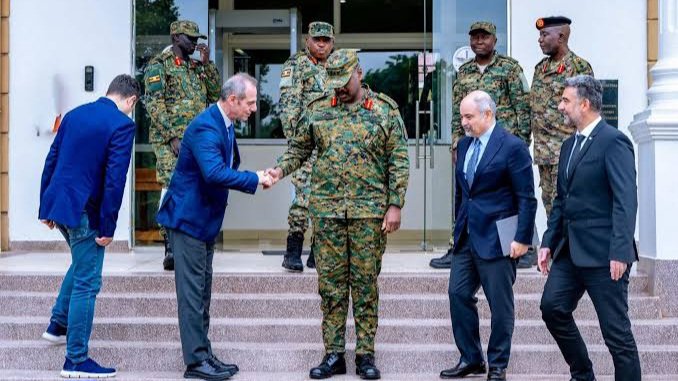
The unexpected declaration marks a sharp shift in rhetoric from the military chief. In December 2025, Gen Muhoozi hosted senior executives from Yapi Merkezi at the Special Forces Command (SFC) headquarters in Entebbe, where he greenlit early construction work.
During that meeting, technical teams briefed the general on critical designs, including a two-kilometre tunnel designed to pass through military land in Mbuya. At the time, he urged the contractors to deliver the project on schedule, which makes the sudden turn unexpected.
Preliminary engineering works have already commenced, with sub-contractors establishing worker camps and manufacturing sleeper components. These activities followed the release of an initial 83 million dollar funding tranche by the Ministry of Finance, Planning and Economic Development.
The central government has yet to issue an official executive decree or legal termination notice. Neither the Ministry of Works and Transport, nor the SGR Project Secretariat have released any statements to clarify the official status of the commercial agreement.
The project had recently secured momentum after the state appointed Citibank as the lead arranger for international syndicated debt. Financing plans also involved a proposed sovereign sukuk, which was designed to fund fifteen percent of the total project costs.
Additional financing was anticipated from the African Development Bank (AfDB) through the African Development Fund (ADF), which tentatively allocated 650 million dollars. A final financial appraisal mission for the multi-billion-dollar line was scheduled to take place in July 2026.
Uganda previously terminated an SGR construction agreement with China Harbour Engineering Company (CHEC) in 2023, after eight years of stalled financial negotiations. The state then turned to Ankara, hoping to replicate the railway successes seen in neighbouring Tanzania.
In addition to his statement on the contract, Gen Muhoozi directed political supporters to hold demonstrations outside the Turkish Embassy in Kampala. He commanded the Uganda People's Defence Forces (UPDF) and other state security services to allow the public protests.
Diplomatic observers indicate that the public friction could strain bilateral relations between Kampala and Ankara. The escalation stems partly from unresolved political demands, including the repatriation of a prominent Ugandan dissident currently residing in Turkey.
The SGR project remains highly critical for the region, as transport policymakers estimate it would slash cargo shipping costs by half. Currently, the highway corridor linking Uganda to the Port of Mombasa remains one of the costliest freight routes on the continent.
Comments (0)
Leave a Comment
No comments yet. Be the first to share your thoughts!